Table of Contents
As summer temperatures continue climbing each year, homeowners are increasingly searching for smarter ways to keep their living spaces comfortable without breaking the bank on energy bills. Whole house fans have emerged as one of the most effective solutions for creating a cooler home environment, particularly when it comes to tackling that stubborn heat that accumulates in your attic. These powerful ventilation systems work by pulling cool evening air through open windows while simultaneously expelling hot, stale air through attic vents, creating a refreshing breeze throughout your entire living space.
Understanding how to select the right whole house fan for your specific needs requires navigating a complex landscape of technical specifications, installation requirements, and performance features. Whether you’re building a new home or retrofitting an existing property, making an informed decision about attic cooling technology will impact your comfort, energy consumption, and maintenance responsibilities for years to come. This comprehensive guide walks you through everything you need to know about choosing and operating a whole house fan system that will transform your attic from a heat trap into an effective heat exhaust mechanism.
Top 10 Whole House Fans for Attic Cooling
Detailed Product Reviews
1. Quietcool QC CL-7000 RF Classic Advanced Whole House Fan with Wireless Control - Up to 6924 CFM - Two Speed - Covers up to 3,462 SQFT - 10 Year Warranty - Removable Grille

Overview: The Quietcool QC CL-7000 RF represents the pinnacle of whole-house ventilation, engineered to service expansive residences up to 3,462 square feet. With an impressive airflow capacity of 6,924 CFM on high speed, this unit can replace stale, hot air with fresh outdoor air in minutes, dramatically reducing reliance on air conditioning during cooler evening hours. The advanced design leverages a 1,147-watt PSC motor that balances power with efficiency, while the included wireless RF remote eliminates the need for hardwired switches.
What Makes It Stand Out: This model’s standout feature is its sheer cooling capacity—nearly 7,000 CFM moves air through your home with hurricane force, yet maintains remarkably quiet operation thanks to Quietcool’s ducted design. The R5 insulated damper doors automatically seal when the fan is off, preventing heat loss in winter and keeping your attic’s temperature separate from your living space. The removable grille simplifies cleaning and maintenance, while the 10-year warranty demonstrates manufacturer confidence.
Value for Money: While positioned at the premium end of the market, the CL-7000 delivers exceptional value for owners of large homes. The potential to cut air conditioning costs by 50-90% during shoulder seasons means payback within 2-4 years in most climates. Compared to installing a second HVAC zone or upgrading to a larger central system, this fan costs a fraction while providing superior fresh air circulation.
Strengths and Weaknesses: Strengths include massive airflow capacity, energy-efficient operation relative to air conditioning, whisper-quiet performance, robust warranty coverage, and excellent seasonal insulation. Weaknesses involve higher upfront investment, significant attic space requirements, and the need for professional installation in many homes due to its size and electrical demands.
Bottom Line: For homeowners with properties exceeding 3,000 square feet in dry or temperate climates, the CL-7000 RF is an unmatched solution for rapid whole-home cooling and ventilation. The combination of power, efficiency, and smart features justifies its premium status.
2. Quietcool QC CL-2250 RF Classic Advanced Whole House Fan with Wireless Control - Up to 2465 CFM - Two Speed - Covers up to 1,233 SQFT - 10 Year Warranty - Removable Grille

Overview: The Quietcool QC CL-2250 RF brings advanced whole-house ventilation to smaller residences and targeted cooling zones, efficiently servicing spaces up to 1,233 square feet. Delivering 2,465 CFM on high speed, this compact powerhouse quickly exhausts accumulated heat while drawing in fresh, cool evening air. The 250-watt PSC motor ensures minimal energy consumption, making it ideal for continuous operation during comfortable outdoor temperatures. Wireless RF control provides convenient operation from anywhere in the home.
What Makes It Stand Out: Unlike its larger siblings, the CL-2250 is specifically optimized for apartments, condos, or large bedroom suites where massive airflow would be overkill. The unit maintains Quietcool’s signature quiet operation while using a fraction of the electricity—consuming only 201 watts on low speed. The identical 10-year warranty and R5 damper system found on premium models demonstrate that quality isn’t compromised for size. The removable grille design simplifies maintenance in tight spaces.
Value for Money: This model offers the most accessible entry point into whole-house fan technology without sacrificing core features. Priced significantly lower than larger units, it delivers comparable energy savings per square foot cooled. For homeowners in moderate climates or those seeking to supplement existing cooling in specific zones, the return on investment accelerates due to lower initial cost and reduced installation complexity.
Strengths and Weaknesses: Strengths include exceptional energy efficiency, ultra-quiet operation, straightforward DIY installation potential, comprehensive warranty, and targeted cooling capability. Weaknesses are limited coverage area, lower absolute CFM that may feel insufficient for open-concept spaces, and reduced impact in multi-story homes where larger units prove more effective.
Bottom Line: Perfect for smaller homes or strategic zone cooling, the CL-2250 RF delivers premium Quietcool performance in a rightsized package. It’s the smart choice for budget-conscious buyers prioritizing efficiency over raw power.
3. Master Flow GAF 6000 CFM 30" Belt-Drive Deluxe Whole House Fan, 1/3 HP Motor, 2-Speed Wall Switch, Energy Efficient Ventilation for Homes upto 3000 sq. ft. - 30BWHFS

Overview: The Master Flow GAF 6000 CFM 30" Belt-Drive Deluxe Whole House Fan represents a traditional approach to residential ventilation, engineered for homes up to 3,000 square feet. This unit moves substantial air volume through a time-tested belt-drive mechanism powered by a robust 1/3 HP permanent split-capacitor motor. The included two-speed wall switch provides straightforward control, while the 30-inch fan diameter ensures broad air intake for effective cooling. Designed for durability, this model appeals to homeowners preferring proven mechanical designs over newer technologies.
What Makes It Stand Out: The belt-drive system inherently reduces motor noise and vibration, positioning this fan as a quieter alternative to direct-drive models in its class. Master Flow’s compatibility with the optional WHT36 12-hour timer (sold separately) allows for automated cooling schedules without complex smart home integration. The unit’s straightforward installation and serviceability appeal to DIY enthusiasts, while the deluxe designation indicates upgraded components and build quality compared to entry-level models.
Value for Money: Positioned in the mid-range price segment, this fan offers professional-grade construction at a consumer price point. The belt-drive design typically extends motor life and reduces operational noise, translating to lower long-term maintenance costs. While lacking wireless convenience, the included wall switch and timer compatibility provide adequate control for most users, delivering solid performance per dollar spent.
Strengths and Weaknesses: Strengths include durable belt-drive mechanism, powerful and reliable motor, quieter operation than comparable direct-drive units, timer compatibility, and established brand reputation. Weaknesses involve bulkier installation footprint, lack of included wireless control, wall switch location inflexibility, and the timer being an additional purchase.
Bottom Line: The Master Flow GAF 6000 is an excellent choice for homeowners valuing mechanical reliability and quiet operation over modern smart features. It’s a workhorse solution that prioritizes function and longevity.
4. Quietcool GA ES-1500 Garage Whole House Fan - 1452 CFM - 47 Watts - Integrated Fire Damper - Wireless RF Control - 20ft Power Cord - Plug-and-play - Covers up to Three Car Garage

Overview: The Quietcool GA ES-1500 addresses a specialized but critical need: garage ventilation with integrated fire safety. Designed for three-car garages, this unit moves 1,452 CFM while consuming a mere 47 watts thanks to its ultra-efficient ECM motor. The standout feature is its 2-hour fire-rated damper, which automatically closes during a fire to prevent flame spread into the attic. With a 20-foot power cord and plug-and-play design, installation requires no electrical work, while the included thermostat enables automatic operation based on temperature.
What Makes It Stand Out: No other whole-house fan combines garage-specific engineering with fire safety certification. The ECM motor technology represents the industry’s most efficient operation, using less power than a standard light bulb while providing substantial airflow. The 15-year warranty exceeds even Quietcool’s residential standards, reflecting confidence in this commercial-grade component. Integrated fire protection provides peace of mind that standard fans simply cannot match, potentially meeting local building codes for attached garages.
Value for Money: While priced higher per CFM than residential units, the fire damper and plug-and-play convenience justify the premium for garage applications. The minimal operating cost—pennies per day—and exceptional warranty ensure decades of reliable service. For homeowners storing vehicles, chemicals, or workshop equipment in attached garages, this investment protects both property and lives.
Strengths and Weaknesses: Strengths include unparalleled fire safety rating, extreme energy efficiency, zero-installation setup, industry-leading warranty, and garage-optimized design. Weaknesses involve limited CFM for larger spaces, garage-specific application only, cord management considerations, and higher upfront cost relative to standard fans.
Bottom Line: For attached garage ventilation, the GA ES-1500 is non-negotiable. Its fire safety features and efficiency make it worth every penny for security-conscious homeowners.
5. Quietcool QC CL-4700 RF Classic Advanced Whole House Fan with Wireless Control - Up to 4415 CFM - Two Speed - Covers up to 2,208 SQFT - 10 Year Warranty - Removable Grille

Overview: The Quietcool QC CL-4700 RF hits the sweet spot for average-sized homes, efficiently cooling and ventilating spaces up to 2,208 square feet. With 4,415 CFM on high speed, this model moves substantial air volume without the energy demands of larger units. The 551-watt PSC motor provides robust performance while maintaining reasonable operating costs. Wireless RF control and the signature R5 damper system come standard, making this a feature-complete mid-tier option for discerning homeowners seeking balanced performance.
What Makes It Stand Out: This model represents the ideal compromise between the entry-level CL-2250 and powerhouse CL-7000. It delivers sufficient CFM for most single-family homes while consuming significantly less power than its larger sibling. The identical warranty and insulation features ensure you’re not sacrificing quality for moderate sizing. Quietcool’s proven quiet operation technology makes this fan nearly inaudible during evening cooling cycles, preserving neighborhood peace while rapidly exchanging indoor air.
Value for Money: Offering the best price-to-performance ratio in the Quietcool lineup, the CL-4700 maximizes return on investment for typical suburban homes. The moderate power draw translates to lower electrical costs while still delivering dramatic cooling effects. Compared to running central air conditioning, this fan pays for itself in 2-3 cooling seasons in most markets, making it a financially sound upgrade.
Strengths and Weaknesses: Strengths include perfectly calibrated CFM for average homes, energy-efficient operation, whisper-quiet performance, comprehensive warranty, and excellent seasonal insulation. Weaknesses may include being slightly underpowered for open-concept great rooms or multi-story layouts, and moderate power consumption that exceeds the smallest units.
Bottom Line: For homes between 1,800-2,200 square feet, the CL-4700 RF is the most logical and effective whole-house fan choice. It delivers premium performance without overkill.
6. QA-Deluxe 5500 Energy Efficient Whole House Fan – Low Voltage Plug & Play, 2-Speed Wall Switch & Timer, Removable Grille – 10-Year Warranty – Up to 3400 sq ft (2-Story) & 2400 sq ft (1-Story)
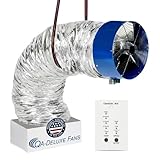
Overview: The QA-Deluxe 5500 is a robust whole-house ventilation system engineered for substantial homes, delivering 5,500 CFM to cool two-story residences up to 3,400 square feet. This unit replaces air conditioning during moderate weather, drawing cool evening air through windows while expelling hot attic air. The low-voltage plug-and-play design simplifies installation between standard 16" to 24" on-center joists without structural modifications.
What Makes It Stand Out: The integrated timer and two-speed wall switch provide exceptional operational control absent in many competitors. The R-5 insulated damper prevents thermal transfer when idle, a critical energy-saving feature often overlooked. Its California Title 24 compliance (3,945 CFM) ensures regulatory adherence. The 10-year motor warranty and USA assembly demonstrate manufacturer confidence and quality commitment.
Value for Money: Priced competitively against premium whole-house fans, the QA-Deluxe 5500 offsets costs within 2-3 cooling seasons by reducing AC dependency. The robust warranty and insulated damper prevent expensive heat gain, delivering superior long-term ROI compared to basic models lacking thermal barriers.
Strengths and Weaknesses: Pros: Powerful airflow for large spaces; intelligent timer controls; excellent insulation; no framing required; extensive warranty coverage. Cons: Wall-switch control less convenient than wireless; requires significant attic ventilation (4.5 sq ft); higher initial investment than smaller units.
Bottom Line: Ideal for homeowners seeking powerful, controlled ventilation in large residences. The timer functionality and superior insulation make it a smart investment for climate-appropriate regions where nighttime cooling is viable.
7. Quietcool QC CL-1500 RF Classic Advanced Whole House Fan with Wireless Control - 1472 CFM - One Speed - Covers up to 736 SQFT - 10 Year Warranty - Removable Grille

Overview: The Quietcool CL-1500 RF delivers targeted ventilation for compact spaces up to 736 square feet, making it ideal for bedrooms, apartments, or supplemental cooling. Its 1,472 CFM airflow and 117-watt PSC motor provide efficient air exchange without overwhelming smaller areas. The wireless RF control eliminates complex wiring, allowing flexible operation from anywhere in the room, while the removable grille ensures straightforward maintenance access.
What Makes It Stand Out: Wireless remote functionality sets this apart from hardwired competitors, offering plug-and-play convenience for renters or DIY-averse homeowners. The precisely calibrated CFM prevents excessive drafts common in overpowered small-room fans. R5 damper doors provide seasonal insulation, blocking attic air infiltration during winter months—a premium feature rarely found in this size class.
Value for Money: This entry-level model costs substantially less than portable air conditioners while consuming minimal electricity. The 10-year warranty protects your investment, and the wireless control adds value typically reserved for premium units. However, its limited coverage restricts applications to single rooms or tiny homes.
Strengths and Weaknesses: Pros: Wireless convenience; ultra-low power consumption; simple installation; perfect for small spaces; robust warranty. Cons: Single-speed operation limits flexibility; inadequate for whole-house cooling; PSC motor less efficient than ECM alternatives; requires manual window management.
Bottom Line: An excellent choice for bedroom cooling or small apartments where wireless convenience and minimal energy use outweigh the need for variable speeds. Best suited as a supplemental system rather than primary whole-house ventilation.
8. Quietcool QC ES-3100 RF Energy Saver Advanced Whole House Fan with Wireless Control - Up to 3081 CFM - As low as 81 watts - Two Speed - Covers up to 1,541 SQFT - 10 Year Warranty

Overview: The ES-3100 RF Energy Saver model serves small homes up to 1,541 square feet with exceptional efficiency. Its ECM motor draws only 81 watts on low speed while moving 2,020 CFM, and 285 watts on high for 3,081 CFM. This variable performance allows customized cooling throughout shoulder seasons. Wireless control provides convenient operation without wall-switch installation.
What Makes It Stand Out: The ECM motor technology delivers remarkable energy savings, using less power than an incandescent bulb on low speed. This efficiency gap widens during partial-cooling days, where competitors run at full power. The two-speed wireless system offers granular control absent in single-speed models, optimizing comfort and savings simultaneously.
Value for Money: Priced higher than PSC motor equivalents, the ES-3100 pays dividends through dramatically reduced operating costs. Homeowners in moderate climates can recoup the premium within 3-4 years through energy savings. The 10-year warranty and durable construction ensure long-term value.
Strengths and Weaknesses: Pros: Ultra-efficient ECM motor; excellent low-speed performance; wireless convenience; ideal for small homes; robust warranty. Cons: Higher upfront cost; PSC-level consumption on high speed; requires adequate attic ventilation; limited to moderate-sized residences.
Bottom Line: The top choice for energy-conscious homeowners prioritizing operational savings. The ECM motor’s low-speed efficiency makes it perfect for climates with frequent mild-temperature evenings where full power is rarely needed.
9. Quietcool QC CL-3100 RF Classic Advanced Whole House Fan with Wireless Control - Up to 3126 CFM - Two Speed - Covers up to 1,608 SQFT - 10 Year Warranty - Removable Grille
Overview: The CL-3100 RF balances performance and convenience for small homes up to 1,608 square feet. Its two-speed PSC motor generates 3,126 CFM on high and 2,847 CFM on low, providing flexible cooling options. Wireless RF control eliminates wiring complexity, while the removable grille facilitates maintenance. The unit’s 299-watt high-speed and 256-watt low-speed consumption offers moderate efficiency.
What Makes It Stand Out: This model bridges the gap between entry-level and premium fans, offering dual-speed wireless control at a mid-range price point. The minimal CFM drop between speeds (approximately 9%) maintains consistent airflow even on low, preventing stagnant pockets. R5 damper doors provide year-round insulation, protecting against heat loss in winter.
Value for Money: The CL-3100 RF delivers premium features—wireless control and two speeds—without the ECM motor price premium. It costs less than the ES-3100 while providing similar coverage, making it attractive for budget-conscious buyers. However, higher wattage reduces long-term savings compared to ECM models.
Strengths and Weaknesses: Pros: Two-speed wireless control; consistent airflow across speeds; easy maintenance; 10-year warranty; good coverage for small homes. Cons: PSC motor less efficient than ECM; minimal wattage difference between speeds; moderate power consumption; requires window coordination.
Bottom Line: A solid mid-tier option for small homes wanting wireless convenience and speed variability without paying for ECM efficiency. Best for occasional use rather than daily operation where energy costs accumulate.
10. QuietCool QC CL-6000 RF Classic Advanced Whole House Fan with Wireless Control - Up to 5665 CFM - Two Speed - Covers up to 2,833 SQFT - 10 Year Warranty - Removable Grille
Overview: The CL-6000 RF delivers maximum residential ventilation power, moving 5,665 CFM on high and 4,289 CFM on low to cool homes up to 2,833 square feet. This flagship Classic series unit employs a robust 769-watt PSC motor for rapid air exchange during intense heat. Wireless RF control provides whole-home operation without complex wiring, while the removable grille accommodates cleaning of the large intake area.
What Makes It Stand Out: This model offers the highest CFM rating in the residential lineup, approaching commercial capacity for substantial estates. The two-speed system provides surprising flexibility—running at low speed most of the time for efficiency, while reserving high speed for extreme temperatures. R5 damper doors prevent significant heat loss during winter, critical for large ceiling penetrations.
Value for Money: While power consumption is considerable, the CL-6000 eliminates the cost of installing multiple smaller units. For large homes, centralized control outweighs zone-based complexity. The 10-year warranty and durable construction justify the premium over lesser-powered alternatives, though ECM efficiency would be welcome.
Strengths and Weaknesses: Pros: Unmatched residential CFM; two-speed versatility; wireless convenience; comprehensive coverage; robust warranty. Cons: High wattage draw; requires substantial attic ventilation; PSC motor less efficient than ECM; premium price point; overkill for moderate-sized homes.
Bottom Line: The definitive choice for large homes in hot climates where maximum airflow is non-negotiable. Energy-conscious buyers in milder regions should consider smaller ECM models, but for pure cooling power, this unit is unmatched.
How Whole House Fans Transform Attic Cooling
Whole house fans operate on a beautifully simple principle: thermal buoyancy combined with strategic air movement. When outdoor temperatures drop in the evening, these systems create a powerful exchange that replaces the superheated air trapped in your attic—often reaching 140-160°F on summer days—with cooler outside air. This process doesn’t just cool your attic; it creates a cascading cooling effect throughout your entire home by drawing comfortable air through living spaces and pushing hot air upward and out. The result is a dramatic temperature reduction that can make your home feel 10-15 degrees cooler within minutes, all while using a fraction of the energy required by traditional air conditioning.
Key Benefits of Installing a Whole House Fan System
The advantages extend far beyond simple temperature control. A properly sized and installed whole house fan can significantly reduce your reliance on air conditioning during shoulder seasons and mild summer nights, leading to substantial energy savings. These systems also provide rapid ventilation, flushing out indoor pollutants, cooking odors, and moisture that can contribute to mold growth. Additionally, by keeping your attic temperature lower, you reduce the thermal load on your ceiling insulation, which helps your HVAC system work more efficiently during the day when you do need mechanical cooling.
Types of Whole House Fans Explained
Direct Drive vs Belt Drive Models
Direct drive fans feature motors that connect directly to the fan blades, offering a more compact design and typically lower upfront costs. These units tend to be easier to install and maintain since they have fewer moving parts. Belt drive models, where the motor connects to the fan via a belt and pulley system, generally operate more quietly and offer greater flexibility in speed adjustment. The belt acts as a natural sound dampener and allows the motor to run at lower RPMs while still moving large volumes of air, making them ideal for homeowners prioritizing noise reduction.
Traditional vs Quiet Operation Designs
Traditional whole house fans are known for their raw power and straightforward operation, but they can be loud enough to interfere with conversation or sleep. Modern quiet operation designs incorporate specialized housings, insulated ductwork, and acoustically dampened mounts that can reduce noise levels by 50% or more. These advanced systems often feature aerodynamically optimized fan blades and vibration isolation technology that allows you to run the fan overnight without disrupting your household’s peace.
Roof-Mounted vs Ceiling-Mounted Options
Ceiling-mounted units install between your living space and attic, drawing air from hallways or central locations and exhausting through attic vents. This traditional approach works well in homes with adequate attic ventilation and accessible installation locations. Roof-mounted systems eliminate the need for significant ceiling modifications and are ideal for homes with flat ceilings, limited attic access, or where interior noise must be minimized. These units mount directly on the roof and vent hot air straight to the outside, though they typically require professional installation and weatherproofing considerations.
Solar-Powered Whole House Fan Innovations
Solar-powered models represent the cutting edge of energy-efficient cooling, operating entirely on renewable energy during peak sunlight hours. These systems typically include battery backup systems for evening operation and can function independently of your home’s electrical grid. While the initial investment is higher, solar-powered fans offer unparalleled operational cost savings and environmental benefits. They’re particularly valuable in sunny climates where attic heat buildup is most severe during daylight hours when solar panels generate maximum power.
Critical Features to Evaluate Before Buying
Airflow Capacity and CFM Ratings
Cubic Feet per Minute (CFM) represents the volume of air a fan can move, and selecting the right capacity is crucial for effective cooling. Undersized fans will struggle to create adequate air exchange, leaving hot spots throughout your home. Oversized units can create excessive pressure differentials that make doors slam and cause uncomfortable drafts. The general rule suggests calculating your home’s total square footage and multiplying by 2-3 for moderate climates, or 3-4 for hot desert regions. However, ceiling height, home layout, and local climate patterns all influence the optimal CFM rating for your specific situation.
Noise Levels and Sound Dampening Technology
Decibel ratings provide objective measurements, but the quality of sound matters as much as the volume. Look for fans with sound ratings below 55 decibels for quiet operation, comparable to a normal conversation. Advanced models feature insulated housings, flexible duct connectors, and rubber isolation mounts that prevent vibration from transferring to your home’s structure. Some premium systems include variable speed controls that let you run at lower, quieter speeds during sleeping hours and higher speeds for rapid cooling when noise isn’t a concern.
Energy Efficiency and Power Consumption
Modern whole house fans typically consume between 200-800 watts, making them substantially more efficient than central air conditioning systems that draw 3000-5000 watts. Look for models with Energy Star certification or those featuring electronically commutated motors (ECM) that automatically adjust power consumption based on demand. Some advanced systems include smart controls that monitor indoor and outdoor temperatures, automatically shutting off when conditions aren’t optimal for efficient operation.
Thermostat and Humidistat Controls
Integrated thermostats allow your fan to automatically activate when indoor temperatures reach your desired setpoint, while humidistats monitor moisture levels. These controls prevent operation during periods of high outdoor humidity that could introduce uncomfortable dampness into your home. Smart controls can be programmed with differential settings, ensuring the fan only runs when outdoor temperatures are at least 5-10 degrees cooler than indoor temperatures, maximizing efficiency and comfort.
Variable Speed Settings and Programmability
Multiple speed settings give you precise control over cooling intensity and noise levels. Two-speed models offer basic flexibility, while three-speed or variable-speed units provide fine-tuned control. Programmable timers allow you to set operation schedules that align with your daily routines and local temperature patterns. The most advanced systems integrate with home automation platforms, allowing you to control your fan remotely via smartphone apps and create sophisticated cooling schedules based on weather forecasts.
Construction Materials and Durability
The harsh attic environment demands robust construction. Look for housings made from galvanized steel or heavy-duty aluminum that resist corrosion and warping. Fan blades should be constructed from aluminum or reinforced composite materials that won’t crack or deform under temperature extremes. Motors with sealed bearings and thermal overload protection will provide years of reliable service, while weather-resistant finishes protect against humidity and temperature fluctuations.
Sizing Your Whole House Fan Correctly
Calculating Home Volume for Proper CFM
Accurate sizing requires more than simple square footage calculations. Measure each room’s length, width, and ceiling height to determine total cubic footage of living space. Don’t forget to include hallways, stairwells, and other open areas in your calculations. For homes with vaulted ceilings or open floor plans, you may need to increase CFM ratings by 15-20% to ensure adequate air movement reaches all areas. Professional HVAC contractors can perform detailed load calculations that account for these variables.
Climate Zone Considerations
Your geographic location dramatically impacts sizing requirements. Desert climates with extreme temperature swings benefit from higher CFM ratings that can rapidly flush superheated air during evening cooldown periods. Coastal regions with more moderate temperatures may require less aggressive ventilation but need enhanced humidity controls. Mountain climates with cool nights but intense daytime sun need balanced systems that can handle rapid temperature transitions. Research your area’s cooling degree days and typical diurnal temperature ranges when selecting fan capacity.
Attic Ventilation Requirements
A whole house fan is only as effective as its exhaust pathway. Calculate your attic’s net free ventilation area by measuring all existing vents, soffit openings, and gable vents. Building codes typically require 1 square foot of ventilation for every 750 CFM of fan capacity, but whole house fans often need more—generally 1 square foot per 300-500 CFM. Insufficient attic ventilation creates backpressure that reduces fan efficiency and can force hot attic air back into living spaces through light fixtures and ceiling penetrations.
Installation Fundamentals
Professional vs DIY Installation
While handy homeowners can install basic models, professional installation ensures proper sizing, electrical connections, and code compliance. DIY installation typically saves $300-600 but requires comfort working with electrical wiring, cutting ceiling joists, and sealing attic penetrations. Professional installers bring expertise in structural reinforcement, ductwork optimization, and warranty protection. Complex installations involving roof mounting, solar integration, or smart home connectivity almost always benefit from professional expertise.
Electrical Requirements and Wiring
Most whole house fans require dedicated 120-volt circuits with 15-20 amp breakers. Check your electrical panel’s capacity before purchasing, as older homes may need service upgrades. Hardwired units offer cleaner installation and better reliability than plug-in models. Consider installing a timer switch or smart controller during initial wiring to avoid retrofitting later. Some high-capacity models may require 240-volt service, which significantly impacts installation complexity and cost.
Attic Preparation and Structural Modifications
Your attic must provide adequate clearance for safe installation and maintenance. Measure available height between ceiling joists and roof rafters, ensuring at least 30 inches of working space. You may need to sister joists or install headers to support the fan’s weight, typically 50-100 pounds. Seal all attic air leaks around plumbing stacks, chimneys, and electrical penetrations before installation to prevent conditioned air from escaping during operation.
Safety Features and Building Codes
Modern whole house fans should include automatic shutters that close when the unit is off, preventing heat loss in winter and blocking fire spread. Firestat sensors automatically shut down the fan if attic temperatures exceed safe limits, typically 180-200°F. Verify that your chosen model meets UL safety standards and local building codes regarding electrical connections, ventilation requirements, and fire safety. Some municipalities require permits for whole house fan installation, so check with your local building department before beginning work.
Operating Your System for Maximum Efficiency
Optimal Temperature Differentials
The sweet spot for whole house fan operation occurs when outdoor temperatures drop 10-20 degrees below indoor levels. Running your fan when the temperature difference is less than 5 degrees provides minimal cooling benefit while consuming energy. Use a simple indoor-outdoor thermometer to monitor conditions, or invest in a smart controller that automatically calculates differentials. In most climates, operation between 7 PM and 7 AM during summer months yields the best results.
Window Management Strategies
Strategic window opening is crucial for effective cooling. Open windows in living areas where you want cooling, but keep windows closed in unused rooms to focus air movement. Create a clear path by opening windows on the shaded side of your home first, then progressively opening others as temperatures drop. Crack windows 4-6 inches rather than fully opening them to create controlled airflow that maximizes the cooling breeze effect without overwhelming the fan’s capacity.
Seasonal Maintenance Protocols
Monthly cleaning during cooling season prevents dust buildup on fan blades and motor housing, which can reduce efficiency by up to 20%. Lubricate motor bearings annually with high-temperature bearing grease. Inspect belt drive systems for tension and wear every six months, adjusting or replacing belts as needed. Before winter, clean the entire system thoroughly, close automatic shutters, and consider covering the ceiling grille to prevent heat loss. Spring startup should include testing all controls, inspecting electrical connections, and verifying that attic vents remain clear of debris.
Cost Analysis and ROI
Initial Investment Factors
Basic direct-drive models start around $300-500, while premium quiet-operation systems with advanced controls can exceed $1500. Installation costs range from $200 for simple DIY projects to $1000+ for professional roof-mounted installations. Solar-powered systems require the highest upfront investment, typically $1200-2500 before installation, but qualify for federal and state renewable energy incentives. Factor in potential electrical upgrades, attic ventilation improvements, and smart home integration costs when budgeting.
Energy Savings Projections
In suitable climates, whole house fans can reduce air conditioning usage by 50-90% during mild weather, translating to $200-600 in annual savings for typical households. The payback period usually ranges from 2-5 years depending on local electricity rates and climate patterns. Homes in regions with high cooling degree days and significant nighttime temperature drops see the fastest returns. Track your energy usage before and after installation to accurately measure savings and adjust operating strategies accordingly.
Maintenance Cost Expectations
Annual maintenance costs typically run $50-100 for cleaning supplies, lubricants, and occasional belt replacements. Professional servicing every 2-3 years adds $150-250 but extends system lifespan significantly. Budget for motor replacement every 10-15 years, which costs $200-400 depending on the model. Proper maintenance can extend fan lifespan beyond 20 years, while neglected systems may fail within 5-7 years, making preventive care a wise financial investment.
Troubleshooting Common Issues
Excessive Noise Problems
Rattling often indicates loose mounting hardware or debris in the fan housing. Tighten all bolts and screws, and inspect for loose attic insulation that may have been drawn into the unit. Humming or buzzing suggests electrical issues, potentially loose wire connections or a failing capacitor. Grinding noises point to bearing failure, requiring immediate motor service or replacement. Persistent noise despite these fixes may indicate an undersized or oversized fan for your space, requiring professional assessment.
Insufficient Cooling Performance
If your fan runs but doesn’t cool effectively, first verify that adequate windows are open and attic ventilation isn’t blocked. Check that the fan blades rotate in the correct direction—some models can be wired backward. Measure actual CFM output using an anemometer to confirm the fan meets specifications. Poor performance often stems from improper sizing, so recalculate your home’s volume and compare it to the fan’s rated capacity. Consider that extreme outdoor humidity can make cooling feel less effective even when temperatures drop.
Electrical and Motor Issues
Fans that won’t start may have tripped breakers, blown fuses, or faulty wall switches. Test voltage at the fan connection to confirm proper power supply. Intermittent operation often indicates overheating motors with automatic thermal protection shutting down the unit. Check for adequate attic ventilation around the motor and clean any dust buildup on cooling fins. Capacitor failure is common in older units, recognizable by humming without blade rotation—this inexpensive part is easily replaced by a qualified technician.
Frequently Asked Questions
What size whole house fan do I need for a 2,000 square foot home?
For a typical 2,000 square foot home with 8-foot ceilings, you’ll need approximately 4,000-6,000 CFM for moderate climates, or 6,000-8,000 CFM for hot desert regions. Calculate your exact needs by multiplying square footage by ceiling height to get cubic footage, then aim for 30-40 air changes per hour for optimal cooling performance.
How much does it cost to run a whole house fan overnight?
Most whole house fans consume 200-400 watts on medium speed. Running for 8 hours at an average electricity rate of $0.13 per kWh would cost approximately $0.20-0.40 per night. This is roughly 90% less than the cost of running central air conditioning for the same period, making whole house fans extremely economical for nighttime cooling.
Can I install a whole house fan myself or do I need a professional?
DIY installation is possible for handy homeowners with electrical experience, particularly for basic ceiling-mounted direct-drive models. However, professional installation is recommended for belt-drive units, roof-mounted systems, or situations requiring structural modifications. Professional installation ensures proper sizing, code compliance, and warranty protection, typically costing $300-600 for standard installations.
Will a whole house fan work in humid climates?
Whole house fans work best when outdoor humidity is moderate to low. In very humid climates, they can introduce uncomfortable moisture levels into your home. However, they remain effective during dry periods and can be used selectively when humidity drops. Models with integrated humidistats automatically prevent operation when outdoor moisture levels exceed your comfort threshold.
How loud are modern whole house fans compared to older models?
Traditional whole house fans typically operate at 60-70 decibels, comparable to a vacuum cleaner. Modern quiet-operation models reduce noise to 45-55 decibels, similar to normal conversation levels. Premium systems with insulated ductwork and vibration isolation can achieve noise levels as low as 40 decibels, quiet enough to run while sleeping.
What maintenance does a whole house fan require?
Monthly cleaning of fan blades and grilles during cooling season prevents dust buildup. Annual lubrication of motor bearings and inspection of belt tension (for belt-drive models) ensures smooth operation. Check electrical connections yearly and test safety features like firestats. Professional servicing every 2-3 years extends system lifespan and maintains efficiency.
How long do whole house fans typically last?
With proper maintenance, quality whole house fans last 15-20 years. Direct-drive models may have shorter motor lifespans of 10-15 years, while belt-drive systems can exceed 20 years with regular belt replacement and motor servicing. Harsh attic conditions and neglected maintenance can reduce lifespan to 5-7 years.
Do whole house fans bring in pollen and outdoor allergens?
Yes, whole house fans draw unfiltered outdoor air into your home, which can introduce pollen, dust, and allergens. Running the fan during low-pollen times (early morning or after rain) reduces exposure. Some homeowners install window screens with higher filtration ratings or use the fan primarily when pollen counts are low. The rapid air exchange can actually reduce indoor allergen concentrations by flushing out accumulated dust and dander.
Can a whole house fan replace my air conditioning system?
Whole house fans complement rather than replace air conditioning in most climates. They excel during evening and nighttime hours when temperatures drop, potentially eliminating AC usage during mild weather. However, during extreme heat waves or when outdoor humidity is high, air conditioning remains necessary. The two systems work best together, with the whole house fan handling mild cooling loads and AC managing peak conditions.
What happens if my attic doesn’t have enough ventilation for a whole house fan?
Insufficient attic ventilation creates dangerous backpressure that reduces cooling efficiency and can force hot attic air back into living spaces through ceiling leaks. This situation requires adding attic vents before fan installation. Install additional soffit, ridge, or gable vents to achieve the recommended 1 square foot of ventilation per 300-500 CFM of fan capacity. Never operate a whole house fan without adequate exhaust ventilation.
See Also
- The 10 Ultimate Best Box Fans for Whole-Room Cooling in 2026
- The 10 Ultimate Best Floor Rechargeable Fans for Whole-Room Circulation in 2026
- How to Solve Poor Air Circulation with the 10 Best Whole House Fans in 2026
- The 10 Most Revolutionary Whole House Fans of 2026
- 10 Best Whole House Fans for Energy Efficiency in 2026