Table of Contents
Tired of watching your hard-earned money disappear into skyrocketing utility bills every winter and summer? You’re not alone. Millions of homeowners are discovering that portable heat pumps offer a game-changing solution to this annual budget battle. These versatile units work smarter, not harder, by transferring heat instead of generating it—delivering up to three times more energy efficiency than traditional space heaters or window air conditioners.
The beauty of modern portable heat pumps lies in their year-round utility. One compact device can both warm your drafty home office in January and cool your stuffy bedroom in July, all while using a fraction of the electricity that would normally keep your central system running overtime. Understanding what separates exceptional models from average ones is key to maximizing your savings and comfort.
Top 10 Portable Heat Pumps
Detailed Product Reviews
1. Westinghouse 14,000 BTU Air Conditioner with Heat Mode, Cools 700 sq. ft., WiFi Enabled, Remote Controlled, Dehumidifier, 3-Speed Fan, Programmable Timer, Window Kit

Overview: This Westinghouse portable AC delivers 14,000 BTU (ASHRAE) cooling capacity suitable for spaces up to 700 square feet, making it ideal for family rooms, apartments, or offices. The 4-in-1 design combines air conditioning, heating, dehumidification, and fan modes in a single unit with WiFi connectivity and remote operation for modern convenience.
What Makes It Stand Out: The standout feature is its massive dehumidifier capacity—removing 90 pints of moisture daily across 4,000 square feet, far exceeding typical portable AC units. The 5-minute installation process with a quick-adjust knob for the window panel simplifies setup considerably. WiFi enablement allows smartphone control alongside the included remote, while the programmable timer enables automated climate management throughout the day.
Value for Money: Priced competitively for a 4-in-1 unit, this model offers exceptional value by essentially bundling a whole-home dehumidifier with a portable AC. The dual ASHRAE and DOE ratings (14,000/8,150 BTU) provide transparent performance expectations compared to single-hose alternatives that often inflate numbers. For humid climates, the dehumidifier alone justifies the investment.
Strengths and Weaknesses: Strengths: Exceptional dehumidifier coverage (4,000 sq ft/90 pints), WiFi connectivity, rapid 5-minute installation, comprehensive 4-in-1 functionality, programmable timer, remote control included. Weaknesses: Lower DOE rating indicates reduced efficiency in extreme heat, single-hose design limits cooling effectiveness versus dual-hose models, noise levels not specified, heating capability details are minimal.
Bottom Line: An excellent choice for humid environments where moisture control is paramount. The Westinghouse unit serves as a capable all-season solution for medium-sized rooms, though efficiency-conscious buyers in hot climates should consider dual-hose alternatives.
2. Whynter Portable Air Conditioner 14,000 BTU & Heater with Dual Hose Dehumidifier & Cooling Fan for 500 Sq Ft Rooms, Includes AC Unit Window Kit, ARC-14SH (9,200 SACC)

Overview: The award-winning Whynter ARC-14SH delivers 14,000 BTU cooling for rooms up to 500 square feet through an efficient dual-hose system. This 4-in-1 unit functions as an air conditioner, heater, dehumidifier, and fan, operating at a quiet 51 dBA on low speed. The package includes a comprehensive window kit and washable filtration system.
What Makes It Stand Out: Earning Good Housekeeping’s 2024 “Best Overall Portable Air Conditioner” award immediately establishes credibility. The patented auto-drain function automatically exhausts condensate in most environments, eliminating manual draining hassles. Its dual-hose configuration separates intake and exhaust for more efficient cooling than single-hose competitors. The CFC-free refrigerant demonstrates environmental responsibility while maintaining powerful performance.
Value for Money: While positioned at a premium price point, the award recognition, dual-hose efficiency, and auto-drain technology justify the cost. The 71-pint daily dehumidifier capacity is robust for most applications, and the included activated carbon filter plus washable pre-filter reduce long-term maintenance expenses. The 9,200 SACC rating provides honest performance metrics.
Strengths and Weaknesses: Strengths: Award-winning performance, quiet 51 dBA operation, dual-hose efficiency, auto-drain eliminates manual emptying, full thermostatic control (61°F-89°F), comprehensive filter system, storage bag included. Weaknesses: 500 sq ft coverage is modest for the BTU rating, no smart/WiFi connectivity mentioned, larger footprint at 19"D x 16"W x 35.5"H, premium pricing.
Bottom Line: A top-tier choice for bedrooms and living spaces where quiet operation and trusted performance matter. The Whynter ARC-14SH excels in user convenience and cooling efficiency, making it worth the premium for quality-focused buyers.
3. Uhome 12000 BTU Portable Air Conditioner with Heater up to 400 Sq. Ft, Ac Heater Combo Window Unit, Portable AC Unit with Dehumidifier & Fan, Cools & Heats,Remote Control and Window Kit Included,White

Overview: The Uhome 12,000 BTU portable AC provides year-round climate control for spaces up to 400 square feet. This 4-in-1 unit combines cooling, heating, dehumidification, and fan functions in a compact 17.4" x 13.4" x 32.7" white cabinet. Operation is managed via LED display panel or remote control with a 24-hour programmable timer.
What Makes It Stand Out: The self-evaporating system significantly reduces manual maintenance by automatically recycling condensation, a feature rarely found at this price tier. It achieves an impressive 91-pint daily dehumidifier capacity despite its compact size. The unit operates at 52 dB, balancing performance with reasonable noise levels. Automatic air swing functions distribute airflow evenly throughout the room.
Value for Money: This represents strong budget-friendly value for smaller spaces. While the 12,000 BTU rating limits coverage compared to 14,000 BTU competitors, the self-evaporating technology and high dehumidifier capacity deliver features typically reserved for premium models. The inclusion of both remote and timer functions at a lower price point enhances its affordability.
Strengths and Weaknesses: Strengths: Self-evaporating system minimizes maintenance, excellent 91-pint dehumidifier capacity, compact and mobile design with wheels, 24-hour timer, automatic air swing, washable dust filters, easy installation. Weaknesses: Limited to 400 sq ft coverage, 52 dB noise level is slightly higher than premium competitors, no smart connectivity, single-hose design reduces efficiency, lower BTU rating struggles in extreme temperatures.
Bottom Line: Ideal for dorm rooms, apartments, or small bedrooms where space is limited and maintenance convenience is valued. The Uhome unit punches above its weight class in dehumidification, making it a smart budget pick for moderate climates.
4. Cooper&Hunter 14,000 BTU (12,000 BTU SACC) Inverter Portable Air Conditioner with Heat Pump with Dual Hose, Dehumidifier, and Fan For Areas Up To 550 Sq. Ft, with Remote Control & Window Kit

Overview: The Cooper&Hunter 14,000 BTU portable AC employs variable-speed inverter technology to cool up to 550 square feet efficiently. Its innovative hose-in-hose dual design consolidates intake and exhaust into one tube for cleaner installation. The unit provides four functions—cooling, heating, dehumidification, and ventilation—while operating at an ultra-quiet 42 dB.
What Makes It Stand Out: Inverter technology delivers substantial energy savings by adjusting compressor speed rather than cycling on/off, reducing electricity consumption considerably. The hose-in-hose design eliminates the cluttered appearance of traditional dual-hose setups while maintaining efficiency benefits. At just 42 dB, it’s one of the quietest portable ACs available. US-based technical support provides domestic customer service assurance.
Value for Money: Premium pricing is offset by long-term energy savings from inverter operation. The 12,000 BTU SACC rating indicates honest performance metrics, and the heat pump functionality extends seasonal utility. While initially more expensive than conventional units, the 40%+ energy reduction and durable construction justify the investment for frequent users.
Strengths and Weaknesses: Strengths: Ultra-quiet 42 dB operation, energy-saving inverter technology, space-saving hose-in-hose design, covers 550 sq ft effectively, US-based technical support, rapid 5-second full cooling speed, anti-freeze protection. Weaknesses: Heating function disables below 45°F, premium price point, requires understanding of inverter operation for maximum benefit, limited brand recognition versus established competitors.
Bottom Line: Perfect for bedrooms, home offices, or any space where noise is a concern. The Cooper&Hunter unit’s inverter technology and whisper-quiet operation make it the premium choice for energy-conscious buyers prioritizing comfort and efficiency.
5. Midea Duo 14,000 BTU (12,000 BTU SACC) High Efficiency Inverter Ultra Quiet Portable Air Conditioner, with Heat up to 550 Sq. Ft., Works with Alexa/Google Assistant, with Remote Control & Window Kit

Overview: The Midea Duo revolutionizes portable cooling with its industry-first dual hose-in-hose design and smart home integration. This 14,000 BTU inverter unit cools and heats up to 550 square feet while saving over 40% energy compared to federal standards. Voice control via Alexa/Google Assistant and app connectivity provide modern convenience.
What Makes It Stand Out: Smart control capabilities allow operation from anywhere using the SmartHome app or voice commands, a standout feature in the portable AC market. The dual hose-in-hose design creates balanced air circulation while preventing hot air infiltration. Inverter technology combined with optimized ductwork delivers 2X faster cooling than conventional units. The 41°F-86°F heat pump operating range extends usability across seasons.
Value for Money: Despite a premium price, the Midea Duo offers compelling value through 40% energy savings that reduce utility bills substantially. Smart home integration eliminates the need for separate smart plugs or controllers. The faster cooling means less runtime, further cutting costs. For tech-savvy homeowners, the convenience and efficiency justify the upfront investment within one to two cooling seasons.
Strengths and Weaknesses: Strengths: Smart app and voice control, 40%+ energy savings, 2X faster cooling, dual hose-in-hose efficiency, ultra-quiet inverter operation, 550 sq ft coverage, modern design, comprehensive window kit. Weaknesses: Heating limited to 41°F minimum, requires WiFi for full feature access, app dependency may not suit all users, premium pricing, potential software update requirements.
Bottom Line: The ultimate choice for smart home enthusiasts seeking maximum efficiency and convenience. The Midea Duo’s innovative design and intelligent controls set a new standard, making it worth every penny for those wanting cutting-edge climate control technology.
6. Hisense AP55023HR1GD Smart 8,000 BTU Dual Hose Portable Air Conditioner with Heat Pump (Renewed)

Overview: This manufacturer-refurbished Hisense unit provides dual-hose cooling and heating in an 8,000 BTU configuration. Fully tested to meet original specifications, it arrives with all components needed for installation and offers year-round comfort through its integrated heat pump system, making it suitable for small bedrooms or offices up to 300 square feet.
What Makes It Stand Out: The certified refurbished status delivers substantial savings while maintaining quality through rigorous manufacturer testing. Its dual-hose architecture maximizes efficiency by preventing negative air pressure and hot air infiltration, a feature rarely found in budget-friendly units. The integrated heat pump extends functionality beyond summer cooling into winter heating, while the 90-day warranty provides essential purchase protection.
Value for Money: Refurbished pricing makes dual-hose technology accessible to budget-conscious buyers. The inclusion of heating capability eliminates the need for separate space heaters, consolidating climate control costs. While the 90-day warranty is shorter than new units, it allows adequate time to verify performance. For small spaces requiring efficient year-round temperature management, this represents compelling value compared to purchasing separate cooling and heating devices.
Strengths and Weaknesses: Pros include significant cost reduction, manufacturer quality assurance, dual-hose efficiency, year-round heating/cooling, and complete component inclusion. Cons feature the limited 90-day warranty, potential cosmetic blemishes, modest 8,000 BTU output restricting coverage, and ambiguous smart capabilities despite the product title.
Bottom Line: Ideal for budget-minded consumers with small spaces seeking efficient dual-hose performance. Accept the refurbished trade-offs for 30-40% savings, but verify your space requirements match the BTU capacity before purchasing.
7. Midea Duo 14,000 BTU (12,000 BTU SACC) High Efficiency Inverter Ultra Quiet Portable Air Conditioner, with Heat up to 550 Sq. Ft., Works with Alexa/Google Assistant, with Remote Control & Window Kit
Overview: The Midea Duo represents a premium portable AC solution featuring an industry-first dual hose-in-hose design, inverter technology, and smart home integration. With 14,000 BTU cooling capacity (12,000 SACC) and heating functionality, it efficiently manages climates in spaces up to 550 square feet while consuming considerably less electricity than conventional units.
What Makes It Stand Out: Midea’s innovative hose-in-hose architecture creates balanced air circulation, preventing hot outside air infiltration while delivering 2X faster cooling. The variable-speed inverter technology achieves over 40% energy savings compared to federal standards. Smart controls via app and voice assistants, combined with ultra-quiet operation, position this as a technologically advanced solution for modern homes.
Value for Money: While commanding a premium price, the Duo justifies investment through substantial energy savings that accumulate over time. The true dual-hose efficiency and inverter technology outperform cheaper single-hose alternatives, reducing electricity bills significantly. For tech-savvy users prioritizing performance, comfort, and long-term operational savings, the upfront cost delivers strong return on investment.
Strengths and Weaknesses: Pros include exceptional energy efficiency, rapid cooling performance, genuine dual-hose design, smart home integration, quiet operation, and year-round heating capability. Cons involve high initial cost, complex installation, the SACC rating being lower than ASHRAE, and potential app connectivity issues reported by some users.
Bottom Line: The ultimate choice for discerning buyers wanting cutting-edge efficiency and smart features. Perfect for medium-sized spaces where energy savings and performance justify the premium. Invest if you value technology and long-term cost reduction.
8. Midea 14,000 BTU ASHRAE (10,000 BTU SACC) Portable Air Conditioner, Cools up to 450 Sq.Ft., with Dehumidifier&Fan mode&Heat, Control with Remote, Amazon Alexa&Google Assistant, Easy-to-use and Install

Overview: This Midea portable AC delivers 14,000 BTU ASHRAE (10,000 SACC) cooling capacity for spaces up to 450 square feet, complemented by heating, dehumidifying, and fan modes. Smart control compatibility and straightforward installation make it a versatile, user-friendly climate solution for year-round comfort in medium-sized rooms.
What Makes It Stand Out: Comprehensive smart home integration allows control via app or voice commands through Alexa and Google Assistant. The multi-season functionality combines four operational modes in one unit, eliminating need for separate appliances. Midea’s reputation for reliability, coupled with an easy-installation design and included window kit, distinguishes it from competitors requiring professional setup.
Value for Money: Positioned in the mid-range price segment, this unit offers excellent feature density. Smart capabilities typically found in premium models, combined with true year-round heating and cooling, provide strong value. The 10,000 SACC rating reflects realistic performance, and the 3-in-1 functionality consolidates equipment costs, making it financially sensible for apartment dwellers.
Strengths and Weaknesses: Pros include robust smart features, multiple operational modes, straightforward installation, brand reliability, and complete accessory inclusion. Cons feature a lower SACC rating than ASHRAE suggests, single-hose design reducing efficiency compared to dual-hose models, moderate noise levels, and occasional app connectivity inconsistencies.
Bottom Line: An excellent smart AC for medium rooms where convenience and features matter. Ideal for tech-comfortable users wanting year-round functionality without premium pricing. Choose this for reliable performance with modern connectivity.
9. SereneLife Portable Air Conditioner with Heat & Built-in Dehumidifier 10,000 BTU, Portable Heater & AC for Rooms up to 450 Sq Ft - Remote Control & Window Mount Exhaust Kit Included
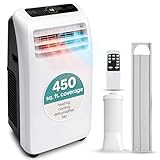
Overview: SereneLife’s 10,000 BTU portable AC provides affordable year-round climate control for spaces up to 450 square feet. This 4-in-1 unit combines cooling, heating, dehumidification, and fan modes in a lightweight, mobile design. The included remote control and window kit enable straightforward setup and operation without professional installation.
What Makes It Stand Out: Remarkable versatility at a budget price point defines this unit. The integrated dehumidifier removes 15 liters hourly while cooling, addressing humidity and temperature simultaneously. Rolling wheels enhance portability between rooms, and the automatic swing mode ensures comprehensive air circulation. Four operational modes eliminate need for multiple seasonal appliances.
Value for Money: Among the most affordable true 4-in-1 units available, it delivers exceptional functionality per dollar. While efficiency doesn’t match inverter models, the low purchase price makes it accessible for renters and budget-conscious homeowners. The 9,000 BTU heating capability provides year-round utility that standalone ACs lack, consolidating equipment expenses effectively.
Strengths and Weaknesses: Pros include low purchase price, genuine portability, four operational modes, dehumidifier performance, and simple operation. Cons feature higher noise levels (52-56 dBa), modest 6,000 SACC rating revealing real-world cooling limitations, no smart features, and basic build quality reflecting the price point.
Bottom Line: Perfect entry-level solution for small apartments or supplemental climate control. Accept performance trade-offs for affordability and versatility. Best suited for users prioritizing budget and basic functionality over advanced features and whisper-quiet operation.
10. Humhold Inverter 16000BTU Portable Air Conditioners with Remote, Free Stand Cooling Portable AC Unit for Room up to 800 sq.ft, with Dehumidifier & Fan, Dual Hose, Quiet Sleep Mode(42dB), Windows Kit

Overview: The Humhold Inverter portable AC delivers powerful 16,000 BTU (12,000 SACC) cooling for large spaces up to 800 square feet. Featuring variable-speed inverter technology, dual-hose design, and ultra-quiet 42dB sleep mode, this 3-in-1 unit provides energy-efficient cooling, dehumidification, and fan operation for substantial areas where quiet performance matters.
What Makes It Stand Out: Exceptional cooling capacity combined with inverter efficiency creates a compelling package for large rooms. The dual-hose system prevents hot air infiltration, cooling 30-40% faster than single-hose designs. Sleep mode maintains optimal temperatures below 42dB, while auto-swing distributes air across 15-75° angles. The built-in temperature sensor enables intelligent mode switching for consistent comfort.
Value for Money: Competitive pricing for a high-capacity inverter unit with dual hoses offers strong value. The 40% energy savings versus traditional ACs reduce operational costs in large spaces, offsetting the moderate premium over basic models. Coverage for 800 sq ft eliminates need for multiple units, consolidating expenses effectively.
Strengths and Weaknesses: Pros include high BTU output, inverter efficiency, dual-hose design, whisper-quiet operation, wide coverage, and intelligent features. Cons involve brand recognition concerns, limited long-term reliability data, remote requiring separate batteries, and potential customer service uncertainties compared to established manufacturers.
Bottom Line: Excellent choice for cooling large bedrooms, living rooms, or open-plan spaces quietly and efficiently. The feature set rivals premium brands at a competitive price. Recommended for buyers comfortable with emerging brands who prioritize capacity, quiet operation, and energy savings.
Understanding Portable Heat Pump Technology
How Heat Pumps Slash Energy Consumption
Portable heat pumps operate on a brilliantly simple principle: they move existing heat rather than creating it from scratch. During winter, they extract ambient warmth from outdoor air (even when it feels cold to you) and transfer it inside. In summer, they reverse the process, pulling heat from your room and expelling it outdoors. This heat transfer mechanism requires significantly less electricity than resistive heating elements or conventional AC compressors, which is why your energy bills can drop dramatically when you use them strategically.
The Dual Heating and Cooling Advantage
Unlike single-function appliances that sit idle for half the year, a quality portable heat pump earns its keep in every season. This dual functionality means one investment covers both your supplemental heating and cooling needs. Top-tier models seamlessly switch between modes with a single button press, eliminating the need for separate storage spaces and reducing the total number of appliances you need to purchase, maintain, and eventually replace.
Inverter Technology Explained
Premium portable heat pumps feature inverter-driven compressors that revolutionize efficiency. Instead of constantly cycling on and off—wasting energy with each restart—inverter technology allows the compressor to adjust its speed continuously. When your room approaches the target temperature, the compressor slows down to maintain it gently. This variable operation consumes up to 30% less electricity than traditional fixed-speed units while keeping temperatures more stable and reducing noise levels significantly.
Key Efficiency Metrics That Matter
Decoding SEER and HSPF Ratings
Energy efficiency ratings are your roadmap to real savings. SEER (Seasonal Energy Efficiency Ratio) measures cooling efficiency—the higher the number, the less electricity used to keep you cool. HSPF (Heating Seasonal Performance Factor) does the same for heating mode. Look for units with SEER ratings above 15 and HSPF ratings above 9 for optimal performance. These numbers directly translate to lower kilowatt-hour consumption on your monthly bill.
BTU Sizing for Your Space
Oversized units waste money through frequent cycling, while undersized ones run constantly without ever reaching comfort. Calculate your needs precisely: multiply your room’s square footage by 20 BTUs for standard ceilings. A 300-square-foot room requires approximately 6,000 BTUs. However, adjust upward if you have poor insulation, large windows, or high ceilings. Proper sizing ensures your heat pump operates in its efficiency sweet spot.
Energy Star Certification Importance
The blue Energy Star label isn’t just marketing fluff—it represents rigorous third-party testing. Certified portable heat pumps meet strict EPA guidelines for efficiency and performance, using at least 10% less energy than standard models. This certification also indicates better build quality, more reliable components, and advanced features that contribute to long-term savings beyond just the sticker rating.
Features That Drive Real Savings
Programmable Timers and Smart Controls
Modern units with 24-hour programmable timers let you align operation with your actual schedule. Why cool an empty room during work hours? Set your unit to power down after you leave and restart 30 minutes before your return. Advanced models offer smartphone app control, enabling you to adjust settings remotely if plans change, preventing wasted energy from forgotten running units.
Variable Speed Compressors
Beyond basic inverter technology, the best portable heat pumps feature multi-stage or fully variable compressors that fine-tune output in tiny increments. This precision prevents the temperature swings that trigger energy-wasting cycles. You’ll maintain comfort within half a degree of your setpoint while the unit hums along at minimal power draw instead of repeatedly ramping up to full blast.
Dehumidification Modes
In humid climates, removing moisture is half the battle for comfort. Quality heat pumps include dedicated dehumidify modes that extract water from air without overcooling the room. This function uses far less energy than air conditioning while making spaces feel significantly cooler, allowing you to set temperatures 3-4 degrees higher while maintaining the same comfort level—a direct reduction in runtime and cost.
Sleep Settings and Eco Modes
Intelligent sleep functions gradually adjust temperatures overnight to match your body’s natural cooling, then return to daytime settings before you wake. Eco modes limit maximum power draw, prioritizing efficiency over speed. These features can shave another 15-20% off operating costs by preventing unnecessary heating or cooling when you’re unconscious or when gentle conditioning suffices.
Installation and Placement Strategies
Window Kit Essentials
Proper sealing is non-negotiable for efficiency. Premium portable heat pumps include adjustable window kits with insulated panels that create an airtight seal around the exhaust hose. This prevents the expensive heated or cooled air from leaking back outside. Take time to install these kits correctly—gaps as small as a quarter-inch can reduce efficiency by 20% as your unit fights against air infiltration.
Optimal Room Positioning
Place your unit where airflow remains unobstructed. Keep it at least 20 inches from walls and furniture to allow the intake and output vents to breathe freely. Position the unit away from heat sources like direct sunlight or electronics that could trick sensors into overworking. For heating, place it near the coldest exterior wall; for cooling, position it to blow across the room’s longest dimension for even distribution.
Ventilation Requirements
The exhaust hose is your unit’s lifeline to the outside. Keep it as short and straight as possible—every bend restricts airflow and reduces efficiency. Extend the hose only to the minimum length needed. If your unit comes with a dual-hose system (one intake, one exhaust), always use both. Single-hose models create negative pressure that pulls unconditioned air into your home, while dual-hose designs maintain neutral pressure for maximum efficiency.
Operating Tips for Maximum Efficiency
Temperature Set Point Optimization
Each degree matters enormously. In winter, set your heat pump to 68°F instead of 72°F and wear a sweater—this alone cuts heating costs by up to 10%. In summer, 78°F is the efficiency sweet spot. Your heat pump works hardest when temperature differentials are extreme; narrowing the gap between indoor and outdoor temperatures slashes energy consumption. Use your heat pump to maintain “good enough” comfort, not arctic chill or tropical heat.
Complementing Existing Systems
Think zonal, not whole-house. Use your portable heat pump to condition only the rooms you’re actively using while setting your central thermostat to a less extreme temperature. This “setback” strategy lets your main system coast along at minimal cost while your portable unit handles the heavy lifting in occupied spaces. The combined approach often uses 30-40% less energy than conditioning every room uniformly.
Seasonal Maintenance Musts
Clean the air filter every two weeks during heavy use. A clogged filter forces the unit to work harder, increasing energy draw by 15% or more. Before heating season, inspect the outdoor hose for blockages or damage. In spring, clean the condensate collection system to prevent mold and ensure proper drainage. These simple tasks maintain peak efficiency and prevent costly repairs that negate your energy savings.
Zonal Heating and Cooling Strategy
Close doors to unused rooms and use your portable heat pump to create microclimates. This targeted approach prevents wasting energy on empty guest rooms or storage areas. For open floor plans, use ceiling fans on low speed to gently circulate conditioned air throughout the space. This allows you to run the heat pump at lower power levels while still achieving consistent comfort across a larger area.
Cost Analysis and ROI
Initial Investment vs. Long-term Savings
Quality portable heat pumps typically cost more upfront but pay dividends through lower operating costs. A premium unit might cost $200 more than a budget model but save $30-50 monthly on electricity. That premium pays for itself in under a year, then continues delivering savings for 8-10 years. Factor in both purchase price and estimated annual operating cost when evaluating value, not just the sticker price.
Understanding Operating Costs
Calculate real-world costs using the unit’s wattage and your local electricity rate. A 1,000-watt heat pump running 8 hours daily at $0.12 per kWh costs about $29 monthly. Compare this to resistive heating at 1,500 watts ($43 monthly) or central AC cooling your entire home. The math reveals why strategic portable heat pump use is a financial win, especially when targeting specific zones rather than whole-house conditioning.
Utility Rebates and Incentives
Many utilities offer rebates for Energy Star certified heat pumps, typically $50-150. Check your provider’s website or call their efficiency program. Some states provide additional tax incentives for energy-saving appliances. These programs directly offset your purchase cost, accelerating your return on investment. Keep all documentation and model numbers when applying—rebates often require specific efficiency thresholds.
Common Mistakes to Avoid
Oversizing Your Unit
Bigger isn’t better with heat pumps. An oversized unit reaches set temperature too quickly, shuts off, then cycles on again minutes later. This short-cycling wastes energy, creates uncomfortable temperature swings, and prematurely wears components. Stick to calculated BTU requirements. If between sizes, choose the smaller unit and supplement with proper insulation or ceiling fans rather than overshooting.
Poor Sealing and Insulation
Even the most efficient heat pump can’t overcome a leaky room. Before blaming your unit for high bills, check for drafts around windows, doors, and electrical outlets. Use weatherstripping and caulk to seal gaps. Ensure your window kit installation is airtight. A well-insulated, properly sealed space allows your heat pump to work at low, efficient speeds rather than constantly battling outdoor air infiltration.
Ignoring Filter Maintenance
That “check filter” light isn’t a suggestion—it’s a warning. Running a heat pump with a dirty filter is like trying to breathe through a straw. The unit strains to pull air through clogged media, forcing the compressor to run longer and harder. This single oversight can transform your energy-saving investment into an electricity hog. Set phone reminders to check filters bi-weekly during peak seasons.
Frequently Asked Questions
What size portable heat pump do I need for a 400-square-foot room?
A 400-square-foot room typically requires an 8,000 BTU unit for standard 8-foot ceilings. However, increase to 10,000 BTUs if you have poor insulation, large south-facing windows, or live in extreme climate zones. Always measure your exact space and consider heat load factors rather than guessing.
How much can I realistically save on my energy bills?
Most households save 20-40% on heating and cooling costs for the zones they condition with a portable heat pump. If you use it to maintain your main living area while setting your central thermostat back 5-7 degrees, monthly savings of $50-100 are common, depending on your local energy rates and climate.
Are portable heat pumps effective in temperatures below freezing?
Standard models experience efficiency drops below 40°F and may struggle below 25°F. However, units with low-ambient temperature kits or enhanced vapor injection technology can operate effectively down to 5°F. For consistently sub-freezing climates, consider a dual-fuel approach using the heat pump as primary down to 35°F, then switching to a backup system.
Do portable heat pumps need to be vented outside?
Yes, absolutely. They must exhaust heat during cooling mode and intake air during heating mode. The included window kit provides this connection. Attempting to operate without proper venting is dangerous, inefficient, and will quickly damage the unit while providing no meaningful temperature change.
How noisy are portable heat pumps compared to window units?
Quality portable heat pumps typically operate at 45-55 decibels, comparable to a refrigerator hum. This is generally quieter than window units because the noisiest component (the compressor) sits inside your room rather than projecting sound outdoors. Inverter models are even quieter since they avoid the jarring on/off cycles of traditional units.
Can I run a portable heat pump on a standard 120-volt outlet?
Most models under 12,000 BTUs operate on standard 120-volt, 15-amp circuits. Larger units may require a dedicated 120-volt circuit or even 240 volts. Check your electrical panel capacity before purchasing—continuous load from a heat pump shouldn’t exceed 80% of the circuit’s rated amperage to prevent tripping breakers.
How often should I drain the condensate water?
It depends on humidity levels. In dry climates, you might never need to drain manually as the unit evaporates moisture through the exhaust. In humid conditions, you may need to empty the collection tank daily or connect a continuous drain hose to a floor drain. Models with auto-evaporation technology minimize this chore.
What’s the difference between single-hose and dual-hose designs?
Single-hose units use indoor air to cool their condensers, creating negative pressure that pulls unconditioned outdoor air into your home through cracks and gaps. Dual-hose models have separate intake and exhaust hoses, maintaining neutral air pressure and improving efficiency by up to 40%. Dual-hose is worth the small price premium for serious energy savers.
How long do portable heat pumps typically last?
With proper maintenance, expect 8-12 years of service. Inverter models often last longer due to reduced component stress from gentle operation. Regular filter cleaning, annual coil cleaning, and proper winter storage significantly extend lifespan. Units used seasonally rather than year-round may last 15+ years.
Are there any safety concerns with leaving them running unattended?
Modern units include tip-over switches, overheat protection, and automatic shutoffs. They’re generally safe for unattended operation, but follow basic precautions: keep flammables away, ensure the vent hose isn’t blocked or kinked, and plug directly into wall outlets (never extension cords). For overnight use, enable sleep mode and ensure the unit has adequate clearance on all sides.
See Also
- Stop High Energy Bills with the 10 Best Reversible Portable Heat Pumps This Year
- Stop Wasting Energy with the 10 Best Smart Portable Heat Pumps This Year
- How to Solve High Energy Bills with the 10 Best Energy Efficient Portable Heat Pumps in 2026
- Stop High Energy Bills with the 10 Best Heat Pump Wall Mounted Air Conditioners This Year
- Stop Wasting Energy with the 10 Best Reversible Portable Heat Pumps This Year