Table of Contents
Ever tossed and turned through another sweltering night, counting ceiling tiles instead of sheep? You’re not alone. When humidity clings like a second skin and your bedroom feels like a sauna, the struggle for restorative sleep becomes all too real. Traditional window units might offer relief, but their bulky frames often block precious views, restrict window operation, or simply clash with your home’s aesthetic. This frustration is especially acute in apartments with narrow sashes, historic homes with unique windows, or any space where every inch of sightline matters. The good news is a smarter solution exists, designed specifically for these challenges.
Enter the world of low-profile window air conditioners – the unsung heroes of compact cooling. Forget the hulking units of the past; modern engineering has squeezed serious cooling power into sleeker, shorter designs that prioritize both function and form. But navigating this category requires more than just spotting the shortest unit on the shelf. Choosing the right low-profile model involves understanding unique installation quirks, cooling capacity nuances, and efficiency trade-offs specific to their condensed design. This guide cuts through the noise, focusing purely on the features, considerations, and practical knowledge you need to transform those hot, restless nights into cool, comfortable slumber – without compromising your view or your peace of mind.
Top 10 Low Profile Window Air Conditioners
Detailed Product Reviews
1. GE Profile ClearView Inverter Window Air Conditioner Unit, 10,300 BTU, U-Shaped Adjustable Depth, Energy Efficient Cooling up to 450 sq ft., Ultra Quiet, SMART Home Capable, Includes Remote, White

Overview:
This 10,300 BTU Energy Star-certified window AC unit targets medium to large rooms (up to 450 sq ft), prioritizing unobstructed views and quiet operation. Its U-shaped design preserves window functionality, while inverter technology promises efficiency and seamless smart integration via the SmartHQ app or voice assistants.
What Makes It Stand Out:
GE’s exclusive Flex-Depth system accommodates walls from 4.5" to 13.75" thick—a rarity in window ACs—ensuring a custom fit. At 40 dB, it’s among the quietest models (backed by GE’s “Quietest Brand” claim), and its inverter tech delivers 34% greater efficiency than conventional units. The full-window-view design maintains natural light and window mobility, unlike bulkier competitors.
Value for Money:
Priced premium, it justifies cost through long-term energy savings and versatility. The Flex-Depth feature eliminates the need for costly adapters, while smart capabilities match pricier smart thermostats. Though Midea offers similar specs cheaper, GE’s build quality and warranty support enhance longevity, making it a sound investment for view-conscious users.
Strengths and Weaknesses:
Strengths: Industry-leading adjustable depth; ultra-quiet operation; maintains full window visibility; robust SmartHQ integration; Energy Star certified.
Weaknesses: Slightly higher noise floor than Midea’s 32 dB; no explicit mention of R32 refrigerant (less eco-friendly); narrower window width range (20"-40") versus some rivals.
Bottom Line:
Ideal for homeowners prioritizing window aesthetics and flexible installation in medium-large spaces. While pricier, its unique depth adjustability and quiet, efficient performance deliver exceptional value for long-term use.
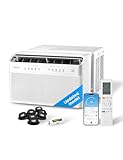
2. Midea 8,000 BTU U Shaped Smart Inverter Window Air Conditioner - Cools 350 Sq Ft, Ultra Quiet with Open Window Flexibility - Alexa/Google Assistant Compatible - 37% Energy Savings, Remote (Updated)
Overview:
This compact 8,000 BTU unit cools up to 350 sq ft with a focus on extreme quietness and energy efficiency. Its U-shaped design preserves window access, while R32 refrigerant and inverter tech target eco-conscious buyers seeking smart climate control for smaller rooms.
What Makes It Stand Out:
Midea’s standout 32 dBA operation—10x quieter than traditional ACs—makes it perfect for bedrooms. It pioneered ENERGY STAR certification for window units, touting 37% energy savings. The anti-theft window lock and tool-free “quick-snap” bracket simplify installation, and R32 refrigerant reduces environmental impact versus older models.
Value for Money:
Excellent value for small spaces; the 37% efficiency claim translates to noticeable utility savings. At a mid-range price, it outperforms non-inverter competitors in noise and running costs. While GE offers similar features, Midea’s lower BTU model is more affordable for apartments, though lacks depth adjustability.
Strengths and Weaknesses:
Strengths: Unmatched 32 dBA quietness; highest energy savings (37%); R32 refrigerant; easy anti-theft window lock; widest app/voice compatibility.
Weaknesses: Limited to 350 sq ft; fixed bracket (no depth adjustment); narrower window width range (22"-36"); slightly less robust smart app than GE’s.
Bottom Line:
A top pick for quiet, efficient cooling in studios or small bedrooms. Its energy savings, whisper-quiet operation, and straightforward setup offer compelling value, especially for eco-aware renters.
3. GE Profile ClearView Window Air Conditioner Unit, 8,300 BTU, U-Shaped Adjustable Depth, Energy Efficient Cooling up to 350 sq ft., Ultra Quiet, SMART Home Capable, Includes Remote, White

Overview:
This 8,300 BTU model delivers targeted cooling for rooms up to 350 sq ft with GE’s signature ClearView design. It emphasizes maintaining window functionality and natural light while integrating smart controls and quiet operation for smaller living spaces.
What Makes It Stand Out:
GE’s Flex-Depth technology (4.5"-13.75" compatibility) sets it apart, ensuring secure fits in diverse windowsills. The built-in condensation pump auto-drains moisture—uncommon in rivals—reducing manual maintenance. Combined with 40 dB quiet operation and SmartHQ app control, it balances practicality and convenience.
Value for Money:
Justifies its premium price with unique features: the condensation pump prevents leaks, and Flex-Depth avoids adapter costs. Energy efficiency aligns with competitors, but GE’s brand reputation for durability offers long-term savings. For view-focused users, it’s worth the extra cost over basic Midea models.
Strengths and Weaknesses:
Strengths: Built-in condensation pump; versatile Flex-Depth system; full window visibility; reliable SmartHQ ecosystem; Energy Star certified.
Weaknesses: 40 dB noise slightly higher than Midea’s 32 dB; no R32 refrigerant; window height requirement (13" min) may exclude some installs.
Bottom Line:
Best for renters or homeowners needing a low-maintenance, view-preserving solution for small rooms. The condensation pump and depth adjustability make it a hassle-free upgrade worth considering over standard models.
4. Midea 12,000 BTU U Shaped Smart Inverter Window Air Conditioner - Cools 550 Sq Ft, Ultra Quiet with Open Window Flexibility - Alexa/Google Assistant Compatible - 35% Energy Savings, Remote (Updated)
Overview:
Targeting large rooms (up to 550 sq ft), this 12,000 BTU powerhouse combines high cooling capacity with Midea’s signature quiet operation. It leverages inverter efficiency and U-shaped design for spaces where traditional units struggle, without sacrificing window access.
What Makes It Stand Out:
As one of few 12k BTU U-shaped models, it uniquely cools large areas while maintaining window openness. The 32 dBA noise level defies its size, and R32 refrigerant enhances eco-friendliness. ENERGY STAR certification validates 35% energy savings, and the anti-theft lock adds security—key for ground-floor installations.
Value for Money:
A cost-effective solution for spacious rooms; the energy savings offset higher electricity use from larger capacity. Priced competitively against 10k-12k BTU units, it outperforms non-inverter giants in noise and efficiency. Though lacking depth adjustment, its quick-snap bracket simplifies setup for most windows.
Strengths and Weaknesses:
Strengths: High-capacity cooling (550 sq ft); remarkably quiet for size (32 dBA); R32 refrigerant; strong energy savings; secure anti-theft lock.
Weaknesses: Fixed bracket limits wall-thickness compatibility; window width range (22"-36") excludes wider sills; no condensation pump.
Bottom Line:
The go-to choice for large rooms needing powerful, quiet, and efficient cooling. Its balance of capacity, whisper operation, and smart features delivers outstanding value for spacious living areas or offices.
5. Midea 10,000 BTU U Shaped Smart Inverter Window Air Conditioner - Cools 450 Sq Ft, Ultra Quiet with Open Window Flexibility - Alexa/Google Assistant Compatible - 35% Energy Savings, Remote (Updated)
Overview:
This 10,000 BTU unit bridges the gap between small and large cooling needs, covering up to 450 sq ft. It merges Midea’s U-shaped convenience with inverter efficiency, targeting medium-sized rooms where window visibility and quiet operation are priorities.
What Makes It Stand Out:
Operating at a near-silent 32 dBA, it’s ideal for bedrooms or home offices. The R32 refrigerant and ENERGY STAR certification ensure eco-friendly efficiency, while the anti-theft window lock enhances security. The streamlined quick-snap installation appeals to DIY users, and universal voice assistant support adds modern convenience.
Value for Money:
Offers the sweet spot for mid-sized spaces at a fair price. The 35% energy savings lower running costs significantly versus non-inverter models, and R32 future-proofs refrigerant compliance. Though GE has depth adjustability, Midea’s lower noise and eco-credentials provide better bang for buck in standard-width windows.
Strengths and Weaknesses:
Strengths: Exceptionally quiet (32 dBA); R32 refrigerant; 35% energy savings; easy anti-theft lock; broad voice/app compatibility.
Weaknesses: Fixed bracket (no depth adjustment); window width limited to 22"-36"; no condensation pump like GE’s model.
Bottom Line:
A stellar all-rounder for medium rooms seeking quiet, efficient cooling. Its unbeatable noise profile, eco-friendly design, and hassle-free setup make it the top recommendation in the 10k BTU category.
6. GE Profile ClearView Inverter Window Air Conditioner Unit, 12,200 BTU, Energy Efficient Cooling up to 550 sq ft., Ultra Quiet, SMART Home Capable, Includes Remote, White
Overview: The GE Profile ClearView is a high-capacity, Energy Star-certified 12,200 BTU window AC unit designed for larger rooms up to 550 sq. ft. It emphasizes maintaining your window view and natural light while offering smart connectivity and ultra-quiet operation. What Makes It Stand Out: Its unique full-view design preserves window functionality and light, a rarity in window units. The inverter technology significantly boosts energy efficiency (34% more than non-inverter models) and enables remarkably quiet operation (as low as 40 dB). The Flex-Depth design accommodates various wall thicknesses (4.5"-13.75"), and built-in Wi-Fi with SmartHQ app and voice assistant compatibility provides seamless remote control. Value for Money: Priced at a premium, it justifies the cost through superior energy savings via inverter tech, exceptional quietness, the unique view-preserving design, and robust smart features. It outperforms standard 12k BTU units in efficiency and user experience, making it a worthwhile investment for larger spaces where comfort and convenience matter. Strengths and Weaknesses: Strengths: Unmatched quiet operation; significant energy savings; maintains full window view/light; flexible installation via Flex-Depth; comprehensive smart controls; strong cooling for large rooms. Weaknesses: Higher initial cost; complex installation compared to basic models; requires robust window structure for larger size. Bottom Line: An excellent, premium choice for large rooms demanding quiet, efficient cooling without sacrificing natural light or window function. Its smart features and energy savings deliver strong long-term value despite the higher upfront price.
7. GE Profile ClearView Window Air Conditioner 8,300 BTU, WiFi Enabled, Ultra Quiet for Medium Rooms, Full Window View with Easy Installation, 8K Window AC Unit, White (Renewed)
Overview: This renewed GE Profile ClearView 8,300 BTU unit offers smart, quiet cooling for medium-sized rooms (up to ~350 sq. ft.), featuring the signature full-window view design and Wi-Fi connectivity, refurbished to meet GE’s standards. What Makes It Stand Out: The key differentiator remains the full-view design, allowing windows to open freely and maximizing natural light – uncommon in ACs. As a renewed model, it provides access to GE’s quiet operation (a hallmark of the Profile line) and SmartHQ app control at a reduced price point, maintaining the core benefits of the new version. Value for Money: The renewed status offers substantial savings over new models while retaining the valuable full-view functionality, Wi-Fi smart controls, and GE’s quality. For budget-conscious buyers needing reliable medium-room cooling with these premium features, it presents exceptional value, though the warranty might differ from new units. Strengths and Weaknesses: Strengths: Significant cost savings via renewed status; preserves window view and operation; includes Wi-Fi/app control; GE’s quiet operation; suitable for medium rooms. Weaknesses: Limited feature details provided (e.g., exact noise level, specific efficiency gains); potential shorter warranty than new; inherent uncertainty with any refurbished product. Bottom Line: A highly recommended option for medium rooms if the full-window view and smart features are priorities and you seek value. Verify the specific warranty terms of the renewed unit, but it effectively delivers GE’s premium experience at a lower cost.
8. Hisense 8,000 BTU Smart Inverter Window Air Conditioner Easy Install Bracket, Up to 350 Sq Ft, Ultra-Slim Profile, 3 Speed, 700W, 4‑Way Air Direction HLAW0825TW (Renewed)

Overview: This renewed Hisense 8,000 BTU smart inverter AC targets medium rooms (up to 350 sq. ft.), combining energy-efficient inverter tech, a space-saving ultra-slim profile, and app connectivity via ConnectLife, enhanced by an included installation bracket. What Makes It Stand Out: The ultra-slim profile minimizes visual intrusion, a key advantage for aesthetics. The included easy-install bracket ensures robust, secure mounting – a frequent pain point. Inverter technology promises quieter operation and energy savings compared to conventional units, while the 4-way air direction and multiple modes (Cool, Fan, Dry, Eco, Sleep) offer versatile comfort. Value for Money: As a renewed model, it offers a compelling entry point into smart, inverter-driven cooling. The combination of energy efficiency (lower running costs), the practical installation bracket, slim design, and comprehensive mode selection provides strong value for medium rooms, especially compared to non-inverter or non-smart alternatives at similar price points. Strengths and Weaknesses: Strengths: Space-saving ultra-slim design; includes secure installation bracket; energy-efficient inverter tech; versatile 4-way airflow and multiple modes (including Dry/Sleep); ConnectLife app control; renewed price advantage. Weaknesses: Renewed status carries inherent risk; app ecosystem (ConnectLife) may be less proven than GE/LG’s; specific noise levels not highlighted. Bottom Line: An excellent value-focused choice for medium rooms where a discreet profile, secure installation, and smart/inverter efficiency are desired. The included bracket and renewed pricing make it a practical and cost-effective smart cooling solution.
9. Amazon Basics 5000-BTU Small Window Air Conditioner, Up to 150 Sqf, Window AC Units with Cool and Fan Functions, Washable Filter, Adjustable Window Kit, Intuitive Mechanical Controls, White

Overview: Amazon Basics delivers a no-frills, budget-friendly 5,000 BTU window AC unit engineered for cooling small spaces (up to 150 sq. ft.) like bedrooms or offices, prioritizing straightforward functionality and ease of setup. What Makes It Stand Out: Its core strength is exceptional simplicity and affordability. The intuitive mechanical dials offer foolproof operation without apps or remotes. The included adjustable window kit ensures compatibility with standard windows (23"-36" wide), and the focus on basic, reliable cooling for very small rooms sets it apart from feature-heavy competitors. Value for Money: This is the quintessential value champion for tiny spaces. It provides essential cooling and fan functions at the lowest possible price point. While lacking smart features or inverter efficiency, it excels at its core task for minimal cost, making it ideal for renters, seasonal use, or tight budgets where advanced features are unnecessary. Strengths and Weaknesses: Strengths: Very low cost; extremely simple mechanical controls; includes comprehensive adjustable window installation kit; easy-access washable filter; quiet enough for small rooms (56 dB); ideal for spaces under 150 sq. ft. Weaknesses: No remote or smart features; limited to very small rooms; basic cooling only (no dry/dehumidify mode); mechanical controls feel dated; no energy-saving inverter tech. Bottom Line: Highly recommended only for cooling very small rooms (≤150 sq. ft.) on a strict budget. It delivers reliable, no-nonsense cooling and fan operation with simple setup, but lacks any advanced features or efficiency found in pricier models.
10. LG 5000 BTU Window Air Conditioner with Remote, Easy Mechanical Control Ultra-Quiet Compact-size Cools 150 Sq.Ft. for Small Room, Washable Filter AC Unit Easy Installation White LW5025R

Overview: The LG LW5025R is a compact 5,000 BTU window AC unit designed for small rooms up to 150 sq. ft., balancing user-friendly controls, quiet operation, and essential features like a washable filter and remote convenience. What Makes It Stand Out: It effectively combines mechanical simplicity with modern touches: intuitive front-panel controls plus a full-featured remote for bed/couch operation. The emphasis on ultra-quiet performance and the inclusion of an Eco-friendly R32 refrigerant (more efficient than older types) differentiate it in the entry-level segment. The EZ Mount kit simplifies installation. Value for Money: Positioned slightly above basic no-name brands, it justifies its price with LG’s reliability, the practical remote control, genuinely quiet operation, R32 refrigerant for better efficiency, and the convenient slide-out washable filter. It offers a noticeable step up in usability and features over the most basic models like the Amazon Basics. Strengths and Weaknesses: Strengths: Includes useful remote control; very quiet operation; user-friendly mechanical controls with LCD; energy-saving function & R32 refrigerant; easy slide-out washable filter; straightforward EZ Mount installation. Weaknesses: Limited to very small rooms (150 sq. ft.); no smart/app connectivity; basic cooling/fan modes only (no dry mode); R32 efficiency gain is modest vs inverter tech. Bottom Line: A top recommendation for small rooms needing reliable, quiet cooling with the convenience of a remote. It offers the best blend of user-friendly features, quietness, and reputable build quality in the compact 5k BTU category, providing excellent value over bare-bones alternatives.
Why Low-Profile Design Matters Beyond Just Looks
Understanding the Height Constraint Challenge
Standard window ACs often require significant vertical space within your window frame, typically 13-16 inches or more. This height can be problematic for many common window types, especially double-hung windows where the lower sash doesn’t raise high enough, slider windows with limited vertical clearance, or older architectural styles with shorter sashes. Low-profile units address this fundamental limitation, usually measuring under 12.5 inches in height, making installation feasible where standard units simply won’t fit. It’s not just about aesthetics; it’s about basic functionality and access to cooling where it was previously impossible.
Preserving Your View and Natural Light
One of the most immediate benefits users notice is the dramatic improvement in sightlines. A shorter unit sits lower in the window, leaving significantly more glass area above it. This means you can actually see out of your window while the AC is running – watching the rain, enjoying a garden view, or simply letting in more natural daylight during the day. This psychological boost from maintaining a connection to the outside world is a major quality-of-life improvement that standard units often sacrifice for raw cooling power.
Adapting to Unique Architectural Features
Historic homes, apartments with specific building codes, or rooms with oddly shaped windows present unique hurdles. Low-profile models are often the only viable window AC solution for these spaces. Their reduced height allows them to integrate into window frames that wouldn’t accommodate deeper units, respecting architectural integrity while providing essential climate control. This adaptability makes them indispensable for renters and homeowners facing non-standard installations.
Decoding Cooling Capacity for Compact Units
BTU Requirements: Size vs. Space Reality
Don’t assume a smaller unit means less cooling power across the board. Low-profile models come in various BTU (British Thermal Unit) ratings, just like standard units. The critical factor remains matching the BTU capacity to your room’s square footage, ceiling height, sun exposure, and insulation quality. A common mistake is under-sizing because the unit looks smaller; always calculate your specific room’s needs first. An undersized low-profile unit will struggle, run constantly, and fail to cool effectively, negating any space-saving benefit.
The Impact of Reduced Airflow Design
Due to their compressed internal layout, low-profile units sometimes have slightly different airflow patterns compared to taller models. The air intake and exhaust vents are positioned closer together vertically. While modern designs mitigate this, it’s worth considering room layout. Ensure there’s adequate clearance above the unit for warm exhaust air to disperse efficiently, and position furniture so cooled air can circulate freely throughout the space without immediate obstruction.
Realistic Expectations for Room Size
Generally, the most compact low-profile models top out around 8,000-10,000 BTUs due to the physical constraints of fitting a powerful compressor and coils into a shorter chassis. This makes them ideal for rooms up to 450 square feet. If you’re cooling a larger space, you might need to explore higher-BTU low-profile options (if available for your height constraint) or consider alternative solutions like ductless mini-splits, as pushing a compact unit beyond its capacity leads to poor performance and higher energy bills.
Installation Nuances Specific to Slim Designs
Measuring Your Window with Precision
Accuracy is non-negotiable. Measure the exact height of the window opening where the AC will sit – from the inside sill to the closed lower sash (or track for sliders). Remember, low-profile units require this measurement to be less than the unit’s specified maximum installation height (usually 12.5" or less). Also measure width meticulously, as side panels must fill the gap securely. Don’t rely on old measurements; windows can settle, and trim can vary.
Dealing with Shallow Sills and Unique Frames
Many low-profile units have a slightly deeper chassis (front-to-back) to compensate for the reduced height, ensuring adequate internal components. This can be problematic for windows with very shallow sills (the ledge the unit sits on). Check the unit’s depth requirement against your sill depth before purchasing. Some models come with optional mounting brackets or extender kits specifically designed for shallow sills – a crucial feature often overlooked.
Securing Stability in Smaller Openings
The reduced height can sometimes mean less surface area for the unit to grip the window frame. This makes proper installation with sturdy, correctly sized side panels absolutely critical. Ensure the panels expand fully and lock tightly against both sides of the window frame. Never skip installing the included anti-tip bracket or security bar, especially in ground-floor units or homes with children/pets, as the lower center of gravity doesn’t eliminate tipping risks.
Energy Efficiency Considerations
SEER Ratings in a Compact Package
The Seasonal Energy Efficiency Ratio (SEER) indicates how efficiently an AC uses electricity. Look for the ENERGY STAR label, which signifies the unit meets strict efficiency guidelines set by the EPA. While compact design poses engineering challenges, many modern low-profile models achieve respectable SEER ratings (often 10-12 or higher). Don’t assume a smaller unit is automatically more efficient; always compare the specific SEER number. A higher SEER, even in a low-profile unit, translates directly to lower cooling costs over the unit’s lifespan.
Features That Boost Efficiency
Smart features aren’t just for convenience; they save energy. Prioritize models with programmable timers to cool the room only when needed (e.g., turning on 30 minutes before you get home). Auto modes that adjust fan speed based on temperature demand are more efficient than constant high-speed operation. Look for units with sleep modes that gradually raise the temperature at night once you’re asleep, reducing runtime without sacrificing comfort. Energy-saver modes that cycle the compressor while maintaining airflow can also provide incremental savings.
Minimizing Air Leaks for Maximum Effectiveness
The biggest efficiency drain often isn’t the unit itself, but poor installation allowing cooled air to escape. Low-profile units require meticulous sealing. Use high-quality foam tape or specialized window insulation kits designed for ACs on all gaps between the unit, the side panels, and the window frame. Pay special attention to the top gap between the unit and the closed sash – this is a common leak point. A well-sealed low-profile unit will perform significantly better and use less energy than a poorly sealed standard unit.
Noise Levels: Finding Quiet Comfort
Understanding Decibel Ratings
All ACs generate noise, but the condensed design of low-profile units can sometimes concentrate sound sources. Manufacturers provide decibel (dB) ratings – lower numbers mean quieter operation. Look for specific “sleep mode” or “quiet mode” dB ratings, as these reflect the noise level during the gentlest operation, crucial for bedroom use. Ratings below 50 dB are generally considered very quiet for bedroom environments; above 55 dB can be disruptive for light sleepers.
Placement Impact on Perceived Noise
Where you install the unit affects how loud it sounds inside your room. Units mounted on an exterior wall shared with a quiet room (like a bedroom) will transmit more noise than those on an exterior wall facing away from sleeping areas. If possible, avoid installing the unit directly under an open bedroom window on another floor. The direction the exhaust fan faces can also influence noise; pointing it towards a solid wall might reflect sound back, while pointing it into open space allows sound to dissipate.
Vibration Dampening Techniques
Vibrations traveling through the window frame can amplify noise. Ensure the unit is perfectly level during installation – use shims if necessary. Check that the side panels are snug but not overtightened, which can warp the frame. Placing a thin, dense rubber mat (like weatherstripping foam) between the unit and the window sill can significantly reduce vibration transfer into the structure, leading to a quieter experience inside.
Essential Features for Modern Convenience
Smart Connectivity and App Control
Remote management via smartphone apps has become increasingly common, even in compact units. This allows you to turn the unit on/off, adjust temperature, and set schedules from anywhere – perfect for ensuring your room is cool when you arrive home. Look for compatibility with your existing smart home ecosystem (like Google Home or Alexa) for seamless voice control, adding significant convenience without extra hardware clutter.
Advanced Air Filtration Systems
Beyond cooling, many low-profile models now incorporate multi-stage filtration. Basic washable filters capture large dust particles, but higher-end options include activated carbon filters to reduce odors and sometimes even antimicrobial treatments to inhibit mold and bacteria growth on the filter itself. This is particularly beneficial for allergy sufferers, as cleaner air circulating in your room contributes significantly to overall sleep quality and respiratory comfort.
Intuitive Control Interfaces
A clear, easy-to-read display and responsive controls matter, especially when adjusting settings in low light. Look for units with backlit displays and physical buttons in addition to touch controls, as physical buttons are often more reliable and easier to use blindly at night. Remote controls should have intuitive layouts and ideally, a light for nighttime use. Avoid overly complex menus that make simple adjustments frustrating.
Maintenance for Longevity and Performance
Simplified Filter Access in Tight Spaces
One advantage of many low-profile designs is easier filter access. Since the unit sits lower, reaching the filter compartment is often less of a stretch. Regular cleaning (every 2-4 weeks during heavy use) is even more critical in compact units; a clogged filter restricts airflow more dramatically in a tighter internal space, forcing the compressor to work harder, reducing cooling, increasing noise, and spiking energy use. Check if the filter slides out easily from the front without tools.
Cleaning Coils Without Hitting Obstacles
The evaporator (indoor) and condenser (outdoor) coils need periodic cleaning for optimal heat exchange. The low profile can sometimes make accessing the front grille easier, but the reduced internal space might make brushing the coils themselves slightly trickier. Use a soft brush and coil cleaner specifically designed for ACs. Be extra gentle to avoid bending delicate fins. Always unplug the unit before any internal cleaning.
End-of-Season Storage Best Practices
Proper storage protects your investment. Before storing for winter, run the unit on fan-only mode for 30 minutes to dry out internal components and prevent mold. Carefully remove it with help (they’re heavy!), cover it securely in its original box or a heavy-duty AC cover, and store it upright in a clean, dry place like a basement or closet. Never lay it on its side for extended periods, as this can damage the sealed refrigerant system. Elevate it off concrete floors if possible.
Cost Considerations and Value Assessment
Initial Price Point Variability
Low-profile units often carry a slight premium over comparable BTU standard window units due to the specialized engineering required to fit components into a shorter chassis. Prices vary significantly based on BTU rating, features (like smart connectivity or advanced filtration), and brand reputation. Don’t automatically assume the cheapest option is best; factor in potential energy savings from higher SEER ratings and the long-term value of essential features.
Calculating Long-Term Operating Costs
The real cost of ownership goes far beyond the purchase price. Use the unit’s estimated annual energy consumption (found on the yellow EnergyGuide label) to calculate potential electricity costs. Multiply the kWh/year by your local electricity rate (found on your bill). A unit with a higher upfront cost but significantly lower energy use can save you hundreds over its lifetime. For frequently used bedroom units, this long-term view is essential for true value assessment.
Warranty Coverage Depth
Pay close attention to the warranty terms. A standard warranty might cover parts for 1 year and the sealed system (compressor, coils) for 5 years, but some manufacturers offer extended coverage, especially on critical components. Given the specialized nature of low-profile designs, robust warranty support is crucial. Check if labor is covered and what the claim process entails. A slightly more expensive unit with a stronger warranty often provides better peace of mind.
Environmental Impact and Responsible Choices
Refrigerant Type Matters
Older ACs used ozone-depleting refrigerants like R-22 (Freon), which are now phased out. Modern units, including low-profile models, primarily use R-32 or R-410A. R-32 has a lower Global Warming Potential (GWP) than R-410A and is increasingly becoming the standard. Choosing a unit with R-32 is a more environmentally responsible decision, contributing less to climate change if refrigerant leaks occur (though proper installation minimizes this risk drastically).
End-of-Life Recycling Imperatives
Air conditioners contain materials that shouldn’t go to landfill, including refrigerants (hazardous if released), metals, and plastics. When your unit eventually reaches end-of-life, never discard it with regular trash. Utilize retailer take-back programs, municipal e-waste recycling events, or certified HVAC recyclers. Proper recycling recovers valuable materials and ensures refrigerants are safely captured and processed, preventing environmental harm.
Energy Efficiency as Environmental Action
The single biggest environmental impact of your AC comes from the electricity it consumes during operation, especially if your grid relies on fossil fuels. Choosing a high-SEER low-profile unit directly reduces your carbon footprint associated with cooling. Every kilowatt-hour saved means less pollution from power plants. This makes energy efficiency not just a cost-saver, but a tangible environmental choice for conscientious consumers.
Finding Your Perfect Fit: The Decision Framework
Prioritizing Your Non-Negotiables
Start by listing your absolute requirements: Maximum allowable height (measured!), required BTUs for your room, essential features (e.g., must have remote control, quiet operation is critical), and budget range. Rank these in order of importance. Is fitting the window the absolute priority, or is ultra-quiet operation more crucial for your bedroom? Knowing your top 2-3 priorities prevents getting overwhelmed by features you don’t need.
Researching Beyond the Specifications Sheet
Manufacturer specs give technical details, but real-world performance insights come from user reviews. Focus reviews on comments about installation in similar window types, consistent cooling in your room size, noise levels during sleep hours, and long-term reliability. Look for patterns – one negative review might be an anomaly, but multiple mentions of a specific issue (like difficult filter access) signal a genuine concern. Pay attention to reviews from people who also needed a low-profile solution.
Consulting Experts When Stuck
If you’re unsure about sizing, installation feasibility, or specific model comparisons, don’t hesitate to consult a local HVAC professional. Many offer low-cost or free in-home consultations. They can assess your window structure, room layout, and cooling needs objectively. Their expertise, especially regarding local climate demands and building codes, can be invaluable in avoiding costly mistakes and ensuring you select a unit that delivers comfortable, efficient cooling for years to come.
Frequently Asked Questions
How do I know if a low-profile AC will fit my specific window?
Measure the exact height of the window opening (inside sill to closed lower sash) and width at the installation point. Compare these measurements directly to the unit’s required installation dimensions (max height, min/max width) in its manual – never just the unit’s external size. Account for the side panels’ expansion range.
Can a low-profile AC cool a room as effectively as a standard unit?
Yes, absolutely, if it has the correct BTU rating for your room size. Cooling power depends on BTUs, not physical size. Ensure you calculate your room’s needs accurately and choose a low-profile model with sufficient BTUs. An undersized unit, regardless of profile, won’t cool effectively.
Are low-profile ACs significantly louder than standard models?
Not inherently. Noise levels depend on the specific model’s engineering and features (look for dB ratings). Some compact designs might concentrate sound sources, but many modern low-profile units prioritize quiet operation with features like sleep modes. Always check the decibel rating, especially for sleep mode.
Do low-profile units use more electricity than standard ones?
Not because of their profile. Energy use is primarily determined by the SEER rating and how well the unit matches the room’s cooling load. A high-SEER low-profile unit used appropriately will be more efficient than a low-SEER standard unit. Proper sizing and installation are key factors for efficiency.
Is installation more difficult for low-profile models?
Installation follows the same basic steps as standard units, but the height constraint requires precise measurement. The main challenge is ensuring the unit fits the height of your specific window opening. The process itself (securing panels, sealing gaps) is identical and manageable for most DIYers with careful attention.
Can I use a low-profile AC in a slider window?
Yes, many low-profile models are specifically designed for slider windows. Their reduced height is often perfectly suited to the typical vertical clearance of a sliding glass door track. Ensure the unit’s width fits within the open slider panel’s width and that you have adequate support for the unit’s depth.
How often should I clean the filter in a low-profile unit?
The same as any window AC: every 2-4 weeks during peak cooling season. Due to their compact design, maintaining clean airflow is especially critical. Check the filter monthly; if it looks dirty, clean it. Neglecting this drastically reduces efficiency and cooling power in any unit, but impacts compact models more acutely.
Will a low-profile AC block my view less than a standard unit?
Yes, this is a primary advantage. Because they are significantly shorter (usually under 12.5"), they sit lower in the window frame, leaving much more of the glass pane exposed above the unit, preserving your view and allowing more natural light.
Are low-profile ACs more expensive than standard models?
They often carry a slight premium due to specialized engineering, but prices vary widely based on BTU, features, and brand. Compare the total value, including potential energy savings from higher efficiency and the essential benefit of fitting your specific window, not just the sticker price.
What’s the most important feature to look for besides height?
Correct BTU sizing for your room is paramount. No feature matters if the unit is too small (struggles to cool) or too large (cycles on/off too much, wasting energy and failing to dehumidify properly). Always calculate your room’s BTU needs first before considering other features.
See Also
- How to Solve Overheating Rooms with the 10 Best Low Profile Window Air Conditioners in 2026
- How to Solve Hot Nights with the 10 Best Mini Portable Air Conditioners in 2026
- 10 Essential Low Profile Window Air Conditioners Every Renter Needs in 2026
- 2026’s Top 10 Low Profile Window Air Conditioners for Casement Windows
- 10 Best Low Profile Window Air Conditioners for Casement Windows in 2026