Table of Contents
Staying cool in expansive living areas, open-plan offices, or spacious workshops during sweltering months can feel like an uphill battle. Traditional air conditioning often comes with sky-high energy bills and complex installations, leaving many wondering if there’s a smarter, more sustainable alternative. Enter evaporative cooling—a centuries-old principle revitalized for modern homes. These systems harness the natural power of water evaporation to lower temperatures, offering a breath of fresh air (literally) for those in dry or arid climates. Unlike refrigerant-based AC, they add moisture to the air, creating a pleasant, desert-breeze effect that soothes without that clammy, over-chilled feeling. For large rooms where conventional units struggle, evaporative coolers present a compelling solution that’s gentle on both your comfort and your conscience.
Investing in a premium portable evaporative cooler isn’t just about beating the heat—it’s about transforming how you experience your space. While budget models might tempt with lower price tags, they often fall short in coverage, durability, and nuanced control for rooms exceeding 300 square feet. High-end units, however, marry robust engineering with user-centric innovations, ensuring even airflow across cavernous areas without constant refills or noisy disruptions. Think of it as upgrading from a garden hose to a precision irrigation system: you get targeted relief, energy efficiency that slashes summer costs, and features designed for real-life convenience. For homeowners and facility managers alike, the right evaporative cooler becomes less of an appliance and more of a seamless extension of your living environment—one that pays dividends in comfort, air quality, and long-term value.
Top 10 Portable Evaporative Coolers
Detailed Product Reviews
1. Portable Swamp Coolers - 1300 CFM MC18M Evaporative Air Cooler with 2-Speed Fan, 53.4 dB - 500 sq. ft. Coverage Evaporative Air Cooler Portable High Velocity Outdoor Cooling Fan by Hessaire - White
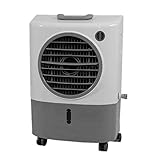
Overview: The Hessaire MC18M is a portable evaporative air cooler designed for spaces up to 500 sq. ft., leveraging XeL50 cooling media and a 4.8-gallon tank to deliver energy-efficient cooling without refrigerants. Ideal for dry climates, it offers a sustainable alternative to traditional AC. What Makes It Stand Out: Its patented axial propeller extends cool air coverage significantly, while the lightweight ABS resin construction ensures portability and reduced noise (53.4 dB). The high-density XeL50 media maximizes evaporation efficiency, promising up to 50% lower electricity costs versus standard AC units. Value for Money: Priced competitively for its coverage area, it excels in operational savings. The durable build and focus on energy efficiency justify the investment for garage or workshop use, though larger spaces may require supplemental cooling. Strengths and Weaknesses: Strengths: Excellent portability, quiet operation for its class, easy maintenance, and significant energy savings. Weaknesses: Limited effectiveness in high humidity, smaller tank requires refills in continuous use, and lacks advanced features like oscillation or remote control. Bottom Line: A reliable, no-frills cooler for small-to-medium dry environments; ideal for budget-conscious users prioritizing efficiency over smart features.
2. Uthfy Evaporative Air Cooler, 3-IN-1 Swamp Cooler with 5.3 Gallon Water Tank, 6 Ice Packs, Remote, 12H Timer, 120°Oscillation, Portable Cooling Fan with 3 Speeds for Bedroom Home Office Garage

Overview: This versatile 3-in-1 unit (cooler/fan/humidifier) targets bedrooms and offices with 1,800 CFM output, a 5.3-gallon tank, and quiet operation (under 25 dB). It combines evaporative cooling with ice pack compatibility for enhanced chill. What Makes It Stand Out: The inclusion of 6 ice packs, 120° oscillation, remote control, and a 12-hour timer sets it apart. The copper motor ensures longevity and whisper-quiet performance, while dual fan modes (Normal/Natural) adapt to seasonal needs. Value for Money: Excellent for its feature density—remote, oscillation, and ice packs justify a mid-range price. It outperforms basic coolers in comfort customization and energy savings (90% less than AC), though the tank size may disappoint in large spaces. Strengths and Weaknesses: Strengths: Ultra-quiet, versatile 3-in-1 functionality, easy remote operation, and strong mobility (13 lbs, lockable wheels). Weaknesses: Ice packs require freezer space, oscillation range is narrower than competitors, and humidifier function isn’t standalone. Bottom Line: Top pick for home/office use where quiet operation and smart controls matter; best suited for rooms under 400 sq. ft.
3. Uthfy Swamp Cooler Air Conditioner, Evaporative Air Cooler with 5.3 Gallon Water Tank, 4 Ice Box, Remote, 12H Timer, 120°Oscillation, Portable Cooling Fan with 3 Speeds for Bedroom Home Office

Overview: Nearly identical to Product 2 but with 4 ice packs instead of 6, this model emphasizes its Uthfy copper motor for efficiency. It covers similar spaces (bedrooms/offices) with 5.3-gallon capacity and 120° oscillation. What Makes It Stand Out: The copper motor reduces noise and extends lifespan versus standard motors, while the “Natural” fan mode mimics breeze variability. Sleep mode and 25 dB operation enhance bedroom suitability. Value for Money: Slightly better value than Product 2 due to motor optimization, though fewer ice packs are a minor drawback. It competes well against pricier AC alternatives with 90% energy savings but lacks Product 2’s ice capacity. Strengths and Weaknesses: Strengths: Superior motor durability, intuitive touch/remote controls, and exceptional portability (13 lbs, 360° wheels). Weaknesses: Reduced cooling boost (4 vs. 6 ice packs), oscillation limited to horizontal, and tank access could be easier. Bottom Line: A refined choice for longevity-focused users in dry climates; opt for Product 2 if maximum ice-assisted cooling is critical.
4. Hessaire MC37M 3100CFM Evaporative Cooler

Overview: A step up in power, the MC37M covers up to 800 sq. ft. with 3,100 CFM and a 10.3-gallon tank. Designed for workshops or patios, it uses a triple-panel intake system for broader coverage. What Makes It Stand Out: The 80% larger evaporation surface minimizes refill frequency, while polypropylene resin construction ensures durability and quiet operation. Its high-velocity airflow tackles larger semi-enclosed spaces effectively. Value for Money: Justified for commercial/light-industrial use—its robust build and extended runtime offset a higher price. Energy savings remain significant, but it lacks modern conveniences like remotes or oscillation. Strengths and Weaknesses: Strengths: High airflow for large areas, infrequent refills, sturdy outdoor-ready design, and exceptional longevity. Weaknesses: Bulky and heavy (no portability focus), no smart features, and ineffective in humidity. Bottom Line: Best for garages or warehouses needing raw cooling power; skip if you prioritize portability or home comfort features.
5. Uthfy 41" Swamp Cooler, 4800 CFM Evaporative Air Cooler with 10.6 Gallon Water Tank, Portable Outdoor Air Conditioner with 3 Ice Pack, 110° Oscillation, 3 Speed for Garage, Yard, Commercial Use

Overview: A commercial-grade unit covering 1,200 sq. ft., featuring 4,800 CFM output, a 10.6-gallon tank, and auto-fill capability. Built for patios, garages, or event spaces with heavy-duty sheet metal construction. What Makes It Stand Out: Three-side cooling pads, auto-fill hose compatibility, and corrosion-resistant coating make it ideal for rugged use. The copper motor delivers high efficiency, while manual oscillation adjustments suit large areas. Value for Money: Premium pricing aligns with its commercial build and coverage. Auto-fill and 3 ice packs reduce maintenance, offering long-term value for high-usage scenarios despite the steep initial cost. Strengths and Weaknesses: Strengths: Unmatched coverage, robust weather-resistant build, auto-fill convenience, and powerful oscillation. Weaknesses: Heavy (no true portability), mechanical controls feel outdated, and auto-fill requires hose access. Bottom Line: The go-to for large/commercial spaces needing relentless cooling; overkill for typical homes but indispensable for workshops or outdoor events.
6. CENSTECH Windowless Portable Air Conditioners w/6Ice Packs, 4Modes&3Speeds, 600Sq.ft Swamp Cooler, Dual Tank for 15H Cooling, 12H Timer, 26Ft Remote, 65°Swing Evaporative Air Cooler for Bedroom Indoor
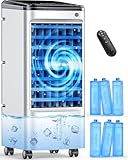
Overview: The CENSTECH portable swamp cooler targets bedrooms and indoor spaces up to 600 sq. ft., leveraging evaporative cooling without window installation. It emphasizes rapid temperature drops and extended runtime through innovative ice-pack integration and dual-water tanks.
What Makes It Stand Out: Its 1-second cooling claim (37–49°F drop) stems from an upgraded motor reducing friction by 75% and airflow boosted by 80%. Six reusable BPA-free ice packs (lasting 10+ hours) and dual 1-gallon tanks enable 15-hour operation. Remote control (26 ft range), 40 dB quiet operation, and no-bend refill design enhance usability.
Value for Money: Priced mid-range, it outperforms basic fans with AC-like cooling at lower energy costs than compressor units. The included ice packs and dual-tank system eliminate frequent refills, justifying the cost for sustained summer use in dry climates.
Strengths and Weaknesses: Strengths: Exceptional runtime (15H), versatile 4 modes/3 speeds, leak-proof ice packs, ultra-quiet. Weaknesses: Cooling efficacy drops in high humidity; large footprint may not suit tiny rooms; ice packs require freezer space.
Bottom Line: Ideal for dry-climate bedrooms seeking extended, customizable cooling without window units. Despite humidity limitations, its innovation and runtime offer compelling value for energy-conscious buyers.
7. SereneLife Portable Swamp Cooler Air Conditioner - 2500 CFM Airflow, 8 Gallon Water Tank Portable Evaporative Air Cooler for Room & Outdoors, WiFi, Humidifier & Fan Modes, Ice Packs & Remote Included

Overview: SereneLife’s 2500 CFM evaporative cooler serves indoor and covered outdoor areas, combining high airflow, WiFi control, and an 8-gallon tank for whole-room cooling without vents or complex setup.
What Makes It Stand Out: Industry-leading 2500 CFM output with 360° oscillation ensures broad coverage. The 8-gallon tank (with safety pump) supports all-day use, while dual ice packs enhance cooling. Unique WiFi/app control, humidifier mode, and casters for mobility set it apart from basic models.
Value for Money: Premium-priced but justified by its capacity (larger rooms/outdoors), smart features, and longevity. Saves significantly on energy versus traditional AC, though the tank size demands space. Outperforms cheaper units in coverage and tech integration.
Strengths and Weaknesses: Strengths: Massive 8-gallon tank, WiFi/app convenience, 3-in-1 functionality, robust outdoor suitability. Weaknesses: Bulky design; 52 dB noise may disrupt sleep; humidity dependency limits effectiveness in muggy areas.
Bottom Line: A top pick for large spaces or patios needing smart, powerful cooling. Best for dry climates—skip if noise sensitivity or humidity is a concern, but excellent for tech-savvy users prioritizing coverage.
8. Uthfy Evaporative Air Cooler with 4 Modes, 3 Speed, 4.2 Gal Water Tank, 32" Swamp Cooler with 4 Ice Packs, 120° Oscillation, Remote, 12 H Timer, Portable Air Conditioner for Large Room, Office

Overview: Uthfy’s 32-inch tower cooler targets large rooms/offices with 1800 CFM airflow, a 4.2-gallon tank, and ice packs for efficient evaporative cooling, emphasizing portability and multi-functionality.
What Makes It Stand Out: The 24-hour runtime from its large tank—paired with 4 ice packs and a high-absorption pad—delivers extended cooling. 120° oscillation, 32" height for vertical coverage, and 360° wheels ensure flexible placement. Remote control and 4 modes (including natural wind simulation) enhance user experience.
Value for Money: Mid-tier pricing balances capacity and features. The 24-hour runtime reduces refill frequency, while energy efficiency (vs. AC units) lowers operating costs. Ideal for offices where consistent cooling and mobility matter most.
Strengths and Weaknesses: Strengths: Exceptional runtime, spacious tank visibility, easy mobility, quiet operation. Weaknesses: Cooling intensity lags behind compressor AC; ice packs require freezer prep; oscillation range narrower than competitors.
Bottom Line: A practical, mobile solution for offices or spacious bedrooms. Its endurance and ease of movement make it worthwhile in arid regions, though not for humid environments needing intense cooling.
9. MEPTY 3-IN-1 Evaporative Air Cooler, Cooling Fans that Blow Cold Air with 120° Oscillation, 12H Timer,3 Speeds, Portable Swamp Cooler for Indoor Use, Windowless Portable Air Conditioners

Overview: MEPTY’s tower-style evaporative cooler merges cooling, humidification, and fan functions in a compact unit, targeting year-round indoor climate control with ETL-certified safety and energy efficiency.
What Makes It Stand Out: Its ETL certification and copper motor ensure safety and durability, while 80W low power consumption cuts energy bills. Features like auto-shutoff for low water, 30-second screen-off, and natural wind simulation mode prioritize convenience and eco-friendliness.
Value for Money: Budget-friendly yet robust, it outperforms generic fans with multi-season utility. The copper motor’s longevity offsets the initial cost, making it ideal for cost-conscious households seeking reliable, safe cooling without high electricity drain.
Strengths and Weaknesses: Strengths: Exceptional energy efficiency, certified safety, intuitive controls, space-saving tower design. Weaknesses: Smaller water tank (shorter runtime); no ice packs for extra cooling; oscillation limited to 120°.
Bottom Line: A smart, economical choice for safety-focused users in dry climates. Its eco-design and versatility suit bedrooms or small living areas, though those needing intense cooling should consider higher-capacity models.
10. BLACK+DECKER Desktop Air Cooler, Personal Portable Fan with 3-Speeds, Evaporative Air Cooler with 0.5L Water Tank, Air Cooler Fan for Desk, Home, Office, Bedroom, and more, BDMC10, White/Gray

Overview: BLACK+DECKER’s micro-USB-powered desktop cooler delivers personal evaporative cooling for desks or bedside tables, prioritizing portability and simplicity with a compact 0.5L tank.
What Makes It Stand Out: Ultra-portable (fits in tight spaces) and USB-powered—ideal for laptops or power banks. The 6-color LED nightlight doubles as a water-level indicator, while three speeds cater to subtle personal cooling needs without overwhelming noise.
Value for Money: Affordable and niche-specific. At this price, the included USB cable and dual-function (cooling + nightlight) justify the cost for students or office workers, though not a room-cooling solution. Cheaper than personal AC units.
Strengths and Weaknesses: Strengths: True portability, silent operation (ideal for sleep/desk work), unique nightlight feature, low energy use. Weaknesses: Very limited coverage (personal only); 8-hour runtime requires frequent refills; minimal cooling impact in humidity.
Bottom Line: Perfect for personal micro-climates like desks or nightstands. Skip for room cooling, but excellent for targeted relief where space and power access are constrained. A clever, budget add-on for mild heat.
Why Evaporative Cooling Excels in Spacious Environments
The Natural Physics Behind Moisture-Powered Cooling
Evaporative coolers operate on a simple, energy-efficient principle: as warm air passes through water-saturated pads, evaporation occurs, absorbing heat and lowering the air temperature. This process mimics how sweat cools your skin, making it inherently eco-friendly since it avoids harmful refrigerants. In large rooms, this method shines because it actively humidifies dry air—a double win in arid regions where static electricity and parched throats plague summer days. Unlike AC, which recycles stale indoor air, evaporative systems require open windows or vents, continuously refreshing your space with filtered outdoor air. This constant exchange prevents that “stuffy room” syndrome, keeping expansive areas feeling alive and invigorated.
Climate Compatibility and Performance Boundaries
Not all environments suit evaporative cooling equally. These units thrive best in low-humidity climates (below 60% relative humidity), where dry air rapidly absorbs moisture for maximum cooling. In humid coastal areas, effectiveness diminishes since the air lacks capacity to evaporate additional water. For large rooms in desert states like Arizona or Nevada, however, they can drop temperatures by 15–40°F, outperforming portable AC in both cooling speed and cost. Crucially, they excel in open layouts where traditional AC struggles with uneven temperatures—no more freezing near vents while the far corners bake. Always cross-reference your local average humidity levels before investing; a premium unit won’t compensate for fundamentally unsuitable conditions.
Environmental and Economic Footprint Advantages
Premium evaporative coolers consume up to 75% less electricity than comparable refrigerant-based systems, translating to noticeable savings on utility bills during extended use. Since they rely primarily on a water pump and fan—not energy-intensive compressors—their carbon footprint shrinks significantly. For large commercial or residential spaces running 8+ hours daily, this difference compounds rapidly. Additionally, they require no complex ductwork or permanent installation, eliminating refrigerant leaks that harm ozone layers. While water usage is a consideration (typically 3–5 gallons per hour), it’s often offset by the absence of condenser coils needing regular chemical cleanings. This isn’t just frugal economics; it’s cooling aligned with planetary stewardship.
Critical Features for Large-Room Effectiveness
Sizing Your Unit to Room Dimensions Precisely
Oversizing or undersizing cripples performance in spacious areas. Calculate your room’s cubic footage (length × width × ceiling height), then match it to a cooler’s CFM (cubic feet per minute) rating—aim for 20–40 air changes per hour. For a 400 sq ft room with 9-foot ceilings (3,600 cubic ft), you’d need 1,200–2,400 CFM. Premium models include sizing guides accounting for occupancy, sun exposure, and insulation quality. Never rely solely on square footage claims; a unit rated for “500 sq ft” might falter in a sun-drenched warehouse versus a shaded living room. Smart buyers measure twice and prioritize adjustable airflow settings to fine-tune coverage as conditions change.
Water Reservoir Capacity and Refill Logistics
Large rooms demand coolers that won’t constantly beg for water. Look for tanks holding 10+ gallons to sustain 8–12 hours of runtime—critical for uninterrupted use in offices or open-concept homes. Top-tier designs integrate transparent level indicators and easy-fill ports accessible from multiple angles, avoiding awkward bending during refills. Some feature auto-shutoff when depleted and leak-proof bases to protect hardwood or carpets. For truly hands-off operation, consider models with direct-plumbing options connecting to a faucet, ideal for garages or workshops where manual refills disrupt workflow. Remember: larger tanks add weight, so verify portability features if you’ll move it between zones.
Airflow Engineering for Uniform Temperature Distribution
Weak airflow creates “cool spots” while leaving corners sweltering. Premium units combat this with multi-directional vents, oscillating heads, or dual-fan systems that push air 30+ feet horizontally. Adjustable louvers let you redirect streams toward seating areas or away from sensitive electronics. High-CFM models (2,000+) often include turbo modes for rapid cooldown, then dial back to energy-saving settings once comfortable. Crucially, test noise levels at max output—cheap fans sound like jet engines, but advanced blade designs and insulated housings keep premium units below 50 decibels, blending into background chatter. Without these features, even high-capacity coolers fail to homogenize temperatures across open spaces.
Portability Mechanics for Bulky Units
Don’t assume “portable” means lightweight, especially for large-room models. Verify wheel quality (swivel casters > fixed wheels), handle ergonomics, and overall weight distribution. Premium coolers often use aircraft-grade aluminum frames that resist corrosion yet remain maneuverable when empty. Some include tool-free disassembly for tank removal during transport—a lifesaver when navigating tight hallways. If moving between rooms daily, prioritize units under 50 lbs when empty; for semi-permanent setups, focus on stability over mobility. Remember: full water tanks add 80+ lbs, so never lift alone. The best designs balance sturdiness with thoughtful mobility aids like recessed handles.
Noise Management in Shared Living Spaces
Nothing ruins relaxation like a drone rivaling a subway train. Premium evaporative coolers tackle noise through brushless DC motors, vibration-dampening mounts, and aerodynamically sculpted fan blades. Look for “sleep mode” settings dipping below 40 dB—quieter than a whisper. In large rooms, sound carries farther, making low-noise operation non-negotiable for bedrooms or home offices. Higher-end models also isolate the pump from the fan housing, eliminating that high-pitched whine common in budget units. Always check decibel ratings at multiple speeds; some claim “quiet” operation but only at minimal airflow. Your sanity (and neighbors) will thank you.
Smart Technology and User Experience Upgrades
Intelligent Climate Control and Automation
Gone are the days of manual dials. Premium units integrate smart thermostats that maintain precise temperatures by adjusting fan speed and water flow in real time. Wi-Fi connectivity allows scheduling via smartphone apps—imagine turning on your cooler while commuting home—or voice commands through Alexa/Google Assistant. Advanced sensors detect humidity spikes (like after cooking) and auto-adjust to prevent muggy air. For large spaces, geofencing ensures the unit powers down when you leave, avoiding wasted energy. These aren’t gimmicks; they’re precision tools that maximize comfort while minimizing guesswork and electricity use.
Energy-Saving Innovations Beyond Basic Operation
Look for inverters that modulate motor speed to match cooling demand, slashing power consumption by 30% versus on/off cycling. Some premium models harvest condensation to pre-cool intake air, while others use solar-compatible DC inputs for off-grid setups. Timer functions with memory recall prevent accidental all-night runs, and eco-modes optimize water evaporation efficiency. In commercial settings, these features compound into substantial operational savings. Crucially, verify ENERGY STAR® certifications—they validate rigorous efficiency testing beyond manufacturer claims. With energy costs rising, these aren’t luxuries but necessities for cost-conscious cooling.
Advanced Filtration for Healthier Air Quality
Large rooms accumulate more dust, pollen, and pollutants, making filtration critical. Premium evaporative coolers often pair cellulose or aspen pads with pre-filters capturing larger debris and antimicrobial treatments inhibiting mold in the water tank. Some add HEPA-grade secondary filters for allergy sufferers, though this slightly reduces airflow. Unlike AC filters that get forgotten, evaporative pads self-clean during operation as water flushes particles away—but still require seasonal replacement. For pet owners or urban dwellers, multi-stage filtration transforms these units into air purifiers, removing odors and particulates while cooling. Breathe easy knowing your comfort isn’t compromising health.
Customizable Cooling Profiles and Modes
One-size-fits-all cooling fails in versatile spaces. High-end models offer preset modes like “Desert Breeze” (max airflow, low moisture) for dry heat or “Coastal Comfort” (moderate airflow, higher humidity) in transitional climates. Manual override lets you tweak fan speed and oscillation independently. Some include ionizers that attach negative ions to airborne particles, causing them to fall harmlessly to the floor. For large open areas, a “Party Mode” might boost circulation without drastic temperature drops, keeping energy use in check. These granular controls turn a simple cooler into a tailored climate companion.
Durability Through Material Science
Large-room coolers endure more wear, so premium builds use UV-stabilized ABS plastic resisting cracking under sun exposure, stainless-steel tanks preventing rust, and commercial-grade pads lasting 3–5 seasons. Sealed bearings in fans handle continuous operation, while powder-coated exteriors fend off scratches during moves. Check warranty terms—reputable brands cover motors and pumps for 3+ years, signaling confidence in longevity. Avoid hollow-feeling plastics that vibrate loudly; dense, textured housings absorb operational noise. This isn’t about looks—it’s armor against the rigors of daily use in demanding environments.
Practical Implementation Considerations
Ventilation Requirements for Peak Efficiency
Evaporative cooling demands airflow—seal your space like AC, and performance plummets. For large rooms, calculate 1–2 square feet of open window/vent per 1,000 CFM to exhaust warm, moist air. Position the cooler near an intake vent (like a door) and exhaust opposite to create cross-breeze. In workshops, consider dedicated exhaust fans; in homes, cracked windows suffice. Premium units include airflow direction guides, but improper setup causes stagnant zones. If humidity creeps above 60%, add dehumidifying vents—this isn’t optional, it’s physics. Get ventilation right, and your cooler works harder with less strain.
Water Quality Impact on Maintenance and Output
Hard water clogs pads with mineral scale, reducing cooling and causing musty smells. Premium coolers often include demineralization cartridges or self-cleaning cycles that flush deposits. If your tap water is hard (over 7 grains), use distilled water or install an inline softener—especially critical for large units running constantly. Some models feature drain plugs for easy tank emptying, preventing stagnant water between uses. In dusty areas, pre-filter mesh screens keep debris from gumming up pumps. Treat water care as non-negotiable; it protects your investment and ensures consistent performance.
Seasonal Storage and Off-Season Care
Neglecting winter prep ruins even premium units. Before storing, drain all water, remove and dry pads thoroughly (mold loves damp cellulose), and clean the tank with vinegar solution. Some high-end models have “dry mode” that circulates air to evaporate residual moisture. Store in a dry, temperature-stable place—never leave pads inside where rodents nest. For large commercial units, professional off-season servicing might include lubricating motors and inspecting seals. This ritual extends lifespan dramatically; a well-stored cooler often outlasts AC units twice its price.
Long-Term Value Assessment
Operational Cost Breakdown vs. Alternatives
Run the numbers: a 2,000-CFM evaporative cooler uses ~200 watts versus 1,500+ watts for a comparable AC unit. At $0.15/kWh, that’s $0.03/hour versus $0.23/hour—saving $144 monthly with 8 hours daily use. Factor in no refrigerant refills or duct cleaning, and annual savings exceed $200 even in medium-sized rooms. Premium evaporative models cost $100–$300 more upfront than basic ones, but their efficiency and durability recoup that in 1–2 seasons. For large facilities, these savings fund the unit itself within years. Always calculate based on your actual usage; the math rarely lies.
Durability Metrics Beyond the Warranty Period
Warranties hint at longevity but don’t tell the whole story. Premium coolers use commercial-rated components: motors rated for 20,000+ hours (vs. 5,000 in budget units), stainless-steel fasteners resisting corrosion, and reinforced tank seams. Check user reviews mentioning 5+ year operation—common with top-tier brands. In large-room applications, reduced strain from proper sizing further extends life. Contrast this with AC compressors failing after 7–10 years; evaporative systems have fewer moving parts to break. View it as preventative maintenance: spending more now avoids replacement chaos later.
Resale and Adaptability Value in Evolving Spaces
As needs change—say, converting a garage to a studio—the right cooler moves with you. Premium portable units retain 40–60% resale value due to robust construction, unlike disposable AC units. Modular designs let you swap pads or tanks as technology improves. Some integrate with smart home ecosystems that gain features via firmware updates. This future-proofing matters for large investments; you’re not buying a static appliance but a platform that adapts. In volatile energy markets, its efficiency also becomes increasingly valuable—making it a hedge against rising costs.
Frequently Asked Questions
How much can I realistically expect temperatures to drop in a 500 sq ft room?
You’ll typically see reductions of 15–25°F in dry climates, depending on humidity and unit capacity. Ensure your model matches the room’s cubic footage, not just square footage, for optimal results.
Are evaporative coolers suitable for allergy sufferers in large spaces?
Yes, when equipped with multi-stage filtration—including antimicrobial pads and optional HEPA filters—they trap pollen and dust more effectively than basic AC filters, continuously refreshing air.
Do I need professional installation for a premium portable unit?
No, true portables require zero installation. Just place near a window for ventilation, fill the tank, and plug in—ideal for rentals or temporary setups.
How often should I replace the cooling pads in heavy-use scenarios?
Every 1–2 cooling seasons for large-room models, though hard water or dusty environments may require annual changes. Premium pads often last longer due to denser cellulose blends.
Can these coolers operate effectively with doors closed?
Only if ventilation exists (e.g., cracked windows). Total enclosure prevents exhaust airflow, causing humidity buildup and reduced cooling—always maintain cross-ventilation.
What’s the biggest mistake people make when sizing for large rooms?
Ignoring ceiling height! A 400 sq ft room with 12-foot ceilings needs nearly double the CFM of one with 8-foot ceilings—always calculate cubic footage.
Do premium models work during monsoon season?
Effectiveness drops significantly above 60% humidity, as evaporation slows. Use “fan-only” mode then, or switch to AC; evaporative coolers excel in dry heat, not tropical moisture.
How loud are high-end units at maximum cooling?
Most stay under 55 dB (like moderate rainfall) thanks to insulated housings and advanced fan tech—always verify decibel specs at high speed before buying.
Is hard water really that damaging to evaporative coolers?
Yes, minerals scale buildup on pads and pumps, reducing efficiency and causing odors. Use distilled water or demineralization cartridges in hard-water areas.
Can I leave the cooler running unattended for days?
Only with models featuring auto-shutoff for low water and overheat protection. For extended absences, drain the tank to prevent stagnant water and mold.
See Also
- 10 Premium Portable Evaporative Coolers for RVs (Worth the Investment)
- 10 Premium Industrial Evaporative Coolers for Warehouses (Worth the Investment)
- 10 Premium Whole House Evaporative Coolers for Hot Climates (Worth the Investment)
- 10 Best Budget Portable Evaporative Coolers Under $200 for Dorm Rooms
- How to Master Cooling Efficiency with Evaporative Coolers and Portable AC Combos in Dry Climates