Table of Contents
Summer heatwaves are no longer just uncomfortable—they’re becoming intense, prolonged events that can turn your living space into an unbearable sauna. When central air struggles or isn’t an option, the humble portable air conditioner has undergone a radical transformation. Forget the noisy, inefficient units of the past; today’s smart portable ACs are sophisticated climate control hubs designed for precision, convenience, and seamless integration into your connected home. They anticipate your needs, adapt to changing conditions, and put unprecedented control at your fingertips, making them essential for modern comfort in unpredictable weather.
The evolution from basic cooling to intelligent environmental management means choosing the right unit is about far more than just BTU ratings. In 2026, the most valuable portable air conditioners function as intuitive extensions of your smart home ecosystem, learning your routines, optimizing energy use, and providing relief exactly when and where you need it most. Understanding the critical features that define a truly “smart” portable AC isn’t just helpful—it’s crucial for making an investment that delivers genuine comfort, significant savings, and peace of mind for years to come. Let’s explore what sets the best apart in this rapidly advancing market.
Top 10 Smart Portable Air Conditioners
Detailed Product Reviews
1. DREO Portable Air Conditioners, 8000 BTU ASHRAE (5000 BTU DOE) Smart AC Unit for Bedroom with Drainage-free Cooling, 45dB Quiet, APP/Voice/Remote, Portable AC for Room Indoors, AC318S

Overview: The DREO AC318S is an 8,000 BTU ASHRAE (5,000 BTU SACC) smart portable AC designed for bedrooms up to 200 sq. ft. It emphasizes quiet operation, smart controls, and a unique drainage-free system for hassle-free cooling in moderate humidity.
What Makes It Stand Out: DREO’s patented Noise Isolation System delivers an ultra-quiet 45dB operation, ideal for sleep or work. Its standout feature is the True Drainage-Free System, which automatically evaporates condensation below 90% humidity, eliminating manual draining. The IceCool System boosts airflow coverage up to 14 ft, while app, voice (Alexa/Google/Siri), and remote controls offer versatile climate customization.
Value for Money: Priced competitively for its class, it justifies cost through energy-efficient cooling, the convenience of no-drain operation in most conditions, and robust smart features. It outperforms basic models lacking app integration or advanced humidity handling, though budget units may undercut it slightly.
Strengths and Weaknesses: Strengths: Exceptionally quiet; innovative self-evaporating system; precise smart controls; effective dehumidification. Weaknesses: Drain hose required above 90% humidity; smaller coverage than higher-BTU rivals; app reliability may vary.
Bottom Line: An excellent choice for bedroom cooling where silence and low maintenance are priorities. Its drainage-free tech and smart features deliver strong value for tech-savvy users in average-humidity climates.
2. BLACK+DECKER Smart Portable Air Conditioner, 12,000 BTU for Rooms up to 550 Sq. Ft., Smart Portable AC with Follow Me Remote and Window Kit, BPACT12WT, White

Overview: The BLACK+DECKER BPACT12WT is a 12,000 BTU (8,000 BTU SACC) portable AC targeting large spaces up to 550 sq. ft. It combines cooling, dehumidifying, and fan functions with smart connectivity and a unique “Follow Me” remote.
What Makes It Stand Out: Its standout feature is the Follow Me remote, acting as a mobile thermostat for personalized temperature tracking. The high 12,000 BTU capacity suits larger rooms, while Wi-Fi/app control (iOS/Android) and Alexa/Google Assistant compatibility enable voice and remote management. The included window kit ensures straightforward installation.
Value for Money: Offers solid value for large-room cooling needs. The high BTU rating and smart features justify its price against competitors in this tier, though energy efficiency lags behind inverter models. The Follow Me tech adds niche convenience not widely seen.
Strengths and Weaknesses: Strengths: Powerful cooling for big spaces; innovative Follow Me remote; easy installation; reliable brand support. Weaknesses: Less energy-efficient than inverter models; noise levels (not specified) likely higher than quieter units; app interface may feel basic.
Bottom Line: A top pick for cooling expansive areas like living rooms or open-plan spaces, especially for users valuing the Follow Me remote’s precision. Ideal if raw power trumps ultra-quiet operation.
3. Midea 10,000 BTU ASHRAE (7,100 BTU SACC) Portable Air Conditioner, Smart Control, Cools up to 300 Sq. Ft., with Dehumidifier & Fan mode, Easy- to-use Remote Control & Window Installation Kit Included

Overview: Midea’s 10,000 BTU ASHRAE (7,100 BTU SACC) portable AC targets mid-sized rooms up to 300 sq. ft., featuring smart controls, dehumidification, and user-friendly setup with included installation accessories.
What Makes It Stand Out: The SmartCool branding highlights app-based scheduling and Alexa/Google Assistant voice control for seamless adjustments. Its standout ease-of-use includes a washable air filter for air quality, a 24-hour timer, and tool-free window kit installation (fits 26.5–48" openings). The compact design balances performance and space efficiency.
Value for Money: Excellent value for medium rooms, packing smart features, a reusable filter, and reliable cooling at a mid-range price. It undercuts premium brands while matching their tech, though lower-BTU models cost less for tiny spaces.
Strengths and Weaknesses: Strengths: Intuitive app/voice control; washable filter for cleaner air; simple installation; energy-efficient SACC rating. Weaknesses: Limited to 300 sq. ft.; no standout noise-reduction claims; basic remote lacks “Follow Me” tech.
Bottom Line: A highly recommended, hassle-free solution for apartments or bedrooms under 300 sq. ft., excelling in smart functionality, air quality, and setup simplicity.
4. BLACK+DECKER Smart Portable Air Conditioner,12,000 BTU, for Rooms Up To 550 Sq. Ft., Portable AC with Inverter Compressor & Window Kit, BPACT08NM, White

Overview: This BLACK+DECKER BPACT08NM is an 8,000 BTU SACC portable AC with inverter technology, designed for large rooms up to 550 sq. Ft. It prioritizes energy efficiency alongside smart controls and versatile cooling modes.
What Makes It Stand Out: The inverter compressor is its key differentiator, adjusting speed for consistent temperatures and lower energy use—rare in portable ACs. Wi-Fi/app control (iOS/Android) and voice compatibility (Alexa/Google) enable remote management, while the three-in-one functionality (cool/fan/dry) suits varied needs.
Value for Money: Premium pricing is justified by the inverter tech, which reduces long-term electricity costs significantly. It’s pricier upfront than non-inverter models but offers better ROI for frequent users in hot climates seeking efficiency.
Strengths and Weaknesses: Strengths: Energy-saving inverter compressor; strong cooling for large areas; smart app integration; easy window installation. Weaknesses: Higher initial cost; noise levels unspecified (inverters often quieter but not confirmed); 8,000 BTU SACC less powerful than standard 12K BTU units.
Bottom Line: Best for eco-conscious buyers needing large-room cooling who prioritize energy savings over initial cost. The inverter tech makes it a smart long-term investment despite the premium price.
5. Midea 8,500 BTU ASHRAE (5,000 BTU SACC) Portable Air Conditioner, Smart Control, Cools up to 150 Sq. Ft., with Dehumidifier & Fan mode, Easy- to-use Remote Control & Window Installation Kit Included
Overview: Midea’s compact 8,500 BTU ASHRAE (5,000 BTU SACC) portable AC is engineered for small spaces up to 150 sq. ft., featuring smart controls, dehumidification, and effortless setup with a complete window kit.
What Makes It Stand Out: Tailored for tight spaces like studios or home offices, it offers the same SmartCool app/voice control (Alexa/Google) and washable filter as larger Midea models. Its standout trait is optimized efficiency for small rooms, with a precise 24-hour timer and temperature range (62°F–90°F) ensuring targeted comfort without energy waste.
Value for Money: Outstanding value for compact areas. It matches premium features of costlier units (smart controls, reusable filter) at an entry-level price, avoiding overkill BTU for tiny rooms where bigger models would be inefficient.
Strengths and Weaknesses: Strengths: Perfect sizing for small rooms; energy-efficient operation; user-friendly app/remote; included washable filter. Weaknesses: Too weak for rooms over 150 sq. ft.; lacks advanced noise specs; basic functionality vs. high-end units.
Bottom Line: The ideal smart AC for dorms, small bedrooms, or offices. Its space-appropriate design, smart features, and affordability make it a no-brainer for compact cooling needs.
6. DR.PREPARE 8,000 BTU Portable Air Conditioner with WiFi Enabled, Cooling, Dehumidifier, Fan & Sleep Modes 4-in-1 Portable AC w/Remote Control & 67’’ Window Kit, Cools Up To 350 sq. ft, 1-24H Timers

Overview:
This 8,000 BTU portable AC offers versatile climate control for spaces up to 350 sq. ft., combining cooling, dehumidifying, fan, and sleep modes. Its standout feature is seamless Wi-Fi integration for remote management via a dedicated app, alongside user-friendly physical controls.
What Makes It Stand Out:
The app-based smart control is exceptional, enabling real-time temperature adjustments and scheduling from anywhere—ideal for pre-cooling rooms before arrival. The 4-in-1 functionality (including a potent 46-pint dehumidifier) and near-silent 45dB sleep mode cater to diverse needs. Tool-free installation with an adaptable window kit (25.6–67") and mobility via casters/handles enhance practicality.
Value for Money:
Priced competitively for its feature set, it outperforms basic units with its app ecosystem and robust dehumidification. While not the most powerful, the 350 sq. ft. coverage and energy-efficient operation justify the cost for medium-sized rooms, especially against single-mode alternatives.
Strengths and Weaknesses:
Strengths: Intuitive app control; effective dehumidifier; quiet sleep mode; easy portability/installation; reusable filter.
Weaknesses: Remote requires separate AAA batteries; dehumidifier capacity claims may be optimistic in high humidity; app reliability can vary with Wi-Fi strength.
Bottom Line:
A well-rounded, smart AC ideal for tech-savvy users seeking convenience and multi-season utility. Its seamless remote operation and health-focused filter make it a top choice for bedrooms or offices under 350 sq. ft., despite minor battery dependency.
7. KOVIET 12000 BTU Portable Air Conditioners, 6-IN-1 Wi-Fi Smart AC Unit with APP & Voice & Remote Control, Auto-Evaporation, Quiet Cooling, 24H Timer, Dehumidifier, Fan, Window Kit Included, White

Overview:
This 12,000 BTU (ASHRAE) unit targets rooms up to 300 sq. ft. with a 6-in-1 system (Cool/Dry/Fan/ECO/Sleep/Turbo modes), emphasizing energy efficiency, quiet operation, and smart connectivity through app and voice control.
What Makes It Stand Out:
Auto-evaporation technology drastically reduces manual drainage needs—marketed as cutting it by 50%—while its “quieter than light rainfall” claim (via noise-reducing ducts and compressor) appeals to light sleepers. DOE/ASHRAE certification validates its 30% energy savings over standard units, and Alexa/Google compatibility adds hands-free convenience.
Value for Money:
Though pricier than entry models, its certified efficiency, robust BTU output, and low-maintenance design deliver long-term savings. The inclusion of window kits and multi-mode versatility offers better ROI than comparable units lacking auto-evaporation.
Strengths and Weaknesses:
Strengths: Excellent energy efficiency; minimal drainage; whisper-quiet operation; comprehensive 6-mode system; strong voice/app integration.
Weaknesses: Humidity removal limited to 30–70%; ECO mode may reduce cooling speed; window kit size constraints for non-standard windows.
Bottom Line:
A premium investment for those prioritizing quiet, efficient cooling in small-to-medium spaces. Its auto-evaporation and certified efficiency make it ideal for humid climates, justifying the cost for users tired of frequent draining.
8. Portable Air Conditioners, 16000 BTU Smart Room Air Conditioner with Cooling/Dehumidifier/Fan, auto Oscillation, 24-Hour Timed Remote Control

Overview:
A high-capacity 16,000 BTU portable AC designed for larger spaces, featuring smart timer controls, quiet operation, and essential cooling/dehumidifying functions with safety-focused extras like child lock.
What Makes It Stand Out:
Its standout trait is the powerful 16,000 BTU output, suitable for expansive areas where most portables struggle. The 24-hour programmable timer and auto oscillation enhance convenience, while water-full protection prevents overflow—a practical touch absent in budget models.
Value for Money:
This unit excels in raw cooling power for the price, outperforming smaller BTU competitors in large rooms. However, the lack of Wi-Fi or advanced smart features may disappoint tech users, though the child lock and dehumidifier add family-friendly value.
Strengths and Weaknesses:
Strengths: Exceptional cooling capacity for large rooms; reliable water-full shutoff; very quiet operation; child safety lock; straightforward remote control.
Weaknesses: No app/Wi-Fi connectivity; vague square footage claims (unspecified); dehumidifier capacity not quantified; basic feature set vs. smart rivals.
Bottom Line:
Best for users needing maximum cooling in spacious areas without smart frills. Its simplicity, safety features, and robust performance make it a solid workhorse, though tech enthusiasts should consider connected alternatives.
9. Midea Duo 14,000 BTU(12,000 BTU SACC) High Efficiency Inverter, Quiet Portable Air Conditioner, Cools up to 550 Sq.Ft., Works with Alexa/Google Assistant, Includes Remote Control&Window Kit (Renewed)

Overview:
This renewed model boasts Midea’s innovative dual-hose design and inverter technology, cooling spaces up to 550 sq. ft. with energy efficiency, ultra-quiet operation, and smart app/voice control.
What Makes It Stand Out:
The industry-first dual-hose system prevents hot air backflow, enabling 2x faster cooling than single-hose units. Inverter tech delivers 40%+ energy savings versus federal standards, while 42dB operation rivals library silence. Wi-Fi/voice control and SACC-rated efficiency (12,000 BTU) add modern appeal.
Value for Money:
As a renewed unit, it offers premium features at a discount. The dual-hose efficiency and inverter savings translate to lower electricity bills, making it cost-effective long-term versus conventional portables—especially for large rooms.
Strengths and Weaknesses:
Strengths: Revolutionary dual-hose cooling; exceptional energy savings; whisper-quiet; spacious 550 sq. ft. coverage; Alexa/Google support.
Weaknesses: Renewed status may concern some buyers; higher upfront cost; window kit compatibility limited to standard sliders.
Bottom Line:
A top-tier choice for large spaces seeking efficiency and silence. The dual-hose tech and inverter benefits justify the price, particularly for eco-conscious users prioritizing performance over brand-new packaging.
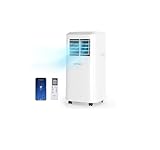
10. ROVSUN WiFi Enabled Smart 8000 BTU Portable Air Conditioner with Remote & APP Control, 3-in-1 Cooler, Dehumidifier & Fan, Powerful Room Mobile AC Unit with Rolling Wheels & Easy Installation Kit
Overview:
This compact 8,000 BTU (5,100 SACC) AC delivers cooling, dehumidifying, and fan functions for rooms up to 300 sq. ft., emphasizing smart control, portability, and hassle-free setup.
What Makes It Stand Out:
Its streamlined Wi-Fi app allows precise remote scheduling and temperature adjustments (60°F–86°F), while 360° casters and side handles ensure effortless mobility. The removable filter and tool-free window installation cater to renters and frequent movers.
Value for Money:
Priced accessibly, it balances smart features with core functionality. Though less powerful than high-BTU models, its SACC-verified cooling (5,100 BTU) and app integration offer better value than non-smart equivalents in its class.
Strengths and Weaknesses:
Strengths: Genuine SACC efficiency rating; intuitive app control; superb portability; simple window kit; reusable filter.
Weaknesses: Limited to two fan speeds; dehumidifier lacks capacity specs; sleep mode less refined than competitors; app occasionally glitchy.
Bottom Line:
An excellent entry-level smart AC for apartments or small rooms. Its mobility, honest SACC rating, and reliable app make it a practical buy for budget-conscious users needing basic climate control.
Why “Smart” Matters in Portable Cooling
Beyond Basic Temperature Control
Modern smart portable air conditioners transcend simple on/off functionality. They leverage connectivity and sensor technology to actively manage your indoor environment based on real-time conditions and your personal preferences. This means automatically adjusting cooling intensity as the sun moves across your room, detecting when you’ve left the house to enter energy-saving mode, or subtly increasing dehumidification during muggy afternoons—all without you lifting a finger. This proactive approach to climate control is the hallmark of true smart functionality.
The Convenience Revolution
The convenience offered by smart features fundamentally changes how you interact with your cooling system. Imagine adjusting the temperature from your office before heading home on a scorching day, receiving maintenance alerts before a minor issue becomes a breakdown, or creating customized cooling schedules that align perfectly with your family’s daily rhythm. Voice commands and intuitive app interfaces eliminate the frustration of hunting for physical remotes or deciphering complex control panels, putting effortless comfort control literally in the palm of your hand.
Integration with Your Existing Smart Home
A truly smart portable AC shouldn’t operate in isolation. The best units seamlessly integrate with popular smart home platforms and voice assistants. This allows for unified control alongside your lights, thermostats, and security systems. Picture routines where your AC powers up as your smart lock detects you arriving home, or where it automatically reduces cooling intensity when your smart blinds close to block intense afternoon sun. This interconnected ecosystem creates a harmonious, responsive living environment.
Key Considerations Before Your Purchase
Assessing Your Specific Cooling Needs
Accurately determining the required cooling capacity (measured in BTUs) is paramount and depends on more than just room size. Factors like ceiling height, number of windows, sun exposure, occupancy levels, and even the heat generated by appliances in the space significantly impact the unit’s effectiveness. An undersized unit will run constantly without adequately cooling, while an oversized one will cycle too frequently, wasting energy and failing to properly dehumidify the air. Taking precise measurements and considering these variables prevents costly mismatches.
Evaluating Room Layout and Venting Feasibility
Portable ACs require a way to expel hot air, typically through a window kit. Your room’s layout is critical: Is there a suitable window nearby? Are there obstacles? How will the exhaust hose routing affect aesthetics and functionality? Measure the distance from your ideal unit placement to the chosen venting point. Also, consider the window type (sliding, double-hung) and ensure the included kit is compatible. Ignoring venting logistics is the most common cause of post-purchase regret.
Understanding Your Electrical Requirements
These units are significant power consumers. Verify the electrical specifications (voltage, amperage, plug type) match the outlet where you plan to install it. Most standard models require a dedicated 115V circuit; larger units might need 230V. Using extension cords or sharing circuits with other high-wattage appliances is a fire hazard and often violates safety certifications. Check your home’s electrical capacity before finalizing your decision to avoid dangerous or impractical setups.
Essential Smart Features to Prioritize
Intuitive Mobile App Control and Customization
The quality of the companion mobile app is non-negotiable. Look for apps that are responsive, visually clear, and offer deep customization. Beyond basic on/off and temperature adjustment, the best apps allow for detailed scheduling (different settings for weekdays vs. weekends), geofencing (using your phone’s location to trigger auto-on/off), energy usage tracking, and firmware update notifications. A clunky or limited app severely diminishes the smart experience.
Advanced Sensor Technology and Automation
Superior units incorporate multiple sensors beyond simple thermostats. Look for models with occupancy sensors (to adjust cooling when the room is empty), humidity sensors (for precise dehumidification control), and even air quality monitors. True intelligence lies in how these sensors feed into automation: automatically switching to “dry mode” during high humidity, reducing fan speed when no one is present, or learning your patterns to suggest optimal schedules without manual programming.
Voice Assistant Compatibility and Routine Integration
Robust compatibility with major voice platforms (like Alexa, Google Assistant, or Siri) is essential. Ensure the unit responds reliably to voice commands for temperature changes, mode switching, and status checks. Even more valuable is the ability to incorporate the AC into broader smart home routines. For example, “Goodnight” could trigger lowering the thermostat, dimming lights, and closing smart shades—your AC should be a seamless part of these automations.
Performance and Cooling Capability Factors
Real-World BTU Output vs. Advertised Ratings
Manufacturer BTU ratings are often measured under ideal laboratory conditions. Real-world performance can be significantly impacted by ambient temperature, humidity levels, venting hose length, and room insulation. Research independent testing data or user reviews that discuss actual cooling performance in typical home environments, especially during extreme heat. Don’t solely rely on the box rating; consider opting for a slightly higher capacity than your basic calculation suggests for challenging conditions.
Dual-Hose Efficiency Advantages
While single-hose units are common, dual-hose models offer a tangible performance benefit. One hose draws in outside air to cool the condenser, while the other exhausts hot air. This prevents the unit from depleting indoor air pressure, which forces cool air out through gaps in the room (like doors), significantly improving overall cooling efficiency and reducing energy waste, particularly in well-sealed spaces.
Effective Dehumidification as a Core Function
High humidity makes heat feel much more oppressive. A capable portable AC must effectively remove moisture from the air, not just lower the temperature. Look for units with strong dehumidification ratings (measured in pints per day) and dedicated “dry” or “dehumidify” modes that prioritize moisture removal over aggressive cooling, which is ideal for milder, humid days. This feature is crucial for true comfort and preventing mustiness.
Energy Efficiency and Operating Costs
Understanding the Importance of CEER Ratings
While older EER (Energy Efficiency Ratio) ratings are still sometimes cited, the newer CEER (Combined Energy Efficiency Ratio) is the standard metric for portable ACs. CEER accounts for energy consumed during standby and off modes, providing a more accurate picture of real-world efficiency. Higher CEER values indicate lower energy consumption for the same cooling output. Prioritize units with the highest CEER rating within your capacity range—it translates directly to lower electricity bills over the unit’s lifespan.
Smart Features That Drive Down Energy Use
The intelligence built into these units is a major energy-saving tool. Features like adaptive start (learning how long the room takes to cool and starting at the optimal time), occupancy detection (reducing cooling when rooms are empty), and precise scheduling prevent the unit from running unnecessarily. Geofencing ensures it’s only cooling when you’re near home. These smart functionalities often deliver greater energy savings than the raw CEER rating alone might suggest.
Long-Term Value vs. Upfront Cost
While a smart portable AC might carry a higher initial price tag than a basic model, the long-term savings from superior energy efficiency and optimized operation can offset this cost significantly over several cooling seasons. Factor in potential electricity savings, reduced wear and tear from intelligent cycling, and the added value of convenience and comfort when evaluating the true investment. It’s about total cost of ownership, not just the purchase price.
Ease of Installation and Portability
Streamlined Window Kit Design and Flexibility
The window installation process can make or break the user experience. Look for kits with universal adapters that fit various window types (sliding, double-hung, casement) and offer adjustable panels to minimize gaps. Magnetic seals, flexible hoses, and clear, illustrated instructions are hallmarks of a user-friendly kit. Avoid units requiring permanent modifications to your window frame; temporary, removable installations are essential for renters and ease of seasonal setup.
Maneuverability and Weight Distribution
True portability means more than just having wheels. Consider the unit’s weight (especially when filled with condensed water), the quality of the casters (swivel locks are vital), and the handle design. Can you easily move it between rooms, up a slight step, or store it in a closet? Units with well-placed, sturdy handles and smooth-rolling, lockable casters make relocation a breeze, while poorly distributed weight can turn a simple move into a chore.
Hose Management and Storage Solutions
The exhaust hose is often cumbersome. Look for units where the hose connects securely and stores neatly on the unit itself when not in use. Features like twist-lock connectors prevent accidental disconnection, and hoses with built-in insulation reduce heat transfer back into the room. Consider how easily the hose can be routed to your window without kinking, which impedes airflow and reduces efficiency.
Noise Levels and User Experience
Decibel Ratings in Realistic Context
Manufacturer noise ratings (in decibels, dB) are usually measured under specific, often ideal, conditions. Pay attention to whether ratings are given for different fan speeds (low/med/high). Real-world noise can be influenced by vibration, the unit’s placement on uneven surfaces, and the sound of the exhaust fan. Seek out user reviews that specifically comment on noise levels during typical operation, especially on lower settings used for sleeping.
Vibration Dampening Technology
Excessive vibration is a major source of noise and can be annoyingly transmitted through floors. Higher-end models incorporate advanced vibration dampening in the compressor and fan assembly, along with sturdy, non-resonant housings. Rubberized feet that grip the floor firmly also help isolate vibration. This technology is crucial for maintaining quiet operation, particularly important for bedrooms or home offices.
Night Mode and Quiet Operation Features
Dedicated “Quiet” or “Night” modes are essential for undisturbed sleep. These modes typically reduce fan speed significantly, prioritize efficient compressor cycling, and may dim or turn off control panel lights. The best implementations lower noise levels by several decibels without sacrificing necessary cooling, creating a much more restful environment during the hottest nights.
Design, Build Quality, and Maintenance
Air Filter Accessibility and Types
Regular filter cleaning is critical for performance and air quality. The filter should be incredibly easy to access—no tools required—and simple to remove, clean, and reinstall. Look for multi-stage filtration (like pre-filters for dust and carbon filters for odors) that effectively captures common allergens. Washable, reusable filters are standard and preferred over disposable ones for cost and environmental reasons.
Water Management Systems
Condensate water management is a key operational aspect. Most units either evaporate the water internally (ideal, requiring no manual emptying) or collect it in a tank that needs periodic draining. Evaporative systems are vastly preferred, but understand their limits—if ambient humidity is extremely high, a tank might still fill. If a tank is present, ensure it’s easy to access, has a clear level indicator, and ideally features an auto-shutoff with a drain port for continuous external drainage via a hose.
Durability of Materials and Construction
Given the weight and moving parts, build quality matters for longevity. Look for robust plastics that don’t feel flimsy, solid metal components in critical areas like the chassis, and well-secured internal components that minimize rattling. Check reviews for mentions of durability over time. A unit that feels substantial and well-assembled is more likely to withstand the rigors of seasonal setup, movement, and continuous operation.
Future-Proofing Your Investment
Firmware Update Capabilities
Technology evolves rapidly. Units designed with future updates in mind will have this capability clearly stated. Regular firmware updates can introduce new features, improve app functionality, enhance sensor accuracy, fix bugs, and ensure compatibility with future smart home platform changes. This extends the useful life of your hardware investment significantly beyond the initial purchase.
Open Platform Compatibility
Choose units that support widely adopted, open communication protocols (like Wi-Fi with common standards, Matter support where applicable) rather than proprietary ecosystems. This reduces the risk of the unit becoming obsolete if a specific smart home platform is discontinued or changes its policies. Open compatibility ensures your AC can integrate with whatever smart home system you adopt in the future.
Long-Term Manufacturer Support
Research the manufacturer’s reputation for long-term customer support and software maintenance. How long do they typically provide app and firmware updates for previous models? Is their customer service responsive? A company known for supporting older hardware gives you greater confidence that your smart AC won’t become a “dumb” brick in a few years due to abandoned software.
Frequently Asked Questions
How much more do smart portable air conditioners cost compared to basic models?
Smart models typically carry a 20-40% premium over comparable basic portable units. This cost reflects the integrated sensors, connectivity hardware, app development, and advanced control systems. However, the potential energy savings from intelligent operation and the significant convenience gains often justify this initial investment over the unit’s lifespan.
Can a smart portable AC effectively cool a large open-plan living area?
Cooling large, open spaces is challenging for any single portable unit due to their localized cooling nature. Success depends heavily on accurate BTU calculation for the entire volume, strategic placement near the heat source or main seating area, and minimizing drafts. For very large areas (e.g., over 500 sq ft), multiple units or a central system might be necessary; a single portable unit, even a smart one, has physical cooling capacity limits.
Is the mobile app essential, or can I rely solely on the physical controls?
While physical controls are usually present for basic operation, the full value of a “smart” AC is unlocked through the mobile app. Features like advanced scheduling, geofencing, energy monitoring, remote control, and firmware updates are typically app-exclusive. The physical panel often lacks the granularity and convenience of the app interface. Relying solely on physical controls negates the primary benefits of the smart functionality.
Do smart features significantly increase energy consumption?
Generally, no. The connectivity components (Wi-Fi module) consume minimal power. Crucially, the intelligence provided by smart features (occupancy sensing, optimized scheduling, adaptive operation) usually leads to net energy savings by preventing unnecessary runtime. The energy used by the smart features themselves is negligible compared to the potential savings from smarter operation.
How reliable are the occupancy sensors in smart portable ACs?
Occupancy sensor reliability varies. Basic motion sensors can miss people who are very still. More advanced units use a combination of PIR (motion) sensors and sometimes temperature/humidity pattern analysis to infer occupancy more accurately. While not perfect, they are generally effective at detecting when a room has been empty for a sustained period (e.g., 15-30 minutes), triggering energy-saving modes. They shouldn’t be relied upon for critical security functions.
Can I install a smart portable AC without a window?
Venting through a window is the standard and most practical method. Alternatives like venting through a dryer duct, drop ceiling, or wall sleeve are possible but often complex, less efficient, potentially unsafe (if not done correctly with proper seals), and may void warranties. There is no truly effective “ventless” portable air conditioner that doesn’t require expelling hot air externally; units claiming this are typically evaporative coolers, which work very differently and have limited effectiveness in humid climates.
Are dual-hose models noticeably quieter than single-hose models?
The number of hoses doesn’t directly dictate noise levels; compressor and fan design are the primary factors. However, dual-hose models often operate more efficiently, potentially allowing them to achieve the same cooling with slightly lower fan speeds in some conditions, which could contribute to marginally quieter operation. Noise differences between specific dual and single-hose models are more dependent on individual engineering than the hose count itself.
How often do I need to clean or replace the air filters?
Washable pre-filters should be inspected and cleaned every 2-4 weeks during heavy use, or whenever visibly dirty. Carbon or other specialty filters may need replacement every 3-6 months, depending on air quality and usage. Regular filter maintenance is non-negotiable for optimal airflow, cooling efficiency, air quality, and preventing frost buildup. Neglecting filters is the leading cause of reduced performance and increased energy use.
Will a smart portable AC work with my existing smart home system (e.g., Google Home, Apple HomeKit)?
Compatibility varies significantly. Before purchasing, verify the specific platform support (e.g., “Works with Google,” “Apple HomeKit Certified,” “Alexa Built-in”) on the product specifications. Not all “smart” ACs work with all platforms. Check for required hubs or specific Wi-Fi standards (e.g., 2.4 GHz only). Don’t assume broad compatibility; confirm it matches your existing ecosystem.
Can I use geofencing if I have poor cellular signal at home?
Geofencing relies on your smartphone’s location services and cellular/data connection to determine when you’re approaching or leaving home. If your phone consistently loses signal right at your property line, geofencing triggers might be delayed. The AC unit itself only needs stable Wi-Fi at home; the phone’s signal strength away from home determines how promptly geofencing activates the unit as you return. Consistent home Wi-Fi is the critical factor for the AC to receive the command.
See Also
- 10 Must-Have Smart Portable Air Conditioners for Home Automation in 2026
- 10 Must-Have Portable Air Conditioners with Dehumidifier for Humid Climates in 2026
- 10 Must-Have Portable Window Air Conditioners for Temporary Cooling in 2026
- 10 Must-Have Quiet Window Air Conditioners for Bedroom Comfort in 2026
- 10 Must-Have Portable Air Conditioners for Hot Climates in 2026