Table of Contents
Working from home should mean comfort and productivity, not constantly battling a sweltering environment or the distracting roar of an outdated window unit. For many dedicated home office professionals, finding the right cooling solution is a non-negotiable element of maintaining focus, professionalism during video calls, and overall well-being. The frustration of inadequate temperature control can derail entire workdays, making the search for a seamless, efficient system critical. Single-zone mini split air conditioners have emerged as the premier solution for this specific challenge, offering targeted comfort without the compromises of alternatives.
Unlike cumbersome window units that block light and views or central air that cools the entire house inefficiently, mini splits deliver precise climate control exactly where you need it. They operate with remarkable quietness, essential for clear conference calls and deep concentration, while providing exceptional energy efficiency by cooling only your workspace. Understanding the key features and considerations for selecting the perfect unit for your home office environment is the first step toward transforming your productivity and comfort. Let’s explore what makes these systems ideal and how to choose the right one for your unique space.
Top 10 Single Zone Mini Split AC Units
Detailed Product Reviews
1. Cooper & Hunter 9,000 BTU 115V Single Zone Wall Mount Ductless Mini Split Air Conditioner & Heat Pump – 21.5 SEER2 – 16FT Installation Kit – R-410A Refrigerant Pre-Charged – Inverter

Overview: This Cooper & Hunter MIA Series mini-split delivers efficient 9,000 BTU cooling and heating for spaces up to 400 sq. ft., like bedrooms or offices. Operating on standard 115V, it features a 21.5 SEER2 rating, pre-charged R-410A refrigerant, and functions as a heat pump down to 5°F. The included 16ft installation kit simplifies professional setup. What Makes It Stand Out: Its key differentiator is compatibility with standard household voltage (115V), eliminating the need for complex electrical upgrades. The included smart kit enables app-based control for scheduling and mode adjustments, while the low-temperature heating capability ensures year-round usability in moderate climates. Pre-charged refrigerant streamlines installation. Value for Money: Priced competitively among 9k BTU 115V units, the comprehensive included kit (lines, drain, wiring) adds significant value versus systems requiring separate purchases. The 21.5 SEER2 rating promises lower operating costs than older, less efficient models, justifying a slight premium over basic alternatives. Strengths and Weaknesses: Strengths: Standard 115V operation; effective heating down to 5°F; quiet inverter technology; smart app control; AHRI-certified performance; complete installation kit. Weaknesses: Requires professional installation (adds cost); 115V limits circuit availability in some setups; SEER2 slightly lower than Olivia Series alternatives. Bottom Line: An excellent choice for homeowners seeking an easy-to-install (electrically), energy-efficient solution for single rooms. Its 115V compatibility and solid heating performance make it highly practical, earning a strong recommendation for smaller residential spaces.
2. Cooper & Hunter Olivia Series, 9,000 BTU, 115V, 23 SEER, Single Zone Mini Split AC/Heating Ductless Inverter System, Including Installation kit

Overview: The 2022-release Cooper & Hunter Olivia Series offers 9,000 BTU cooling/heating in a 115V, single-zone ductless system. Boasting a high 23 SEER rating for superior energy efficiency, it includes a full 16ft installation kit and is pre-charged with refrigerant. Designed for rooms up to 400 sq. ft., it requires professional installation. What Makes It Stand Out: The standout feature is its leading 23 SEER rating, among the highest for 9k BTU 115V models, translating to significant energy savings. As the latest Olivia Series iteration, it benefits from refined inverter technology for quieter operation and precise temperature control compared to older lines like the MIA series. Value for Money: While potentially a premium over lower-SEER units, the exceptional 23 SEER efficiency delivers substantial long-term savings on electricity bills, especially in regions with high cooling demands. The included professional-grade installation kit adds immediate value, offsetting initial costs versus bare-bones systems. Strengths and Weaknesses: Strengths: Industry-leading 23 SEER efficiency; latest 2022 model updates; standard 115V compatibility; complete installation kit; UL/ETL safety certifications; strong U.S. tech support. Weaknesses: Professional installation mandatory (cost not included); freight delivery may incur extra fees; no integrated smart kit/app mentioned in features. Bottom Line: For energy-conscious buyers prioritizing maximum efficiency in a 9k BTU 115V unit, the Olivia Series’ 23 SEER rating makes it a top-tier investment. Highly recommended despite the need for pro install, offering the best operating cost savings in its class.
3. Cooper & Hunter Olivia Series, 6,000 BTU, 115V, 23 SEER2, Single Zone Mini Split AC/Heating Ductless Inverter System, Including Installation kit

Overview: This compact Cooper & Hunter Olivia Series mini-split provides 6,000 BTU cooling and heating for small spaces (up to 250 sq. ft.) like studio apartments, home offices, or garages. Operating on standard 115V, it achieves an impressive 23 SEER2 rating and includes a full 16ft installation kit, while functioning as a heat pump down to -13°F. What Makes It Stand Out: Its exceptional low-temperature heating capability (-13°F) surpasses most competitors, making it ideal for colder climates. The inclusion of a smart port adapter enables smartphone control via the C&H app, offering remote scheduling and adjustments uncommon at this smaller capacity. Whisper Technology ensures near-silent operation. Value for Money: The 23 SEER2 efficiency promises lower running costs than older 6k BTU models. The bundled smart adapter and comprehensive installation kit provide excellent value, eliminating the need for costly add-ons. It’s competitively priced for a high-efficiency, cold-climate-capable ultra-compact unit. Strengths and Weaknesses: Strengths: Outstanding -13°F heating performance; very high 23 SEER2 efficiency; quiet Whisper Tech; smartphone control via included adapter; complete kit; AHRI/UL certified. Weaknesses: 6k BTU limited to very small areas; professional installation required; freight delivery logistics. Bottom Line: An exceptional choice for efficiently heating and cooling small, well-insulated spaces even in frigid conditions. The smart features and top-tier efficiency justify its price, making it the premier recommendation for compact room climate control needing serious heating power.
4. Cooper & Hunter 9,000 BTU 230V Single Zone Wall Mount Ductless Mini Split Air Conditioner & Heat Pump – 21.2 SEER2 – 16FT Installation Kit – Refrigerant Pre-Charged – Inverter

Overview: This Cooper & Hunter MIA Series unit delivers 9,000 BTU cooling and heating using 230V power, suitable for spaces around 400 sq. ft. Featuring a 21.2 SEER2 rating, pre-charged refrigerant, and operation down to 5°F, it includes a full 16ft installation kit and emphasizes quiet performance for bedrooms or offices. What Makes It Stand Out: The integrated smart kit enables robust remote control via smartphone app (on/off, temp, modes, fan speed), a significant convenience feature. While 230V is less common in standard outlets, it’s often preferred for dedicated circuits in workshops or renovations, offering stable power for continuous operation. Value for Money: Positioned as a mid-range option, its value lies in the included smart functionality and comprehensive installation kit. The 21.2 SEER2 is solid but not class-leading; it offers good efficiency at a potentially lower upfront cost than the highest-SEER 115V Olivia models, especially where 230V is readily available. Strengths and Weaknesses: Strengths: Full-featured smart app control included; reliable 230V operation; quiet Whisper Technology; effective down to 5°F; complete installation kit; UL/AHRI certified. Weaknesses: Requires 230V circuit (less common in homes than 115V); SEER2 slightly lower than Olivia Series; professional installation mandatory; freight delivery. Bottom Line: A practical solution for spaces with existing 230V circuits, particularly where the included smart features are valued. Recommended for garages, workshops, or dedicated home circuits, though the Olivia Series may be preferable for standard outlets due to higher efficiency.
5. Cooper & Hunter Olivia Series, 24,000 BTU, 230V, 21 SEER2, Single Zone Mini Split AC/Heating Ductless Inverter System, Including Installation Kit & Smart Kit
Overview: This powerful Cooper & Hunter Olivia Series system delivers 24,000 BTU (2-ton) cooling and heating, designed for large areas (1,000-1,500 sq. ft.) like open-plan living spaces, garages, or commercial zones. Operating on 230V with a 21 SEER2 rating, it functions as a heat pump down to -13°F and includes a smart kit and full installation components. What Makes It Stand Out: Its massive 24k BTU capacity and exceptional -13°F heating capability make it ideal for challenging, large, or poorly insulated spaces. The inclusion of a smart kit enables full remote control via smartphone, crucial for managing such a powerful unit efficiently across expansive areas. Value for Money: While the initial cost is higher due to capacity, the 21 SEER2 efficiency and inclusion of the smart kit and full installation kit provide strong value. It avoids the expense of multiple smaller units for large spaces, and the cold-climate heating reduces reliance on auxiliary heat sources, lowering operational costs. Strengths and Weaknesses: Strengths: High-capacity 24k BTU output; excellent -13°F heating performance; smart app control included; suitable for large/commercial spaces; complete professional installation kit; AHRI certified. Weaknesses: Requires 230V circuit; significant professional installation cost; freight delivery only; higher energy draw during peak cooling/heating. Bottom Line: An essential solution for effectively climate-controlling large or demanding spaces year-round. Its power, cold-weather capability, and smart features justify the investment, making it a top recommendation for substantial residential additions or commercial applications needing robust, single-zone HVAC.
6. COSTWAY 12000BTU Mini Split Air Conditioner& Heater, 20 SEER2 115V Wall-Mounted Ductless AC Unit Cools Rooms up to 750 Sq. Ft, Energy Efficient Inverter AC with Heat Pump (Blast Series)

Overview: The COSTWAY 12000BTU Mini Split offers year-round climate control for spaces up to 750 sq. ft., featuring AHRI-certified inverter technology for efficient cooling and heating. Designed for single-room use, it operates on standard 115V power, making it suitable for typical North American households without complex electrical upgrades. What Makes It Stand Out: Its 20 SEER2 rating and inverter-driven compressor significantly cut energy use by avoiding frequent on/off cycles. The 5-mode operation (auto, cool, dry, heat, fan), self-cleaning function at 134.6°F, and robust warranty (5 years parts, 8 years compressor) provide exceptional value. The quiet operation and sleep-friendly remote display enhance usability. Value for Money: Priced competitively for its class, it undercuts premium brands while delivering comparable efficiency and dual-season functionality. The inclusion of a heat pump for winter use and strong warranty justify the cost, though professional installation (required) adds to the total investment. Strengths and Weaknesses: Strengths: Energy-efficient 115V operation; comprehensive warranty; self-cleaning and auto-defrost features; quiet performance. Weaknesses: Single-zone only; requires licensed HVAC installer; remote lacks smart/Wi-Fi connectivity; no explicit refrigerant type mentioned. Bottom Line: An excellent budget-friendly choice for single-room heating and cooling, especially where 115V compatibility is essential. Its strong warranty and energy savings make it a practical, reliable solution for cost-conscious homeowners seeking year-round comfort without smart features.
7. Smart 4 Zone Mini Split AC/Heat Pump System, 35000 BTU Ductless, Wifi App/Alexa Control, 19 SEER2, 208–230v, 9000+12000+12000+12000 BTU, Pre-Charged Outdoor Condenser, Remote Included
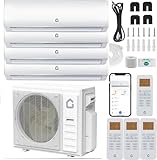
Overview: This COSTWAY 4-zone system delivers targeted climate control across four distinct areas (totaling 35,000 BTU), ideal for multi-room homes or offices. It includes one outdoor condenser and four indoor units (9k + three 12k BTU), operating on 208-230V power with ETL/AHRI certification for reliability. What Makes It Stand Out: True multi-zone independence is its hallmark, allowing customized temperatures per room. Smart integration via Wi-Fi app and Alexa/Google Assistant, coupled with extreme-weather operation (-13°F to 131°F), sets it apart. Pre-charged lines simplify installation, and features like iFEEL mode and self-diagnosis add convenience. Value for Money: While the upfront cost is higher than single-zone units, controlling four spaces with one system offers significant long-term savings on energy and installation. The smart controls and durability justify the investment for larger properties, though 208-230V requirements may necessitate electrical upgrades. Strengths and Weaknesses: Strengths: True 4-zone flexibility; robust smart home integration; exceptional cold-weather heating; pre-charged for easier setup. Weaknesses: Requires 208-230V power; ships in 5 boxes (logistical hassle); no copper line sets included; professional installation mandatory. Bottom Line: The top pick for whole-home ductless comfort in larger residences. Its zoning precision, smart capabilities, and resilience in harsh climates deliver outstanding value for those needing multi-room efficiency and modern control, provided 208-230V power is available.
8. Nexaro 12000BTU Mini Split Air Conditioner Heat Pump, 19 SEER2 Inverter Compressor AC Unit Cools Rooms up to 750 Sq. Ft, 115V Ductless Split AC with Pre-Charged Condenser & Installation Kit

Overview: The Nexaro 12000BTU Mini Split provides efficient heating and cooling for rooms up to 750 sq. ft. using inverter technology and a heat pump, operating on standard 115V power. It includes a pre-charged condenser and basic installation kit, targeting DIY-friendly setups (though professional help is still recommended). What Makes It Stand Out: Eco-conscious R32 refrigerant (lower global warming potential) and built-in mildew protection are key differentiators. Whisper-quiet operation, 5 modes (cool, heat, auto, fan, dry), and versatile features like 24-hour timer, Eco mode, and Turbo Boost cater to comfort-focused users seeking environmental responsibility. Value for Money: Positioned as a mid-range option, it offers solid efficiency (19 SEER2) and eco-friendly refrigerant at a reasonable price. The included installation kit adds tangible value, though warranty terms are less detailed than competitors, potentially affecting long-term cost-effectiveness. Strengths and Weaknesses: Strengths: Environmentally friendly R32 refrigerant; extremely quiet operation; mildew protection; comprehensive mode/fan options; 115V compatibility. Weaknesses: Warranty specifics unclear; no smart/Wi-Fi features; installation kit is basic; lacks explicit AHRI certification mention. Bottom Line: A strong eco-friendly contender for single-room use where quiet operation and lower environmental impact are priorities. Best suited for buyers wanting reliable 115V performance without smart tech, though the ambiguous warranty warrants caution compared to market leaders.
9. Cooper & Hunter 12,000 BTU 115V Black Single Zone Wall Mount Ductless Mini Split Air Conditioner & Heat Pump – 23.2 SEER Inverter – Smart Kit & 16FT Installation Kit – Pre-Charged

Overview: The Cooper & Hunter Olivia Series Midnight Edition is a premium 12,000 BTU single-zone mini-split featuring industry-leading 23.2 SEER2 efficiency and striking black aesthetics. It includes a Smart Kit for app control and a full 16ft installation kit, targeting users seeking high performance and modern design for spaces up to 750 sq. ft. What Makes It Stand Out: Its exceptional 23.2 SEER2 rating ensures maximum energy savings, while the Midnight Edition’s sleek black finish elevates room decor. The included Smart Kit enables smartphone control, and the ultra-quiet inverter operation makes it ideal for bedrooms or offices. Pre-charged design streamlines professional installation. Value for Money: Though priced higher than budget models, its superior efficiency, included Smart Kit, and premium build quality justify the cost through long-term energy savings and enhanced usability. The comprehensive installation kit and US-based support add significant value for a professional-grade system. Strengths and Weaknesses: Strengths: Best-in-class 23.2 SEER2 efficiency; elegant black design; includes Smart Kit and full installation accessories; ultra-quiet; US technical support. Weaknesses: Highest upfront cost; freight shipping only; requires licensed installer; single-zone limitation. Bottom Line: The premium choice for discerning buyers prioritizing efficiency, aesthetics, and smart control. It justifies its price with unmatched energy savings and a refined user experience, making it ideal for primary living spaces where performance and style matter most.
10. ROVSUN 28000 BTU Tri Zone WIFI Mini Split AC/Heating System, 20 SEER2 3 Zone (9K/9K/9K) BTU Ductless Split Air Conditioner with Pre-Charged Condenser, Heat Pump & 25Ft Line Set, 208-230V

Overview: The ROVSUN 28000 BTU Tri Zone system cools or heats three separate rooms (each up to 400 sq. ft.) with identical 9,000 BTU indoor units. Operating on 208-230V, it features 20 SEER2 efficiency, Wi-Fi/app/Alexa control, and pre-charged 25ft line sets, targeting multi-room setups needing smart integration. What Makes It Stand Out: Uniform 9k+9k+9k BTU zoning ensures balanced climate control across similar-sized rooms. Its seamless smart connectivity (app, voice, remote) and capable -4°F heating performance are major advantages. ETL/AHRI certification and energy-saving inverter tech (30% savings claimed) bolster reliability. Value for Money: Offers strong value for tri-zone setups with included smart features and pre-charged lines. The 20 SEER2 rating ensures operational savings, though the 208-230V requirement and need for professional installation (plus extra power cord) increase total cost compared to single-zone units. Strengths and Weaknesses: Strengths: Consistent tri-zone capability; full smart home integration; effective cold-weather heating; 25ft pre-charged lines; ETL/AHRI certified. Weaknesses: Requires 208-230V power; ships in 7 boxes (complex delivery); no copper line sets included; professional install mandatory. Bottom Line: A compelling smart solution for three similarly sized rooms, especially where app/voice control is essential. Its balanced zoning and energy efficiency make it a smart investment for tech-savvy homeowners, provided 208-230V power is accessible and installation logistics are manageable.
Understanding Single-Zone Mini Split Systems
Core Components Explained
A single-zone mini split consists of two primary components: an outdoor condenser/compressor unit and a single indoor air-handling unit. These are connected by a conduit housing refrigerant lines, power cables, and a drain line, requiring only a small three-inch hole through your wall for installation. This design eliminates the need for extensive ductwork, making them ideal for retrofits and dedicated spaces like home offices.
How Inverter Technology Works
Modern units utilize inverter-driven compressors, a significant advancement over older on/off models. Instead of cycling the compressor fully on and off, inverters continuously adjust its speed to maintain the precise desired temperature. This results in smoother temperature control, reduced energy consumption, quieter operation, and less wear and tear on the system components over its lifespan.
Why Single-Zone Fits Home Offices Perfectly
Home offices are typically one distinct, defined space. A single-zone system is engineered to cool or heat exactly one room or zone, matching this requirement precisely. There’s no wasted energy cooling adjacent hallways or unused rooms, maximizing efficiency for your dedicated workspace and avoiding the complexity and cost of multi-zone systems you simply don’t need.
Calculating the Right Cooling Capacity
The Critical Role of BTU Sizing
Selecting a unit with the correct British Thermal Unit (BTU) capacity is arguably the most crucial factor for performance and efficiency. An undersized unit will struggle constantly, failing to cool the space adequately and driving up energy bills. An oversized unit will short-cycle – turning on and off too frequently – leading to poor humidity control, temperature swings, increased wear, and higher energy use. Getting the sizing right is non-negotiable.
Factors Beyond Simple Square Footage
While room size (length x width x height) is the starting point, numerous other elements significantly impact heat load. Consider the number and size of windows (especially south or west-facing), the amount of direct sunlight, the quality of insulation in walls and ceiling, the presence of heat-generating equipment (computers, servers, lighting), and even the number of people typically in the room. A room packed with electronics requires more cooling power than an empty room of the same size.
When to Consult a Professional for Load Calculation
For the most accurate sizing, especially in rooms with complex factors like high ceilings, numerous windows, or significant electronic equipment, a professional Manual J load calculation is highly recommended. HVAC technicians use industry-standard software that accounts for all these variables, ensuring you select a unit perfectly matched to your specific home office’s demands, not just a rough estimate based on square footage.
Prioritizing Quiet Operation for Professionalism
Decibel Levels: What Numbers Mean for You
Indoor unit noise is measured in decibels (dB). For a home office environment, especially one used for frequent video conferencing or tasks requiring deep concentration, aim for indoor units operating at 25 dB or lower on their lowest fan setting. To put this in perspective, 25 dB is comparable to a whisper or rustling leaves – quiet enough not to distract you or be picked up noticeably by your microphone. Higher dB levels become increasingly disruptive.
Fan Speed Settings and Night Mode
Look for units offering multiple fan speed settings, including an ultra-quiet “sleep” or “night” mode. This lowest setting is often essential for maintaining silence during critical calls or focused work periods. Ensure the quietest setting genuinely meets your decibel threshold requirements by checking detailed specifications, not just marketing claims.
Placement Impact on Perceived Noise
Even a quiet unit can seem louder if poorly placed. Avoid installing the indoor air handler directly above or immediately beside your primary desk. Mounting it higher on a wall (following manufacturer clearances) allows sound to dissipate upwards before reaching ear level. Consider the direction of airflow; pointing it away from your immediate workspace can also minimize the perception of noise.
Navigating Installation Considerations
Assessing Wall and Outdoor Unit Placement
Careful planning of both indoor and outdoor unit locations is vital. The indoor unit needs a suitable wall section, typically near the ceiling, with proper clearance above, below, and on the sides as specified by the manufacturer. The outdoor unit requires a level, stable surface (like a concrete pad or wall bracket) with adequate airflow space on all sides, away from direct obstructions like bushes or fences, and consideration for drainage.
Understanding Line Set Length and Complexity
The distance between the indoor and outdoor units affects installation feasibility and cost. Most standard systems support line sets up to 15-25 feet, but some models offer extended capabilities (up to 50+ feet). Longer runs require larger diameter refrigerant lines and potentially additional refrigerant charging, increasing complexity and cost. Minimizing the run distance where possible simplifies installation.
The Non-Negotiable Need for Professional Installation
While the concept seems straightforward, installing a mini split is a complex HVAC task requiring specialized tools, knowledge of refrigerant handling (which often requires EPA certification), electrical work, and vacuuming procedures. Improper installation is the leading cause of system failure, reduced efficiency, and voided warranties. Always hire a qualified, licensed HVAC contractor experienced specifically with mini split systems.
Essential Smart Features for Modern Workspaces
Seamless Integration with Existing Ecosystems
For maximum convenience, prioritize units that integrate smoothly with your current smart home platform (like Apple HomeKit, Google Home, or Amazon Alexa). This allows you to adjust the temperature using voice commands without interrupting your workflow, a small but significant productivity boost during intense focus sessions.
Advanced Scheduling and Remote Control
Robust scheduling features let you program cooling based on your typical work hours, ensuring your office is comfortable when you sit down and conserving energy when you’re away. Remote control via a smartphone app is invaluable for unexpected schedule changes – cool down the space before an important evening call or turn it off if you leave for a meeting.
Air Quality Monitoring and Management
Some advanced models include built-in air quality sensors that monitor particulates or humidity. They can automatically adjust fan speed or integrate with compatible air purifiers. For home offices, where air can become stale with prolonged use, features that promote better indoor air quality contribute significantly to sustained focus and well-being.
Maximizing Energy Efficiency and Cost Savings
Understanding SEER2 Ratings for 2026
By 2026, the updated SEER2 (Seasonal Energy Efficiency Ratio 2) metric will be the standard, reflecting more realistic testing conditions than the older SEER rating. Higher SEER2 numbers indicate greater efficiency. Look for units with SEER2 ratings well above the regional minimum requirements; the energy savings over the system’s lifetime often justify a higher initial investment, especially for a space used daily like a home office.
The Long-Term Value of Inverter Technology
As mentioned earlier, inverter compressors are fundamental to high efficiency. Their ability to modulate output means the system uses only the energy necessary to maintain the set temperature, avoiding the high power surges associated with traditional on/off compressors. This translates directly to lower monthly electricity bills, a critical factor given the extended daily runtime typical for a home office unit.
Utilizing Energy-Saving Modes Effectively
Beyond the core efficiency, leverage built-in features like “Eco” or “Energy Save” modes. These intelligently adjust fan speeds and temperature differentials to minimize energy consumption without drastically sacrificing comfort. Combining these modes with strategic scheduling (e.g., slightly warmer temps when the room is unoccupied for short breaks) compounds your savings.
Maintenance for Peak Performance and Longevity
Simple User-Care Tasks You Must Do
Regular user maintenance is surprisingly straightforward but essential. Clean or replace the indoor air filter every 1-3 months (depending on usage and air quality) – a clogged filter restricts airflow, reduces efficiency, and strains the system. Wipe down the indoor unit’s front panel and gently vacuum the air intake grilles to remove dust buildup. These simple acts significantly impact performance.
Scheduling Professional Tune-Ups
Even with diligent user care, schedule an annual professional maintenance visit. A technician will inspect refrigerant levels, clean the outdoor coil, check electrical components, verify system pressures, and ensure all parts are functioning optimally. This proactive care prevents minor issues from becoming major (and expensive) breakdowns and is crucial for maintaining warranty coverage.
Recognizing Signs of Potential Issues
Be aware of warning signs that warrant a service call: unusual noises (grinding, banging), significant ice buildup on lines or the indoor unit, reduced cooling capacity despite clean filters, or excessive moisture/dripping indoors. Addressing these promptly prevents further damage and ensures your system continues to provide reliable, quiet comfort for your workday.
Design and Aesthetics for Your Workspace
Blending with Home Office Decor
The indoor air handler is a visible element in your workspace. Modern units come in various designs, from sleek, minimalist white panels to models with customizable faceplates or even artistic finishes. Consider how the unit’s size, shape, and color will integrate with your room’s aesthetic – it should complement, not clash with, your professional environment.
Size and Profile Considerations
Units vary in physical dimensions. Measure the intended wall space carefully, considering required clearances. Low-profile designs sit closer to the wall, minimizing visual intrusion. If space is extremely tight or aesthetics are paramount, explore ceiling cassette or ducted concealed models (though these often involve more complex installation), ensuring they still meet your noise requirements.
Discreet Placement Strategies
Strategic placement is key to minimizing visual impact. Mount the unit on a wall opposite your main desk or in a corner slightly out of your direct line of sight. Avoid placing it directly above your workspace where it might be a visual distraction. Sometimes, positioning it near a bookshelf or other existing furniture can help it blend in more naturally.
Climate-Specific Considerations
Handling Humidity in Muggy Environments
If you live in a humid climate, look for models with strong dehumidification capabilities, often indicated by a separate “Dry” mode. Effective humidity control is crucial for comfort; high humidity makes the air feel warmer and can lead to stuffiness and mold concerns, directly impacting your ability to focus in the office.
Performance in Extreme Temperatures
Verify the unit’s operating range, especially the lowest outdoor temperature it can effectively heat (if you need heating) or the highest temperature it can effectively cool. While most handle typical summer heat, extreme heatwaves (over 110°F/43°C) can challenge some units. Ensure the model you select is rated for the temperature extremes common in your specific region.
Sun Exposure and Room Orientation
A home office with large, unshaded south or west-facing windows absorbs significant solar heat gain. This dramatically increases the cooling load. You may need to size up the BTU capacity slightly compared to a north-facing room of the same size, or prioritize units known for strong high-temperature performance. Reflective window film can also be a helpful complementary measure.
Investment and Value Assessment
Understanding the Total Cost Picture
The initial purchase price is just one component. Factor in professional installation costs (which can be substantial), potential electrical upgrades, and the estimated annual operating cost based on the SEER2 rating and your expected usage. A slightly more expensive, higher-efficiency unit often provides a better return on investment through lower energy bills over 10-15 years of use.
Warranty Coverage Depth and Duration
Warranties vary significantly. Pay close attention to the length and coverage of both the compressor warranty (often 7-12 years) and the overall parts/labor warranty (typically 1-5 years). Extended warranty options might be available. A comprehensive warranty provides peace of mind and protects your investment against unforeseen manufacturing defects.
Long-Term Reliability and Resale Value
Research general brand and model reliability trends (focusing on the technology, not specific brands per guidelines). A reliably performing mini split enhances the functionality and desirability of your home office, potentially adding value if you decide to sell your home. It’s an infrastructure improvement that future buyers recognize.
Frequently Asked Questions
What is the most important factor when choosing a mini split for my home office?
The absolute most critical factor is correctly sizing the unit’s cooling capacity (BTUs) for your specific room. An improperly sized unit, whether too small or too large, will perform poorly, cost more to operate, and may not adequately control humidity, directly impacting your comfort and productivity.
How quiet do mini splits actually get for video calls?
Top-tier models designed for quiet operation can run as low as 18-25 decibels (dB) on their lowest fan setting. This is comparable to a whisper or rustling leaves and is generally quiet enough not to interfere with clear audio during professional video conferences when placed appropriately.
Can I install a mini split myself to save money?
Professional installation by a licensed HVAC contractor is strongly recommended and often required to maintain the warranty. The process involves handling refrigerant (requiring EPA certification), electrical work, vacuuming lines, and precise mounting – mistakes can lead to system failure, safety hazards, and voided warranties.
How much does professional installation typically cost?
Installation costs vary widely based on complexity (line set length, accessibility, electrical needs) but generally range from $1,500 to $4,000+ for a standard single-zone system. Obtaining multiple quotes from experienced mini split installers is essential for accurate budgeting.
Will a mini split significantly lower my electricity bill compared to a window unit?
Yes, especially if replacing an older window unit. Modern mini splits with inverter technology and high SEER2 ratings are significantly more energy-efficient. They only use the power needed to maintain temperature, avoiding the constant on/off cycling and lower efficiency of many window units, leading to noticeable savings on cooling costs.
Do I need heating capability in my home office mini split?
This depends entirely on your climate and personal comfort needs. If your home office gets cold during winter months and your central heating doesn’t adequately reach it, or you prefer zoned heating, a heat pump mini split (which provides both heating and cooling) is an excellent, efficient solution. Many models operate effectively down to sub-zero temperatures.
How often does a mini split require maintenance?
Perform basic user maintenance (cleaning/replacing the air filter) every 1-3 months. Additionally, schedule a professional tune-up once a year. This annual service ensures optimal efficiency, prevents problems, and is usually required to keep the warranty valid.
Can a mini split handle a home office with lots of computers and equipment?
Yes, but the heat generated by electronics significantly increases the cooling load. You’ll likely need a higher BTU capacity than a standard room of the same size. When calculating size, factor in the wattage of all equipment running simultaneously to ensure the unit isn’t undersized.
Are mini splits suitable for rooms with high ceilings or unusual layouts?
They can be, but sizing becomes more complex. High ceilings, open lofts, or irregularly shaped rooms require careful consideration of air distribution and potentially higher capacity. Consulting a professional for a detailed load calculation is highly advisable in these scenarios to ensure even cooling.
What lifespan can I expect from a well-maintained home office mini split?
With proper installation, regular user maintenance (filter changes), and annual professional servicing, a quality mini split system typically lasts between 12 to 15 years. Some components, like the outdoor fan motor, may need replacement during this period, but the core system should provide reliable service for well over a decade.
See Also
- 10 Must-Have Single Zone Mini Split AC Units for Quiet Cooling in 2026
- 10 Must-Have Single Zone Mini Split AC Units for Bedroom Comfort in 2026
- 10 Premium Single Zone Mini Split AC Units (Worth the Investment)
- How to Choose the 10 Best Single Zone Mini Split AC Units for Your Bedroom in 2026
- 10 Must-Have Mini Split AC Covers for Year-Round Protection in 2026