Table of Contents
Imagine waking up to a bedroom so chilly it steals your breath, or trying to work from home while your fingers stiffen over the keyboard. As winter tightens its grip, the quest for reliable, efficient warmth becomes urgent—yet traditional heating solutions often fall short, spiking energy bills or leaving stubborn cold spots. Ceramic space heaters have emerged as a game-changer for targeted comfort, blending rapid heat delivery with surprising energy efficiency. Unlike older radiant or oil-filled models, they warm the air itself without glowing elements, making them safer for homes with kids or pets while delivering consistent, draft-free warmth exactly where you need it.
What truly sets modern ceramic heaters apart isn’t just their core technology—it’s how they’ve evolved to fit seamlessly into our lives. Today’s models prioritize intelligent features like precision thermostats that maintain your ideal temperature without constant adjustment, whisper-quiet operation for bedrooms or offices, and even smart home integration for remote control via your phone. As energy costs rise and sustainability matters more, understanding how to choose the right ceramic heater—not just the loudest or cheapest—becomes essential for transforming frigid spaces into cozy sanctuaries without guilt or compromise. Let’s unpack what makes these compact units indispensable for winter comfort and how to select one that perfectly matches your unique needs.
Top 10 Ceramic Space Heaters
Detailed Product Reviews
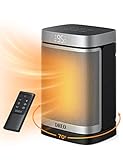
1. DREO Space Heater, 1500W Portable Electric Heaters for Indoor Use, PTC Ceramic Heater for Office with Remote, Thermostat, 70°Oscillation, 12H Timer, 5 Modes, Safe Quiet Room Heater for Bedroom
Overview:
The DREO Space Heater is a premium 1,500W ceramic heater designed for efficient, targeted indoor heating in bedrooms, offices, or small living spaces. Leveraging PTC ceramic technology, it emphasizes rapid warmth, safety, and quiet operation, with smart features like remote control and customizable settings.
What Makes It Stand Out:
DREO’s Hyperamics Technology delivers notably faster heat distribution than standard models, while the 70° oscillation ensures wide coverage. Its standout features include ECO Mode for automated energy savings, a precise 1°F thermostat range (41–95°F), and exceptional quietness at 37.5 dB—ideal for sleep or focus. The ETL-listed Shield360° safety system (tip-over/overheat protection + flame-retardant materials) adds critical peace of mind.
Value for Money:
Priced mid-to-high range, it justifies cost through advanced tech like oscillation, remote control, and energy-efficient ECO Mode—features absent in budget heaters. While pricier than basic models, its durability, safety certifications, and versatility for multiple room types offer solid long-term value.
Strengths and Weaknesses:
Strengths: Ultra-quiet operation; wide oscillation; intuitive thermostat; robust safety suite; remote convenience.
Weaknesses: No explicit room-size specification; premium price may deter budget shoppers; remote requires batteries (not included).
Bottom Line:
A top-tier choice for those prioritizing quiet performance, energy savings, and smart features. Highly recommended for offices or bedrooms where consistent, safe heat and minimal noise are essential, despite its higher upfront cost.
2. Amazon Basics Ceramic Space Heater, Portable Indoor Heating Solution, With Overheat and Tip-Over Protection, Thermostat, Non-Oscillating, 1500W, 7.52"D x 6.34"W x 9.45"H, Silver

Overview:
This compact Amazon Basics heater delivers reliable, no-frills warmth for small spaces like desks or home offices. Its 1,500W ceramic core provides rapid heating with essential safety features, targeting users seeking affordability and simplicity without advanced tech.
What Makes It Stand Out:
Its standout trait is extreme portability (3 lbs, 7.5"L x 6.3"W x 9.5"H) and straightforward operation—three modes (High/Low/Fan Only)—make it ideal for quick spot heating. The non-oscillating design focuses heat directionally, while 43 dB operation ensures moderate quietness for daytime use.
Value for Money:
An exceptional budget option under $30. It outperforms ultra-cheap heaters with solid ceramic heating, tip-over/overheat protection, and a thermostat. Though lacking oscillation or smart modes, it excels as a supplemental heater where basic, safe warmth is the priority.
Strengths and Weaknesses:
Strengths: Ultra-portable; affordable; rapid ceramic heating; essential safety features; low noise for price.
Weaknesses: Non-oscillating limits coverage; no timer/remote; unsuitable for humid areas; thermostat less precise than premium models.
Bottom Line:
Perfect for renters or students needing a dependable, moveable heater for tight budgets. Skip if you require wide coverage or smart features, but ideal for focused warmth in dorms or small offices.
3. Amazon Basics Ceramic Space Heater, Portable Indoor Heating Solution, With Overheat and Tip-Over Protection, Thermostat, Non-Oscillating, 1500W, 7.52"D x 6.34"W x 9.45"H, Black

Overview:
Identical to its silver counterpart but in black, this Amazon Basics heater offers the same no-nonsense ceramic heating for compact spaces. It prioritizes safety and portability, targeting users who prefer minimalist design without premium add-ons.
What Makes It Stand Out:
Its sleek black finish blends discreetly into modern decor—a subtle upgrade over the silver version. Like Product 2, it features rapid ceramic heating, three power settings, and a 43 dB noise profile, making it a versatile desk or bedside companion.
Value for Money:
Priced identically to the silver model, it delivers equal value: unmatched affordability for core functionality. The color choice doesn’t affect performance but adds aesthetic flexibility, maintaining its position as a cost-effective entry point for space heating.
Strengths and Weaknesses:
Strengths: Stylish black finish; identical reliability/safety as silver version; lightweight; budget-friendly.
Weaknesses: Same limitations as silver model—no oscillation, timer, or humidity tolerance; basic thermostat.
Bottom Line:
Choose this over the silver variant purely for aesthetics. It’s equally recommended for those needing a fuss-free, safe, and portable heater for small areas, with no performance trade-offs.
4. GiveBest Portable Electric Space Heater with Thermostat, 1500W/750W Safe and Quiet Ceramic Heater Fan, Heat Up 200 Square Feet for Office Room Desk Indoor Use, Silver

Overview:
The GiveBest heater merges ceramic heating with year-round utility via a 2-in-1 design (1,500W/750W heat + fan mode). Certified for spaces up to 200 sq. ft., it targets home offices or bedrooms seeking versatile, energy-conscious warmth with robust safety.
What Makes It Stand Out:
Its dual functionality (heater + fan) and auto-thermostat cycling distinguish it. The upgraded V0 flame-retardant ABS material and loud-tip-over alert enhance safety, while portability is boosted by a built-in handle. Quiet operation (below conversation levels) suits sleep environments.
Value for Money:
Priced competitively, it offers unique summer-winter versatility and strong safety at a mid-range cost. Though slightly noisier than DREO models, its 200 sq. ft. coverage and auto-shutoff justify the investment for multi-season use in small-to-medium rooms.
Strengths and Weaknesses:
Strengths: 2-in-1 heater/fan; auto-thermostat; loud tip-over alert; portable handle; flame-retardant build.
Weaknesses: Oscillation not mentioned; 43 dB may disturb light sleepers; no remote/timer; limited to dry areas.
Bottom Line:
A smart pick for year-round climate control in compact spaces. Ideal for WFH setups or bedrooms where safety, portability, and dual functionality outweigh desires for smart features.
5. DREO Space Heater, 1500W Electric Heaters for Indoor Use with Thermostat, 70° Oscillation, 8 Safety Protections, 5 Modes, Remote, 12H Timer, Quiet Portable Heater for Office, Bedroom, Large Room

Overview:
This DREO model elevates its predecessor with expanded coverage (270 sq. ft.) and enhanced quietness (34 dB). Targeting larger rooms, it combines 1,500W PTC ceramic heating with 8 safety layers, oscillation, and ECO intelligence for efficient whole-space warming.
What Makes It Stand Out:
Its whisper-quiet 34 dB operation (library-level) and trackball oscillation system—boasting 750,000+ cycles—are unmatched. ETL-certified 8-layer safety (including 24-hour auto-off) and Smart ECO Mode (1,000–1,500W auto-adjustment) optimize energy use while the 70° oscillation boosts coverage by 20%.
Value for Money:
Positioned as a premium heater, it justifies cost through superior coverage, near-silent performance, and rigorous safety. Compared to Product 1, it offers larger room suitability and quieter operation, making it worthwhile for open-plan areas or noise-sensitive users.
Strengths and Weaknesses:
Strengths: Industry-leading quietness; expansive 270 sq. ft. coverage; robust 8-point safety; precise ECO Mode; durable oscillation.
Weaknesses: Requires direct wall plug (no extension cords); remote not included in all bundles; higher price than basics.
Bottom Line:
The definitive choice for large bedrooms or offices demanding silent, even heat and top-tier safety. Worth the premium for those prioritizing performance and peace of mind in spacious environments.
6. Ceramic Space Heater, Portable Indoor Heater with Remote Control, Three Heating Modes, Overheat and Tip-Over Protection, Suitable for Home, Bedroom, and Office Indoor Use

Overview: This ETL-certified ceramic space heater delivers targeted warmth for small to medium rooms using PTC technology. Its core function is efficient, safe spot heating with user-friendly controls, designed for homes, offices, or bedrooms where central heating is impractical or costly.
What Makes It Stand Out: Precise 700W/1000W/1500W power settings offer granular energy control unmatched by simpler models. The smart thermostat automatically maintains set temperatures, while the 1-12 hour timer and included remote (batteries not included) enhance convenience. Comprehensive safety—tip-over shutoff, overheat protection, V0 flame-retardant materials, and a 24-hour auto-off—provides exceptional peace of mind.
Value for Money: Priced competitively, it justifies cost through energy-efficient operation and robust safety certifications. While similar heaters exist, the exact wattage adjustments and thorough safety suite offer better long-term savings and reliability than basic models lacking thermostat intelligence or certified components.
Strengths and Weaknesses: Strengths: Highly adjustable power settings; intelligent thermostat for efficiency; extensive ETL-verified safety features; quiet operation; 12-month warranty. Weaknesses: Remote requires separate batteries; lacks oscillation for wider heat distribution; basic analog controls may feel dated versus digital displays.
Bottom Line: An excellent choice for safety-conscious users seeking precise, efficient heating. Its granular power control, reliable auto-shutoff features, and strong warranty make it a top value for bedrooms or offices, despite minor omissions like oscillation.
7. Space Heater, 1500W Electric Heaters Indoor Portable with Thermostat, PTC Fast Heating Ceramic Room Small Heater with Heating and Fan Modes for Bedroom, Office and Indoor Use
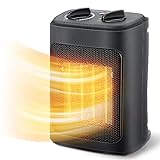
Overview: This compact ceramic heater prioritizes rapid, energy-conscious heating for personal spaces. Using PTC elements paired with a fan, it promises quick warmth while offering flexibility through multiple modes, targeting users wanting to reduce central heating costs in specific rooms.
What Makes It Stand Out: The PTC-fan combo heats spaces notably faster than convection-only units, with even heat distribution. Its standout feature is clear energy-saving potential: three heat settings plus a fan-only mode let users avoid overheating unused spaces, directly cutting electricity bills compared to whole-home heating.
Value for Money: Its affordability shines for budget-focused buyers needing basic, effective supplemental heat. The fan-only mode adds year-round utility, and the focus on energy efficiency delivers tangible long-term savings. However, it lacks a timer or remote, making premium models better for hands-off operation.
Strengths and Weaknesses: Strengths: Very fast heating; effective fan-assisted warmth distribution; simple energy-saving modes; strong safety features (tip-over, overheat); lightweight and portable. Weaknesses: Basic dial thermostat lacks precision; no timer or remote control; analog design feels less modern; limited heat settings versus wattage-specific competitors.
Bottom Line: Ideal for cost-conscious users needing quick, localized warmth without frills. Its speed, energy efficiency, and solid safety make it a practical, budget-friendly pick for desks or small bedrooms, though those wanting automation should look higher up the range.
8. BLACK+DECKER Portable Space Heater, Room Space Heater with Carry Handle for Easy Transport

Overview: BLACK+DECKER’s minimalist heater focuses on portability and essential functionality. This ultra-compact unit (7.3" x 6.3" x 9.2") provides basic spot heating via radiant heat, targeting users needing a no-frills, easily movable solution for desks, offices, or small personal spaces.
What Makes It Stand Out: Its standout feature is exceptional portability—lightweight (2.8 lbs) with an ergonomic handle—making it the easiest to carry between rooms. The inclusion of a fan-only mode adds versatility for warmer months, a rarity in heaters this compact and affordable.
Value for Money: As one of the most budget-friendly options, it offers solid value for simple, localized heating needs. The fan mode extends usability beyond winter, and safety features (tip-over, overheat) are standard. However, it lacks advanced features like thermostats or timers found in similarly priced models.
Strengths and Weaknesses: Strengths: Extremely portable and lightweight; simple fan + two heat settings; intuitive manual dial; reliable safety shutoffs; very quiet operation. Weaknesses: Radiant heat limits room coverage; basic manual thermostat (no auto-maintain); no timer or remote; lower max wattage (1500W) than some competitors’ high settings.
Bottom Line: A superb choice for users prioritizing portability and simplicity above all. Its fan mode, safety, and ease of movement make it perfect for under-desk office use or small personal spaces, though insufficient for larger rooms needing consistent ambient warmth.
9. DREO Quiet Space Heater, 1500W Portable Heaters for Indoor Use with Remote, 70° Oscillation, Fast and Safety Electric PTC Ceramic for Desk Office Bedroom, 12H Timer

Overview: DREO’s heater merges near-silent operation with precision heating, targeting noise-sensitive environments like bedrooms. Utilizing advanced PTC (“Hyperamics”) and oscillation, it delivers wide, even warmth while emphasizing tranquility and safety for families.
What Makes It Stand Out: Its whisper-quiet 34dB operation (thanks to brushless motor tech) is class-leading for undisturbed sleep. The standout precision thermostat allows ±1°F adjustments from 41-95°F, far exceeding competitors’ basic dials. 70° oscillation ensures uniform coverage, while ETL-certified safety (including child-lock) is comprehensive.
Value for Money: Priced mid-to-high, it justifies cost for those valuing silence and precise climate control. The energy savings from accurate temperature maintenance and oscillation efficiency offset the premium. It outperforms similarly priced heaters lacking its noise control or thermostat granularity.
Strengths and Weaknesses: Strengths: Exceptionally quiet; ultra-precise digital thermostat; effective 70° oscillation; robust ETL-certified safety suite (child-lock, V0 material); remote included. Weaknesses: “Hyperamics” marketing may overpromise vs. standard PTC; oscillation range slightly narrow vs. some competitors; remote requires batteries.
Bottom Line: Highly recommended for bedrooms or quiet offices where noise and precise temperature matter most. Its unparalleled quietness, accurate thermostat, and oscillation make it worth the premium for comfort-focused buyers despite minor marketing hyperbole.
10. Space Heater, WINHL 17 Inches Electric Heaters for Indoor Use with Thermostat and Remote, 70°Oscillation, 12H Timer, 5 Modes, 1500W PTC Ceramic Fast Safety Heat for Office Bedroom Home

Overview: WINHL’s larger-format heater (17 inches tall) emphasizes broad oscillation and multi-mode versatility for medium rooms. It combines fast PTC heating with extensive user controls, targeting those needing wide coverage and flexible operation in home or office settings.
What Makes It Stand Out: The 70° oscillation paired with a high-performance fan ensures exceptional heat distribution across larger areas—ideal for rooms where warmth often pools near the unit. Its “5 modes” (including three heat levels, fan-only, and thermostat) offer more flexibility than basic 3-setting competitors.
Value for Money: Competitively priced for its size and oscillation capability, it offers strong value for medium rooms needing even heating. The thermostat’s auto-adjustment saves energy, and ETL certification ensures safety. However, the remote (batteries not included) and oscillation feel essential, not premium.
Strengths and Weaknesses: Strengths: Effective oscillation for room-wide warmth; versatile 5-mode operation; fast PTC heating; comprehensive ETL safety suite (tip-over, overheat, V0 plug); sturdy 6ft cord. Weaknesses: Bulky footprint limits placement; “5 modes” slightly overstated (fan-only + 3 heats + thermostat); analog thermostat less precise than digital rivals.
Bottom Line: A top pick for medium-sized rooms requiring consistent, widespread warmth. Its oscillation and mode variety deliver practical, even heating at a fair price, though space-constrained users may prefer more compact models with similar features.
Understanding Ceramic Heating Technology
How Ceramic Elements Generate Efficient Warmth
Ceramic heaters utilize positively charged ceramic plates that heat up almost instantly when electricity passes through them. As cool air is drawn over these plates by a fan, it absorbs the heat and circulates warmed air into the room. This method avoids the intense, localized heat of radiant coils, distributing warmth more evenly while using less energy to reach your desired temperature. The ceramic material itself acts as a natural insulator, retaining heat efficiently and allowing the unit to cycle on and off intelligently to maintain consistent conditions.
Why Ceramic Outperforms Other Heating Methods
Compared to oil-filled radiators that take ages to warm up or fan heaters that blast noisy, dry air, ceramic units strike an ideal balance. They heat up faster than oil-based systems and distribute warmth more uniformly than radiant heaters, which only warm objects in their direct path. Crucially, ceramic elements don’t get red-hot, significantly reducing fire risks near curtains or furniture. This combination of speed, safety, and balanced output makes them uniquely suited for quick-response heating in frequently used living spaces.
The Energy Efficiency Advantage
Modern ceramic heaters convert nearly all consumed electricity into usable heat, with minimal waste. Advanced models incorporate eco-modes that automatically reduce power once the target temperature is reached, potentially lowering operational costs by 20-30% compared to older portable heaters. Pair this with zone heating—warming only occupied rooms instead of the whole house—and you can achieve substantial savings on your primary heating bill while enjoying personalized comfort.
Critical Safety Features to Prioritize
Essential Overheat Protection Mechanisms
Look for units with dual-layer thermal cutoff systems: a primary thermostat that regulates normal operation and a secondary fail-safe fuse that instantly kills power if internal components exceed safe temperatures. This redundancy is non-negotiable, especially for unattended operation. High-quality models undergo rigorous stress testing to ensure these systems activate reliably even with blocked vents or dust buildup.
Why Tip-Over Switches Are Non-Negotiable
A functional tip-over switch immediately cuts power if the heater tilts more than 15-30 degrees—critical for homes with pets, children, or uneven floors. Verify that the switch resets automatically when upright; some budget models require manual intervention, creating安全隐患 if forgotten. This feature alone prevents countless household fires annually and should never be compromised.
Cool-to-Touch Exteriors for Family Safety
The entire housing, especially front and side grilles, should remain below 60°C (140°F) during operation—a safe threshold to prevent serious burns on brief contact. Test this by checking product certifications; units meeting UL 1278 or ETL standards undergo strict surface temperature evaluations. This is vital for placing heaters near play areas or in high-traffic zones without constant supervision.
Smart Features That Enhance Daily Comfort
Precision Thermostats vs. Basic Heat Settings
Skip heaters with only “high/low” settings. True thermostatic control lets you set an exact temperature (e.g., 21°C/70°F), with the unit automatically modulating power to maintain it. This prevents the uncomfortable cycling of overheating then cooling common in non-thermostatic models and optimizes energy use—no more waking to a sweltering room or returning to a chilly one.
Noise Reduction Technologies for Quiet Operation
Advanced brushless DC motors and aerodynamic fan designs can reduce operational noise to 35-45 decibels—quieter than a whisper. Look for “sleep mode” settings that further slow fan speed at night. This is crucial for bedrooms, nurseries, or home offices where disruptive humming would undermine the heater’s comfort benefits.
Smart Connectivity and Automation
Wi-Fi or Bluetooth capabilities allow scheduling warmth before you wake or arrive home, voice control via smart assistants, and real-time energy monitoring through apps. Some systems even learn your patterns to suggest efficiency improvements. While not essential, these features transform a simple heater into an integrated part of your home’s comfort ecosystem.
Matching Heater Capacity to Your Space
Calculating the Right Wattage for Your Room
A general rule is 10 watts per square foot of space, but adjust for insulation quality and ceiling height. For a standard 150 sq ft bedroom with average insulation, a 1,500W model suffices. Larger or drafty rooms (like sunrooms) may need 2,000W+, while small offices could use 750W-1,000W. Underpowered units will run constantly without warming the space, negating efficiency benefits.
Airflow Design: Oscillation vs. Directional Focus
Oscillating models (swiveling 60-90 degrees) distribute heat broadly in open areas but lose intensity over distance. Fixed-direction heaters with adjustable louvers concentrate warmth in specific zones—ideal for spot-heating a desk or armchair. Consider your primary use: whole-room circulation versus targeted comfort.
Avoiding Common Sizing Mistakes
Never oversize a heater for “faster warming.” An oversized unit will short-cycle (frequent on/off bursts), causing temperature swings and wear. Conversely, undersized units strain to heat the space, increasing energy use. Measure your room accurately, account for windows and exterior walls, and choose capacity accordingly—comfort hinges on this precision.
Portability and Practical Design Considerations
Weight and Handle Ergonomics
Units under 5 lbs with recessed or rubberized handles make relocation effortless—critical for moving between home office and living room. Avoid top-heavy designs that tip easily when carried. Compact cylindrical shapes often maneuver better through doorways than boxy models.
Cord Management Solutions
Look for wrap-around cord storage compartments and 6-foot cords (minimum) to reduce tripping hazards. Some models include cord clips to secure excess length neatly. A tangled, frayed cord isn’t just annoying; it’s a fire risk that undermines all other safety features.
Storage-Friendly Attributes for Off-Seasons
Slim profiles (under 8 inches deep) slide easily under beds or in closets. Detachable handles and nesting accessories prevent damage during storage. Units with dust-proof grilles maintain performance longevity when packed away for months.
Maximizing Longevity and Performance
Cleaning Protocols to Maintain Efficiency
Dust buildup on ceramic plates and fans insulates components, forcing the heater to work harder. Unplug and vacuum intake/exhaust grilles monthly with a soft brush attachment. Wipe the exterior with a dry microfiber cloth—never use liquids near electrical parts. Annual deep cleaning prevents 15-20% efficiency loss.
Optimal Placement for Airflow and Safety
Position heaters 3 feet from combustibles (furniture, bedding) and on hard, level surfaces—not rugs. Elevate slightly (e.g., on a sturdy stool) to improve air intake if floor-level. Avoid corners where airflow gets restricted; central locations in the room’s path of movement circulate heat most effectively.
Recognizing End-of-Life Warning Signs
Frequent tripping of circuit breakers, unusual burning smells after cleaning, or inconsistent heating indicate internal wear. Ceramic plates degrade over 5-7 years; if the unit runs constantly without warming the room, replacement is safer than repair. Never ignore persistent error codes on digital displays.
Frequently Asked Questions
How do ceramic heaters compare to infrared models for whole-room heating?
Ceramic heaters warm the air directly for even ambient warmth, while infrared heats objects and people in its line of sight. Ceramic is superior for consistent whole-room comfort; infrared excels for spot-heating in garages or patios but creates temperature imbalances indoors.
Can I safely use a ceramic heater overnight while sleeping?
Yes, if it has tip-over protection, overheat shutdown, and a cool-touch exterior—and is placed safely away from bedding. Use thermostatic control set to a moderate temperature (e.g., 18°C/65°F) and avoid high-heat settings for unattended operation.
Do ceramic heaters dry out the air like other electric heaters?
All electric resistance heaters reduce relative humidity as they warm air, but ceramic models typically produce less dryness than fan-forced coil heaters due to more gradual heating. Pair with a humidifier if dry air is a concern.
What’s the ideal thermostat setting to balance comfort and efficiency?
Set it to the lowest comfortable temperature—usually 18-20°C (65-68°F) when active. Lower by 2-3°C at night. Every degree reduction saves ~3% on heating costs without sacrificing perceived warmth.
Are ceramic heaters suitable for bathrooms?
Only if explicitly rated for bathroom use (IPX4 water resistance or higher). Standard models risk electrocution near sinks/showers. Always plug into a GFCI outlet if used in moisture-prone areas.
How much does it cost to run a ceramic heater daily?
At 1,500W running 8 hours/day with electricity at $0.15/kWh, expect ~$1.80 daily. Using eco-mode or lower settings can reduce this by 25-40%. Always compare to your central heating’s cost per BTU for true savings.
Can ceramic heaters work in extremely cold environments below freezing?
Most struggle below 0°C (32°F) as fan motors thicken and efficiency drops. For unheated spaces like workshops, choose “cold climate” models rated for sub-zero operation with enclosed heating elements.
Why does my ceramic heater cycle on and off frequently?
This is normal thermostatic operation—signaling it’s maintaining your set temperature. Excessive cycling may indicate an oversized unit, poor placement near drafts, or a faulty thermostat needing calibration.
Do ceramic heaters emit harmful electromagnetic fields (EMFs)?
All electronics emit low-level EMFs, but quality ceramic heaters produce well below international safety limits (ICNIRP). No credible evidence links them to health risks at typical usage distances (3+ feet).
How do I prevent my ceramic heater from tripping the circuit breaker?
Avoid sharing circuits with high-wattage appliances (e.g., microwaves). Use a dedicated 15-amp circuit for 1,500W heaters. If tripping persists, consult an electrician—older wiring may need upgrading.
See Also
- 10 Must-Have Ceramic Space Heaters for Fast Heating in 2026
- 10 Must-Have Electric Fan Heaters for Winter Comfort in 2026
- The 10 Ultimate Best Indoor Ceramic Heaters for Winter Comfort in 2026
- 10 Must-Have Desktop Ceramic Heaters for Home Offices in 2026
- 10 Must-Have Portable Garage Heaters for Winter Vehicle Maintenance in 2026