Table of Contents
Dorm life thrives on a delicate balance: maximizing comfort within incredibly tight quarters while navigating strict rules, limited budgets, and the constant quest for quiet focus. When temperatures rise, a reliable cooling solution isn’t a luxury—it’s essential for surviving late-night study sessions, getting restful sleep, and maintaining sanity in a shoebox-sized room. Forget bulky box fans that dominate precious floor space or noisy oscillating models that disrupt concentration; the sleek, space-saving tower fan has become the unsung hero of the modern dorm. But with evolving technology and dorm-specific challenges, choosing the right one requires more than just grabbing the cheapest option off the shelf.
Navigating the sea of tower fan options in 2026 demands a strategic approach tailored to the unique dorm environment. You need a unit that’s whisper-quiet for library-like silence during exams, energy-efficient to avoid tripping circuit breakers (and campus wrath), and compact enough to fit beside your lofted bed without sacrificing your entire walkway. It must also be durable enough to withstand constant moving between semesters and intuitive enough that you won’t fumble for controls at 2 AM. This guide cuts through the marketing noise, focusing squarely on the critical features, emerging tech trends, and practical considerations that truly matter when selecting a tower fan designed to elevate your dorm experience without breaking the bank or the rules.
Top 10 Tower Fans for Dorm Rooms
Detailed Product Reviews
1. Dreo Tower Fan for Bedroom, 25ft/s Velocity Quiet Floor Fan, 90° Oscillating Fans for Indoors with 4 Speeds, 4 Modes, 8H Timer, Standing Fans, Bladeless Fan, White (DR-HTF007)

Overview: This 36-inch Dreo bladeless tower fan delivers targeted cooling for bedrooms or living spaces, combining quiet operation with versatile airflow control through intuitive touch or remote operation. Its compact design suits modern interiors while prioritizing user safety.
What Makes It Stand Out: The standout feature is its algorithmic impeller design leveraging the Coanda effect, enabling whisper-quiet performance (especially in Sleep Mode with auto-mute) alongside robust 25ft/s airflow. The removable rear grille simplifies maintenance, while ETL certification and pinch-proof grilles underscore safety—a rarity in budget towers.
Value for Money: Priced mid-range, it outperforms cheaper oscillating fans with its 4 modes (including Auto), 8-hour timer, and superior noise control. It justifies cost by replacing multiple seasonal appliances and reducing AC dependency, though premium alternatives offer longer timers.
Strengths and Weaknesses:
Strengths: Effective 90° oscillation coverage; easy cleaning; exceptional quietness in sleep mode; reliable safety features; seamless AC pairing.
Weaknesses: Only 4 speed settings (less granularity than competitors); display lacks backlighting; timer maxes at 8 hours.
Bottom Line: An excellent all-rounder for sleep-focused buyers seeking quiet, safe, and adaptable cooling—ideal for bedrooms where noise sensitivity matters most.
2. Amazon Basics 28" 60-Degree Oscillating Tower Fan for Bedroom, Living Room, Office, With 3 Speeds, Intuitive Mechanical Control, Black, 35W, 27.8"H x 9.4"D x 9.4"W

Overview: This no-frills 28-inch tower fan offers straightforward cooling for offices or small bedrooms, emphasizing mechanical simplicity over smart features. Its compact footprint and plug-and-play operation cater to users prioritizing reliability over customization.
What Makes It Stand Out: Mechanical dials for speed and oscillation eliminate digital complexity, appealing to users who dislike remotes or touchscreens. The 60° oscillation and 35W efficiency provide consistent airflow for enclosed spaces, though it lacks advanced modes or timers found in pricier models.
Value for Money: As a budget entry, it excels for basic cooling needs at a fraction of smart-fan costs. However, its limited functionality (only 3 speeds, no timer) reduces long-term value for tech-savvy users, making it best for temporary or secondary spaces.
Strengths and Weaknesses:
Strengths: Ultra-simple mechanical controls; space-saving dimensions; reliable year-round airflow; sturdy build for the price.
Weaknesses: No remote or timer; basic 60° oscillation (less coverage); louder operation than bladeless competitors; no sleep/auto modes.
Bottom Line: A functional, affordable workhorse for undemanding environments—but skip if you need quiet operation, timers, or nuanced comfort settings.
3. LEVOIT Tower Fan for Bedroom, 25ft/s Velocity Standing Fan with 28dB Quiet for Sleep, Remoter, 12H Timer, 5 Speeds, 4 Modes, 90° Oscillation for Home, Office, Indoor, Bladeless 36 inch, White

Overview: LEVOIT’s 36-inch bladeless fan targets sleepers and tech enthusiasts with sensor-driven cooling, merging high airflow (25ft/s) with near-silent 28dB operation. Its temperature-responsive modes and extended timer cater to hands-off climate control.
What Makes It Stand Out: The temperature sensor dynamically adjusts airflow—a rarity in this segment—while the 12-hour timer surpasses competitors’ 8-hour limits. The 1062 CFM airflow and curtain-like coverage from 90° oscillation make it potent for large rooms, enhanced by a natural-wind simulation mode.
Value for Money: Priced competitively, it offers premium features (5 speeds, Turbo mode, extended timer) absent in similarly priced rivals. The sensor tech justifies a slight premium over entry models, though budget buyers may find it over-specified for small spaces.
Strengths and Weaknesses:
Strengths: Intelligent temperature adaptation; industry-leading 12H timer; powerful airflow coverage; ultra-quiet sleep mode; 5-speed precision.
Weaknesses: No DC motor (less energy-efficient); remote design feels flimsy; lacks bladeless safety certifications of Dreo.
Bottom Line: The top choice for large rooms or tech-forward users wanting automated comfort—especially valuable for hot climates requiring extended runtime.
4. Dreo Tower Fan for Bedroom, 2026 Upgraded DC Motor, 28ft/s High Velocity, 20dB Ultra Quiet Standing Fan, 8 Speeds 4 Modes, 90° Oscillating Bladeless Fan for Indoors, Floor Fans with Remote, Black

Overview: Dreo’s 2026 flagship features a brushless DC motor pushing airflow to 28ft/s while achieving near-silent 20dB operation—positioning it as a premium solution for noise-sensitive environments like nurseries or home offices.
What Makes It Stand Out: The upgraded DC motor delivers unmatched velocity (28ft/s) and whisper-quiet performance (20dB), beating rivals by 3–8dB. Eight speed tiers and TurboWind technology enable granular control, while ETL safety certifications and tool-free disassembly for cleaning enhance practicality.
Value for Money: It commands a premium but justifies cost through energy efficiency (DC motor), durability, and best-in-class quietness. Outperforms LEVOIT on airflow strength and Amazon Basics on refinement, though budget shoppers may balk at the price.
Strengths and Weaknesses:
Strengths: Record-low 20dB noise; strongest airflow (28ft/s); 8-speed precision; exceptional safety features; energy-efficient DC motor.
Weaknesses: Higher price point; remote not backlit; oscillation range identical to cheaper models.
Bottom Line: The definitive upgrade for audiophiles or light sleepers needing powerful yet silent cooling—worth the investment for critical quiet environments.
5. Dreo Tower Fan for Bedroom, 90° Oscillating Standing Fans for Room with 4 Speeds, 3 Modes, 28dB Quiet for Sleep, 25ft/s Velocity, 8H Timer, Remote, Living Room, Office, Home, Black

Overview: A streamlined Dreo model balancing affordability and functionality, this 36-inch fan delivers reliable 25ft/s airflow with 28dB quiet operation. Its focus on portability and essential features suits renters or secondary spaces.
What Makes It Stand Out: Hypersilent tech ensures bedroom-friendly noise levels, while the 29ft airflow reach outperforms similarly priced fans. The sleek, space-saving profile blends into decor, and 90° oscillation covers wider areas than the Amazon Basics’ 60°—without complex tech.
Value for Money: Positioned as Dreo’s entry-tier, it offers core bladeless benefits (safety, oscillation, remote) at a moderate cost. Beats Amazon Basics in airflow range and noise control but lacks LEVOIT’s sensor tech—ideal for buyers wanting Dreo quality without premium extras.
Strengths and Weaknesses:
Strengths: Excellent noise-to-airflow ratio; highly portable; effortless oscillation control; strong 25ft/s breeze; intuitive remote.
Weaknesses: Only 3 modes (no Auto); basic 8H timer; speed options limited to 4; no DC motor efficiency.
Bottom Line: A smart, no-nonsense pick for compact spaces needing dependable, quiet cooling—perfect for students or offices prioritizing simplicity and portability.
6. Uthfy 31 Inch Tower Fan for Bedroom, 120° Oscillating Quiet Standing Bladeless Fan With Remote, 7.5H Timer, 3 Speeds, 3 Modes, for Room, Dorm, Office, Black

Overview:
The Uthfy 31-inch bladeless tower fan targets bedroom and office cooling with a focus on quiet operation and user convenience. Its bladeless design prioritizes safety and minimal noise, making it suitable for light sleepers in compact spaces like dorms or small rooms.
What Makes It Stand Out:
A standout 120° oscillation range ensures broader air distribution than competitors, while the ultra-quiet 25dB operation rivals high-end models. The hidden handle doubling as remote storage is a clever portability feature, and UL certification adds reliability. The 7.5-hour timer with 30-minute increments offers precise sleep-cycle alignment.
Value for Money:
Priced mid-range, it delivers exceptional value with its comprehensive feature set (3 speeds, 3 modes, remote, timer) typically found in costlier units. The energy-efficient design and durable build justify the investment over basic oscillating fans, especially for frequent nighttime use.
Strengths and Weaknesses:
Strengths: Exceptionally quiet (25dB), wide 120° oscillation, intuitive remote/touch controls, compact space-saving design, and robust safety certifications. Weaknesses: Limited to 3 speed/mode options compared to newer smart fans, and the 26ft/s airflow may feel insufficient for large rooms.
Bottom Line:
Ideal for budget-conscious buyers needing reliable, whisper-quiet cooling in small-to-medium rooms; highly recommended for bedrooms and dorms despite modest airflow power.
7. Comfort Zone 32-Inch Oscillating Tower Fan – Ultra-Slim Bladeless Design with 3 Speeds, 90° Wide Oscillation & Built-in Carry Handle – Quiet Portable Standing Fan for Bedroom, Home, or Office, Black

Overview:
Comfort Zone’s 32-inch tower fan emphasizes safety and space efficiency with its bladeless design and slim profile. Tailored for homes with children or pets, it offers straightforward cooling for bedrooms, offices, or tight living spaces without overwhelming complexity.
What Makes It Stand Out:
The enhanced safety grille provides superior protection against accidental contact, a critical edge for family households. Its ultra-slim tower design fits into narrow corners where bulkier fans fail, and the built-in carry handle enhances portability without sacrificing stability.
Value for Money:
This fan excels as a no-frills, durable solution at an affordable price. While lacking timers or remotes, its industrial-strength airflow and safety focus deliver better value than similarly priced basic models, especially for safety-conscious buyers prioritizing reliability over smart features.
Strengths and Weaknesses:
Strengths: Excellent bladeless safety features, space-saving slim design, sturdy build quality, and strong 90° oscillation coverage. Weaknesses: No remote control, timer, or advanced modes; limited to 3 speeds only; slightly louder than ultra-quiet competitors.
Bottom Line:
A top pick for families needing a safe, compact, and dependable fan; best suited for users prioritizing child/pet safety over smart functionality or absolute silence.
8. Honeywell QuietSet Whole Room Tower Fan-Black, Oscillating Tower Fan with Remote, HYF290B

Overview:
Honeywell’s QuietSet tower fan leverages brand reputation for reliable, energy-efficient cooling in medium-to-large rooms. It focuses on simplicity and whole-room air circulation, targeting users seeking a trusted, no-nonsense solution for homes or offices.
What Makes It Stand Out:
Honeywell’s legacy in air quality ensures robust build quality and fused safety plugs for voltage protection. The remote nests neatly into the housing—a practical touch—and its oscillation effectively circulates air without aggressive noise, aligning with energy-saving goals.
Value for Money:
While moderately priced, it offers solid long-term value through durability and energy efficiency. It lacks modern features like app control or extended timers but outperforms cheaper alternatives in motor longevity and consistent performance, justifying the cost for low-maintenance users.
Strengths and Weaknesses:
Strengths: Trusted Honeywell reliability, quiet operation for its class, easy remote storage, and effective room-wide airflow. Weaknesses: Basic 3-speed control only; no timer, sleep mode, or smart capabilities; remote storage is functional but not innovative.
Bottom Line:
Recommended for buyers prioritizing brand trust and durability over tech features; ideal as a secondary fan in living areas where simplicity and steady performance matter most.
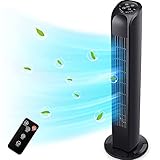
9. Uthfy Oscillating Tower Fan with Remote, Electric Standing Floor Fan for Bedroom Indoor Office and Home Use,Quiet Cooling Portable Bladeless Tower Fans, 30 inchs, Black
Overview:
This 30-inch Uthfy tower fan delivers versatile cooling for bedrooms and offices, emphasizing customizable airflow and user-friendly operation. Its bladeless design combines safety with portability, targeting those needing adaptable comfort in confined spaces.
What Makes It Stand Out:
The “natural wind” mode—mimicking forest-like airflow variability—is a unique comfort feature absent in rivals. ETL certification ensures safety, while the auto-off screen after 30 seconds caters specifically to light-sensitive sleepers, enhancing usability.
Value for Money:
Competitively priced, it offers excellent value with its triple-mode functionality (normal/natural/sleep), 7.5-hour timer, and remote. The focus on sleep-friendly features provides more utility than similarly priced basic models, especially for hot-weather insomniacs.
Strengths and Weaknesses:
Strengths: Innovative natural wind mode, light-sensitive screen-off, ETL safety certification, and compact portability. Weaknesses: 60W power draw is less efficient than newer models; 90° oscillation is narrower than Uthfy’s own 31-inch variant; lacks smart connectivity.
Bottom Line:
A strong choice for sleep-focused buyers wanting customizable airflow; recommended for bedrooms where natural wind simulation and dark-sleep environments are priorities.
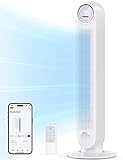
10. Dreo Tower Fan for Bedroom, 25ft/s Smart Standing Fans, 90° Oscillating Floor Fan with 4 Modes, 4 Speeds, 8H Timer, 28dB, Bladeless, Remote, 28 dB, Works with WiFi Voice Control
Overview:
Dreo’s 36-inch smart tower fan merges high-performance cooling with modern connectivity. Designed for tech-savvy users, it offers app control, voice commands, and auto-adjusting airflow, targeting those seeking seamless integration with smart home ecosystems.
What Makes It Stand Out:
WiFi/app integration and voice control (via Alexa/Google) set it apart, while Auto Mode’s temperature-based speed adjustment is genuinely innovative. The 28dB quiet operation, removable grille for easy cleaning, and ETL safety certifications add practical sophistication.
Value for Money:
Priced higher than basic models, it justifies cost through smart features and robust build. The energy-saving Auto Mode and 8-hour timer enhance long-term value, making it cost-effective against frequent AC use—ideal for users invested in smart home tech.
Strengths and Weaknesses:
Strengths: Comprehensive smart controls, Auto Mode intelligence, ultra-quiet 28dB operation, easy-clean design, and 4 versatile modes/speeds. Weaknesses: App dependency may frustrate non-tech users; higher upfront cost; 90° oscillation lags behind Uthfy’s 120°.
Bottom Line:
Highly recommended for smart home enthusiasts wanting automated, customizable cooling; the premium price pays off in convenience and energy savings for connected households.
Understanding Your Dorm Room Constraints
Before diving into fan specs, honestly assess the unique limitations of your campus living space. Dorm rooms are notoriously small, often featuring strict power limitations, shared wall outlets, and minimal floor area. Ignoring these realities can lead to purchasing a fan that’s too large, too power-hungry, or simply incompatible with your room’s layout and regulations. This foundational step ensures your shortlist consists only of fans that can realistically function within your environment.
Measuring Available Space Accurately
Grab a tape measure and map out potential fan locations—beside your desk, under the window, near your bed. Note the exact width, depth, and height clearance required. Remember to account for necessary airflow space behind and around the unit; crowding it against a wall drastically reduces effectiveness. Most dorm-optimized tower fans prioritize a narrow footprint (often under 8 inches wide), but verify dimensions match your specific nooks and crannies.
Navigating Campus Power Restrictions
Many dorms enforce strict wattage limits per room or circuit, sometimes as low as 500-800 watts total for all devices. Exceeding this can trip breakers, causing inconvenience and potential fines. Tower fans are generally efficient, but their wattage varies significantly by speed and features. Prioritize models clearly labeled with low-wattage operation (ideally under 50W on low settings) and always check your dorm’s specific electrical policy before purchasing.
Considering Shared Living Dynamics
Will your roommate have their own cooling device? How sensitive are they to noise or light? Dorm life is communal, so features like ultra-quiet operation on low speeds and completely light-free night modes become non-negotiable for harmony. A fan that disrupts your roommate’s sleep or study time creates more problems than it solves.
Essential Performance Features for Dorm Success
Performance isn’t just about raw airflow; it’s about how effectively and comfortably the fan delivers that air within your confined space. Prioritizing the right blend of airflow control, quietness, and efficiency is key to a fan that genuinely enhances your dorm life rather than becoming an annoyance.
Noise Level Thresholds Explained
This is paramount. Dorms require near-silent operation, especially on the lower speeds used for sleeping or studying. Look for specific decibel (dB) ratings at low, medium, and high settings. Anything below 40 dB on low is ideal for sleep; under 50 dB is generally acceptable for background use. Avoid vague terms like “quiet” – demand actual dB figures in the product specs. Remember, sound perception varies; if possible, seek out genuine user reviews mentioning real-world noise levels.
Airflow Range and Oscillation Benefits
While raw CFM (cubic feet per minute) matters less in a tiny dorm than in a large room, the control over airflow direction and spread is crucial. Effective oscillation (typically 70-90 degrees) ensures cool air reaches your entire space without needing to constantly reposition the fan. Look for adjustable oscillation angles or the ability to lock the head for direct, focused cooling when needed, like at your desk.
Energy Efficiency as a Non-Negotiable
Beyond avoiding circuit trips, energy efficiency saves money on campus utilities (if they’re metered) and aligns with campus sustainability initiatives. Prioritize fans with high Energy Star ratings (if applicable) or explicit low-wattage specifications. Brushless DC (BLDC) motors, increasingly common in 2026, offer significantly better efficiency and quieter operation than older AC motor designs, making them a worthwhile investment.
Safety and Practicality for Student Life
Dorm safety regulations are strict for good reason. Coupled with the realities of student life—frequent moves, potential spills, and tight budgets—safety features and practical usability become critical evaluation points that often get overlooked in favor of flashy specs.
Critical Safety Certifications Demystified
Never compromise here. Ensure the fan carries legitimate safety certifications like ETL, UL, or CSA. These verify the unit meets rigorous electrical and fire safety standards, crucial in densely packed dorm buildings with potentially aging wiring. Avoid any uncertified or obscurely branded fans, no matter how inexpensive; the fire risk isn’t worth it.
Stability and Tip-Over Protection
Dorm life is hectic – a bumped fan can easily topple in a cramped space. A heavy, wide base is essential for stability, especially on uneven dorm floors. Mandatory tip-over switch protection (which instantly shuts off the motor if the fan falls) is non-negotiable for safety and peace of mind. Test the base sturdiness in-store if possible.
Ease of Cleaning and Maintenance
Dorm rooms accumulate dust quickly, and neglected fans become inefficient and potentially smelly. Look for designs with easily removable front grilles and accessible blades that can be wiped clean with a damp cloth. Avoid overly complex disassembly; you won’t have time for intricate cleaning routines. Smooth surfaces that resist dust buildup are a bonus.
Smart Features Worth Considering in 2026
Technology continues to enhance tower fans, but not all “smart” features are equally valuable in a dorm setting. Focus on innovations that genuinely solve dorm-specific problems like noise sensitivity, scheduling needs, or space constraints, rather than gimmicks that drain battery or complicate use.
The Real Value of App and Voice Control
While controlling your fan from bed via smartphone or voice assistant sounds appealing, assess its practical dorm utility. Does your campus Wi-Fi reliably reach your room? Will constant app notifications drain your phone battery? Voice control is excellent for light-sensitive nighttime adjustments but requires compatible smart speakers (another device to manage). Prioritize these features only if they demonstrably solve a specific pain point for you.
Advanced Timer and Scheduling Capabilities
This is where smart features truly shine for students. A precise timer (e.g., 30, 60, 90, 120 minutes) is essential for falling asleep comfortably without running the fan all night, saving energy. More advanced scheduling (e.g., “turn on 15 mins before my 8 AM alarm”) is incredibly useful but ensure it’s intuitive to set up via physical controls or app. Avoid overly complex scheduling interfaces.
Night Mode Evolution Beyond Just Dimming
True dorm-friendly night mode goes beyond dimming the display. Look for modes that combine significantly reduced noise output (often a dedicated ultra-quiet setting), complete elimination of all LED lights (even a tiny standby light can disrupt sleep), and potentially slower, more consistent airflow patterns designed to avoid disruptive gusts during sleep cycles.
Design and User Experience Essentials
In a space that doubles as your bedroom, study zone, and social hub, how the fan looks and feels to interact with matters more than you might think. Prioritize intuitive controls, a design that complements (or at least doesn’t clash with) your dorm aesthetic, and physical attributes that make daily use effortless.
Control Interface Intuitiveness
Fumbling for tiny, poorly labeled buttons in the dark is frustrating. Prioritize fans with clearly differentiated, tactile buttons (not just touch-sensitive panels prone to accidental activation) or a simple, well-lit remote. Physical controls on the unit itself are crucial if you lose the remote or your phone dies. Avoid overly complex digital displays that are hard to read from your bed.
Aesthetic Integration in Compact Spaces
Your fan will be a permanent fixture in your tiny room, so choose a design and color that doesn’t visually overwhelm. Neutral tones (white, black, gray) or subtle finishes often integrate better than bold colors. Consider the overall silhouette – a sleek, minimalist tower is less visually intrusive than one with bulky protrusions. Remember, it needs to look decent on camera for those inevitable video calls.
Portability and Storage Considerations
You’ll move this fan multiple times a year – home for breaks, between dorms, or off-campus housing. Integrated, sturdy carrying handles are invaluable. Consider the weight (lighter is better, but not at the expense of stability) and whether the design allows for relatively compact stacking or storage when not in use. Detachable bases can sometimes aid storage.
Budgeting and Long-Term Value
Students operate on tight budgets, but the cheapest option often costs more in the long run through poor performance, high energy use, or premature failure. Focus on finding the optimal balance between upfront cost and the long-term value delivered through durability, efficiency, and features that genuinely meet your dorm needs.
Beyond the Price Tag: Calculating True Cost
Factor in potential energy costs over a semester. A slightly more expensive fan with a BLDC motor using 30W vs. a cheaper AC motor fan using 60W on your most-used setting can save noticeable money, especially if running constantly. Also, consider the cost of potential hassles: a noisy fan disrupting sleep impacts your well-being, and a flimsy fan breaking before summer means another purchase.
Warranty and Support Realities
A longer warranty (minimum 1 year, ideally 2-3 years) signals manufacturer confidence and offers crucial protection against early failures. Research the brand’s reputation for honoring warranties and providing responsive customer support – vital when you can’t easily return the item at the end of the semester. Avoid brands with extremely short warranties or poor support reviews.
When to Invest vs. When to Save
If you’re only in the dorm for one semester, a reliable, no-frills basic model might suffice. However, if you plan to use the fan for multiple years (dorms, apartments, home), investing in a higher-quality model with better materials, a BLDC motor, superior noise control, and a longer warranty often provides significantly better long-term value and satisfaction, even at a higher initial price.
Frequently Asked Questions
How quiet do tower fans need to be for a dorm room?
Look for models operating below 40 dB on their lowest setting for near-silent sleep conditions. Below 50 dB is generally acceptable for background use while studying, but prioritize specific decibel ratings over marketing terms like “whisper-quiet.”
Can I use a tower fan with other dorm appliances without tripping breakers?
Yes, but check the fan’s wattage (especially on high) and your dorm’s total circuit limit. Prioritize energy-efficient models (often 50W or less on low) and avoid running the fan simultaneously with high-wattage devices like microwaves or space heaters on the same circuit.
Are smart features necessary for a dorm room fan?
Not essential, but features like precise timers and true light-free night modes offer significant dorm-specific benefits. App/voice control is useful only if your campus Wi-Fi is reliable and you consistently use those platforms; prioritize core functionality first.
What size tower fan fits best in a typical dorm room?
Focus on footprint width (often 6-8 inches) rather than height. Measure your intended spot carefully. Most dorm-optimized towers are under 40 inches tall to fit under windows or beside lofted beds, but verify dimensions against your specific space.
How important is oscillation in a small dorm room?
Very important. Effective oscillation (70-90 degrees) ensures even cooling distribution without needing to move the fan constantly, maximizing the utility of limited floor space and airflow.
Should I prioritize a fan with air purifying features?
Generally not necessary for basic cooling in a dorm. Dedicated HEPA air purifiers are more effective for allergens. Basic filters in fans mainly catch large dust, adding maintenance; focus on core cooling performance unless you have specific severe air quality concerns.
How can I clean my tower fan easily in a dorm?
Choose models with tool-free, easily removable front grilles. Wipe blades and grilles with a damp microfiber cloth. Avoid fans requiring complex disassembly; quick weekly dusting is usually sufficient in dorm environments.
What safety certifications are absolutely required?
Look for legitimate marks like ETL, UL, or CSA. These are non-negotiable for verifying electrical and fire safety compliance, especially critical in dense dormitory settings with shared wiring.
Is a remote control essential for a dorm fan?
Highly recommended but not strictly essential. Physical controls must be intuitive. A remote is invaluable for adjusting settings from your bed without getting up, especially during nighttime use, but ensure the fan is fully functional without it.
How long should a good dorm room tower fan last?
With proper care, a quality tower fan should last 3-5 years or more. Look for models with at least a 1-year warranty (2-3 years is better) and read user reviews regarding long-term durability, especially for the motor and oscillation mechanism.
See Also
- 10 Best Budget Tower Fans Under $50 for Dorm Rooms in 2026
- How to Choose the 10 Best Programmable Tower Fans for 2026 Comfort
- 10 Expert-Recommended Tower Fans for Large Rooms in 2026
- 10 Tower Fans That Solve Poor Air Circulation in Large Rooms in 2026
- 10 Best Value Tower Fans for Large Living Rooms in 2026