Table of Contents
Winter workshops transform into icy fortresses the moment temperatures plummet, turning even simple tasks into a battle against numb fingers and frosty metal. That satisfying clink of tools becomes a painful jolt when your hands are stiff, and projects that should take an hour stretch into frustrating marathons. For serious hobbyists and professionals alike, a reliable garage heater isn’t just a luxury—it’s the essential key to maintaining productivity, comfort, and even safety during the long, cold months. Choosing the wrong unit, however, can lead to soaring energy bills, inadequate warmth, or worse, serious safety hazards in a space often filled with flammables and fumes.
Navigating the maze of heating options available as we approach 2026 requires more than just grabbing the biggest or cheapest unit off the shelf. Modern garages vary wildly in size, insulation, usage patterns, and existing infrastructure, making a one-size-fits-all approach ineffective. Understanding the critical factors—from fuel sources and heating technologies to vital safety certifications and installation nuances—empowers you to select a solution that delivers consistent, efficient, and safe warmth exactly where you need it. This guide cuts through the marketing noise, focusing on the essential considerations to help you make a confident, informed decision tailored to your unique workshop environment and needs.
Top 10 Garage Heaters for Winter Workshops
Detailed Product Reviews
1. DR. INFRARED HEATER Portable Infrared Indoor and Outdoor Space Heater for Patio, Garage, Commercial & Residential With Remote Control, Without Thermostat, Black

Overview: This versatile 1,500W infrared heater delivers instant, clean heat for both indoor and outdoor use, featuring IP55 weather resistance for patios, garages, or commercial spaces. Its plug-and-play design requires no thermostat, operating via remote control with three power settings (900W/1200W/1500W).
What Makes It Stand Out: True indoor-outdoor versatility sets it apart, with IP55 certification enabling reliable patio/deck use. The high-reflectivity aluminum mirror (90% efficiency) and carbon lamp design ensure rapid, targeted heating without drying air. Wall/ceiling mounting brackets add flexible installation options.
Value for Money: Priced mid-range for its category, it offers exceptional value for users needing weatherproof heating. While lacking a thermostat limits precision, the remote control and dual-environment capability outperform similarly priced single-use heaters, reducing the need for separate indoor/outdoor units.
Strengths and Weaknesses: Strengths: Instant heat, weatherproof design, space-saving mounting, efficient reflector. Weaknesses: No thermostat for auto-shutoff, remote-only operation (no manual controls), limited to 120V circuits.
Bottom Line: Ideal for outdoor enthusiasts or multi-space users needing reliable, portable heat. Avoid if precise temperature automation is essential; otherwise, a robust, cost-effective solution for spot heating.
2. Shinic 2 Packs Electric Garage Heaters, 1500W/750W Ceiling Mounted Heater Radiant Heaters with Halogen Light, 90 Degree Rotation, 5 Mode Settings, Space Heater for Garage, Shop, Large Room and Patio
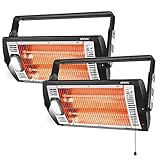
Overview: This dual-pack radiant heater combo features 1,500W quartz tubes and integrated halogen work lights, designed for ceiling mounting in garages, workshops, or patios. Five pull-string modes toggle between heating-only and heat-with-light functions.
What Makes It Stand Out: The built-in halogen work light is a game-changer for dimly lit workshops, providing task illumination alongside warmth. The 90° adjustable angle directs heat precisely, while dual-bulb design ensures rapid, focused radiant heating without warming air—ideal for drafty spaces.
Value for Money: Excellent value as a 2-pack with mounting hardware included. The dual functionality (heating + lighting) surpasses single-purpose heaters at similar prices, though the lack of thermostat may increase energy use versus smarter models.
Strengths and Weaknesses: Strengths: Halogen work light, space-saving ceiling mount, instant radiant heat, flexible angle adjustment. Weaknesses: No thermostat or remote, pull-string operation is outdated, halogen bulb longevity concerns.
Bottom Line: Highly recommended for garage mechanics needing both light and heat. Skip if seeking automated temperature control; otherwise, a practical, budget-friendly duo for targeted warmth.
3. Comfort Zone Hard-Wired Ceiling Mount Garage Electric Space Heater, Fan-Forced, 5,000 watt, 240 volt, Overheat Protection, Thermal Cut-Out Switch, Ideal for Workshop & Garage, ETL Compliant, CZ220

Overview: A hardwired 5,000W/240V fan-forced heater built for commercial spaces like garages and warehouses. Its ceiling-mount design saves floor space, featuring heavy-gauge steel construction and manual dual-knob thermostat controls.
What Makes It Stand Out: Robust steel build withstands harsh environments, while louvers and adjustable mounting enable precise heat direction. The fan-forced system distributes warmth evenly—unlike radiant-only heaters—and ETL compliance ensures safety in demanding settings.
Value for Money: Justifies its premium price with industrial durability and 5,000W output for large areas. Cheaper alternatives lack its steel resilience and consistent airflow, though the manual thermostat feels basic versus digital rivals.
Strengths and Weaknesses: Strengths: Durable steel body, efficient heat distribution, thermal cut-off safety, space-saving mount. Weaknesses: Manual knobs (no remote/digital control), hardwiring requires professional install, no timer.
Bottom Line: A solid investment for workshops needing reliable, wide-area heating. Best for users prioritizing durability over smart features; avoid if DIY installation or automation is preferred.
4. Comfort Zone 10,000W Hard-Wired Garage Heater – Industrial & Commercial Ceiling Mount, 240V Fan-Forced Heater with Remote, Digital Thermostat, Timer, 2 Heat Settings, Overheat Protection, Black

Overview: This heavy-duty 10,000W/240V heater targets large industrial spaces with digital controls, remote operation, and a 12-hour timer. Its fan-forced system and adjustable vents ensure even heat distribution in warehouses or high-ceiling garages.
What Makes It Stand Out: The digital thermostat and remote control offer precision unmatched by manual models, while the 12-hour timer optimizes energy use. Fully sheathed heating elements and an enclosed motor enhance safety in dusty environments.
Value for Money: Higher upfront cost is offset by energy efficiency from programmable settings and robust build quality. Outperforms basic heaters in large spaces, though overkill for small garages—ideal for facilities needing automation.
Strengths and Weaknesses: Strengths: Digital thermostat with remote, energy-saving timer, industrial-grade durability, superior airflow control. Weaknesses: Very high wattage (240V hardwire only), complex setup, premium pricing.
Bottom Line: Top pick for commercial spaces demanding smart, powerful heating. Worth the investment for large facilities; skip if your space is under 1,000 sq. ft. or lacks 240V infrastructure.
5. Comfort Zone Hard-Wired Ceiling Mount Garage Electric Space Heater, Fan-Forced, 5,000 watt, 240 volt, Overheat Protection, Thermal Cut-Out Switch, Ideal for Workshop & Garage, ETL Compliant, CZ220BK

Overview: The black-finished variant of Product #3, this 5,000W/240V hardwired heater shares identical specs: fan-forced airflow, heavy steel construction, and manual dual-knob thermostat for garages or workshops.
What Makes It Stand Out: Matches Product #3’s industrial durability and heat distribution but in a sleek black finish. The thermal cut-off switch and ETL compliance provide critical safety in unheated spaces, while ceiling mounting maximizes floor area.
Value for Money: Priced comparably to the silver model (#3), it offers no functional upgrade—purely aesthetic. Better value than smaller heaters for medium spaces, but lacks digital features of higher-end models like #4.
Strengths and Weaknesses: Strengths: Rugged steel build, efficient fan-forced heat, space-saving design, reliable safety features. Weaknesses: Manual controls only, professional installation required, no modern conveniences (remote/timer).
Bottom Line: Choose only if you prefer black aesthetics; otherwise, identical to #3. Solid for budget-conscious commercial use but outdated next to smart-enabled alternatives.
6. Gardtech Electric Space Heater for Indoor Use, Outdoor Heater with Overheat Protection, Fast Heat PTC Ceramic Portable Garage Heater for Workshop, Greenhouse (Green)

Overview: The Gardtech Electric Space Heater is a compact, PTC ceramic heater designed for targeted warmth in small indoor/outdoor spaces like workshops, greenhouses, or under desks. Its focus is safety, rapid heating, and quiet operation for areas up to 215 sq ft. What Makes It Stand Out: Its standout features are genuine 3-second rapid heating via PTC ceramic elements and an exceptionally quiet 35dB operation, ideal for noise-sensitive environments. The triple-mode versatility (fan-only, 750W, 1500W) and ETL certification with tip-over protection prioritize safety and adaptability for both people and plants. Value for Money: Priced moderately, it offers excellent value for small-space heating needs. The 30% higher thermal efficiency claim translates to real energy savings compared to basic fan heaters, while the portability and quietness justify the cost over louder, less efficient alternatives. Strengths and Weaknesses: Strengths: Near-instant heat, whisper-quiet for office/desk use, energy-efficient PTC tech, versatile modes, solid safety features (tip-over, ETL). Weaknesses: Limited to small areas (215 sq ft), green color may not suit all decors, outdoor use requires covered placement. Bottom Line: An ideal, safe, and efficient solution for quickly warming small workshops, greenhouses, or personal workspaces without noise disruption; highly recommended for targeted, quiet heating where portability matters.
7. TEMPWARE 7500W Electric Garage Heater, 240V Hardwired Digital Ceiling Mount Fan-Forced Shop Heater with Full-Function Remote and 12-Hour Timer, Ideal for Workshop Warehouse

Overview: The TEMPWARE 7500W is a powerful hardwired ceiling-mount heater built for large workshops, warehouses, or garages up to 1,250 sq ft. It demands professional installation but delivers robust, controllable heat for demanding commercial or heavy-duty residential spaces. What Makes It Stand Out: Its 25,590 BTU output and hardwired 240V design enable efficient heating of very large areas. The full-function remote, precise digital thermostat (45°F–95°F), and 12-hour programmable timer offer exceptional convenience and energy management unmatched by plug-in models. Value for Money: While the upfront cost and electrician installation are significant, its value shines in large, poorly insulated spaces. The energy-saving timer, thermostat accuracy, and durability (heavy-duty steel, ETL) justify the investment for frequent, long-term use in workshops where portable heaters fall short. Strengths and Weaknesses: Strengths: High power for large areas, professional-grade durability, precise digital control with remote/timer, excellent energy management features, strong safety (overheat protection). Weaknesses: Requires costly professional hardwired installation, not portable, limited to 240V circuits, higher operating cost for large spaces. Bottom Line: A top-tier choice for serious workshop or warehouse heating where power, coverage, and programmability are critical; essential for large spaces but only recommended if 240V hardwiring is feasible.
8. CTSC 8500W Garage Heater Electric, 240v Hardwired Fan-Forced Electric Garage Heater with Digital Thermostat, Remote Control and Timer, ECO Function, Ideal for Workshop, ETL Listed Garage Heater

Overview: The CTSC 8500W heater targets large workshops or garages (up to 850 sq ft) with hardwired 240V power. It emphasizes user-friendly diagnostics, energy savings, and robust construction for reliable commercial-grade heating. What Makes It Stand Out: Its innovative Voltage Display Screen is a game-changer for troubleshooting installation issues—a common pain point. Combined with an ECO function, 10-hour timer, remote control, and 3 heat settings (8500W/5600W/Fan), it offers exceptional operational intelligence and flexibility. Value for Money: Positioned as a premium hardwired heater, its value lies in longevity (SPCC steel build) and smart features. The voltage display prevents costly service calls, while ECO mode and precise thermostat control reduce running costs, making it cost-effective for frequent workshop use despite the installation expense. Strengths and Weaknesses: Strengths: Unique voltage display for easy troubleshooting, strong ECO energy savings, versatile 3-mode control, durable construction, space-saving wall/ceiling mount. Weaknesses: Requires professional 240V installation, voltage display only helps after installation issues occur, timer maxes at 10 hours (less than some competitors). Bottom Line: A highly intelligent and durable solution for workshop heating; the voltage display and ECO features make it a standout investment for those needing reliable, efficient warmth in large spaces with proper electrical setup.
9. Outdoor Electric Patio Heater, 34-inch 1500W Infrared Tower Heater with Instant Heating, Tip-Over & Overheat Protection, IPX5 Waterproof Space Heater for Patio Garage Workshop Indoor & Outdoor Use

Overview: This 1500W infrared tower heater delivers instant, sun-like warmth for patios, garages, or workshops. Its IPX5 waterproof rating and carbon elements make it uniquely versatile for both sheltered outdoor and indoor use without producing emissions. What Makes It Stand Out: True 1-second instant heat via dual carbon infrared tubes provides direct, comfortable warmth without drying air—ideal for patios. The IPX5 rating ensures genuine weather resistance, while the silent operation and ultra-low running cost (vs. propane) are major advantages for outdoor comfort. Value for Money: Excellent value for patio/outdoor heating. The low operating cost (1/10th of propane), durability against weather, and dual indoor/outdoor use offer significant savings over seasonal propane heaters or less versatile electric models, despite the modest 1500W output. Strengths and Weaknesses: Strengths: Instant infrared heat, truly weatherproof (IPX5), silent operation, emission-free, very low running cost, ergonomic handle for portability. Weaknesses: Limited coverage area (best for personal/spot heating), 1500W insufficient for large open patios in extreme cold, requires covered outdoor placement. Bottom Line: The best electric choice for emission-free, quiet, and affordable personal warmth on patios or in garages; highly recommended for small-to-medium outdoor areas where propane is impractical or costly.
10. Shinic Electric Garage Heaters with Remote Control, 1500W/750W Ceiling Mounted Radiant Quartz Heater with Work Light, 90° Rotation, 5 Mode Settings, Electric Heater for Garage, Shop, Patio Large Room

Overview: The Shinic heater combines radiant quartz heating with a built-in halogen work light in a ceiling-mounted unit. Designed for garages or workshops, it provides targeted warmth and illumination for task-focused environments. What Makes It Stand Out: The integrated halogen work light is a unique dual-purpose feature, eliminating the need for separate lighting. Radiant heat warms objects/people directly (not the air), and the 90° adjustable angle ensures precise heat direction—perfect for workbenches in cold garages. Value for Money: Great value for garage-specific needs. The combination of efficient radiant heat (reducing wasted energy warming empty air), space-saving ceiling mount, and essential work light justifies the price, especially compared to buying separate heater and light fixtures. Strengths and Weaknesses: Strengths: Dual function (heater + bright work light), energy-efficient radiant heat, space-saving ceiling mount, 90° angle adjustment, quiet operation, ETL safety certified. Weaknesses: Radiant heat only warms line-of-sight areas (not whole rooms), limited to ceiling mounting, lower max heat (1500W) for large spaces. Bottom Line: An exceptional choice for garages where task lighting and spot heating are priorities; highly recommended if you need focused warmth and visibility at your workbench, but less ideal for whole-room heating.
Understanding Your Garage Heating Needs
Assessing Your Garage Size and Layout
Accurately measuring your garage’s square footage and ceiling height is the absolute foundation of selecting the right heater. Don’t just look at the floor area; high ceilings common in modern workshops significantly increase the total cubic volume of air that needs heating. Consider the layout too—open spaces heat differently than garages with lofts, workbenches creating zones, or attached storage areas. An oddly shaped space might require strategic heater placement for even warmth distribution, avoiding cold spots near the door or under workbenches.
Evaluating Insulation and Air Sealing
The effectiveness of any heater is dramatically impacted by how well your garage retains heat. Poorly insulated walls, ceilings, and especially the large overhead door, act like open windows for warmth. Check for drafts around doors, windows, and where utilities enter. While upgrading insulation is ideal, understanding your current level (or lack thereof) is crucial. A well-sealed, insulated garage might need significantly less heating power than a drafty, uninsulated one of the same size, directly influencing the type and size of unit you require.
Defining Your Primary Workshop Activities
What you do in your garage dictates your heating requirements. Are you meticulously restoring a classic car where steady, ambient warmth is vital for paint and adhesives? Or are you primarily doing quick oil changes where spot heating near your workbench suffices? Activities involving flammable vapors (like painting or solvent use) impose strict safety limitations on heater types. High-precision metalwork might demand very stable temperatures, while woodworking could benefit from infrared warmth that doesn’t excessively dry out materials.
Heater Types and Fuel Sources Explained
Electric Resistance Heaters: Simplicity and Safety
Electric resistance heaters, including baseboard and fan-forced models, are popular for their straightforward installation (often just plugging into a dedicated circuit) and inherent safety—they produce no open flames or combustion gases. They excel in smaller, well-insulated spaces or for spot heating workbenches. However, their operating cost can be high in regions with expensive electricity, and they may struggle to maintain comfortable temperatures in large, drafty garages during extreme cold without significant electrical capacity.
Infrared Heating Technology: Targeted Warmth
Infrared heaters work by directly warming objects and people in their line of sight, much like the sun, rather than primarily heating the air. This makes them incredibly efficient for workshops where you’re stationary at a workbench—they provide instant, focused warmth exactly where you are, minimizing energy wasted on unoccupied ceiling space. They come in electric and propane models. Ideal for high-ceilinged or poorly insulated garages where convective heat would rise and be lost, but effectiveness diminishes if you move frequently outside the heater’s beam.
Propane-Powered Options: Portability and Power
Propane heaters, both vented and unvented (though unvented require extreme caution), offer powerful, portable heating often independent of electrical grid limitations. They’re a common choice for larger workshops or where electrical capacity is insufficient. Vented models exhaust combustion gases outside, significantly improving indoor air quality and safety. Unvented “blue flame” models are more efficient but release combustion byproducts directly into the workspace, making them generally unsuitable and often prohibited for occupied workshop spaces due to moisture and air quality concerns.
Natural Gas Heaters: Efficiency for Permanent Installations
If your garage is near your home’s natural gas line, a permanently installed, vented natural gas heater can be the most cost-effective and efficient long-term solution for consistent, whole-garage heating. These units typically offer high output, excellent efficiency, and lower operating costs compared to propane or electric in many regions. Installation requires professional gas line work and proper venting to the exterior, making it an investment best suited for workshops used year-round where the heater will become a permanent fixture.
Critical Safety Considerations for Garage Environments
Combustion Safety and Ventilation Requirements
Garages inherently contain flammable liquids (gasoline, solvents, paint thinners, propane tanks) and potential ignition sources. Any heater producing combustion gases must be properly vented to the outside according to strict manufacturer and building code specifications. Inadequate ventilation leads to dangerous carbon monoxide buildup, a silent, odorless killer. Never use unvented combustion heaters in a garage where flammables are stored or used, regardless of claims—they create an unacceptable fire and health hazard in this specific environment.
Clearance Distances and Fire Hazards
Every heater has mandated minimum clearance distances from combustible materials like walls, stored items, workbenches, vehicles, and especially flammable liquids. These distances are non-negotiable safety rules, not suggestions. Ignoring them risks igniting nearby materials. Always measure and strictly adhere to the manufacturer’s specified clearances, which are usually more generous than people assume. Ensure the area around the heater, especially above and behind it, remains completely clear of any debris or stored items.
Essential Safety Certifications and Features
Only consider heaters bearing safety certifications from recognized testing laboratories like UL (Underwriters Laboratories), ETL (Intertek), or CSA (Canadian Standards Association). Look for critical built-in safety features: tip-over switches (automatic shutoff if knocked over), overheat protection (shuts off if internal temps get too high), and for combustion heaters, oxygen depletion sensors (ODS) that shut off the unit if oxygen levels drop dangerously low. Never bypass or disable these safety mechanisms.
Sizing Your Heater Correctly for Optimal Performance
Calculating Required BTU Output
The British Thermal Unit (BTU) rating indicates a heater’s heating capacity. Undersizing leads to a perpetually cold space and an overworked, inefficient heater. Oversizing causes uncomfortable temperature swings, excessive cycling (turning on/off frequently), and wasted energy. A basic starting point is 30-60 BTUs per square foot, but this must be adjusted: use the higher end (50-60) for uninsulated garages, very cold climates, high ceilings, or frequent door openings; use the lower end (30-40) for well-insulated spaces in milder zones. Always factor in your specific insulation and usage.
The Impact of Ceiling Height on Heating Needs
Standard BTU calculations often assume 8-foot ceilings. Garages frequently have 9, 10, or even 12-foot ceilings, drastically increasing the air volume. For every foot above 8 feet, you generally need to add 10-15% more BTU capacity. A 24x24 garage (576 sq ft) with 10-foot ceilings has nearly 25% more air volume than the same floor area with 8-foot ceilings. Ignoring ceiling height is a primary reason garages feel inadequately heated despite seemingly correct sizing.
Adjusting for Climate Zone and Insulation Level
Your geographic location’s typical winter lows significantly impact required heating power. A garage in Minnesota needs far more BTUs than an identical garage in Georgia. Similarly, a well-insulated garage with sealed doors retains heat much better than a drafty, uninsulated shell. Be honest about your garage’s real-world conditions—don’t base sizing solely on ideal scenarios. Manufacturer sizing charts are a guide; real-world adjustments based on your garage are essential for comfort and efficiency.
Key Features Enhancing Usability and Efficiency
Thermostat Types and Temperature Control
Precise temperature control prevents energy waste and maintains comfort. Basic manual dials offer limited control. Programmable thermostats allow setting schedules (e.g., warming up before you arrive). Smart thermostats, controllable via smartphone, offer the ultimate flexibility and potential energy savings by learning your habits and adjusting automatically. For infrared spot heaters, adjustable intensity settings are crucial to avoid overheating your immediate area while leaving the rest of the space cold.
Noise Levels and Workshop Distractions
Workshop environments demand focus. Some heaters, particularly fan-forced electric or certain propane models, can generate significant noise that interferes with concentration or conversation. If quiet operation is paramount (e.g., for detailed assembly work or listening to instructions), prioritize infrared models or low-noise electric units. Check decibel (dB) ratings in specifications; lower numbers indicate quieter operation, though real-world perception matters most.
Portability Versus Permanent Installation
Consider how fixed your heating needs are. Portable propane or electric heaters offer flexibility to move warmth exactly where it’s needed day-to-day but require storage and setup. Permanent installations (wall-mounted infrared, ceiling-mounted units, gas-fired systems) provide seamless, always-ready heat but require professional setup and lack mobility. Weigh the convenience of permanent warmth against the flexibility of moving a portable unit, especially if your workshop tasks shift locations frequently.
Installation and Operational Practicalities
Electrical Requirements and Circuit Capacity
Electric heaters, especially higher-wattage models, demand dedicated circuits. A standard 1500W space heater needs a 15-amp circuit (120V), but larger shop heaters often require 240V circuits (like those for dryers or ovens), which most garages may not have readily available. Check your electrical panel’s capacity and available slots before purchasing. Upgrading electrical service can be costly, so ensure your chosen electric heater matches your existing infrastructure or factor in potential upgrade costs.
Fuel Storage and Accessibility Considerations
Propane heaters require safe, accessible storage for tanks. Outdoor storage is ideal, but tanks must be secured upright and away from ignition sources. Consider the hassle of refilling or exchanging tanks, especially in deep winter. Natural gas offers endless fuel but requires a permanent line. Electric is simplest for fuel access but ties you to grid availability and potential outages. Factor in the practicality of obtaining and storing your chosen fuel source consistently throughout winter.
Maintenance Demands for Longevity and Safety
All heaters require some maintenance. Electric units are generally lowest maintenance (dusting coils/fans). Combustion heaters (propane/natural gas) need annual professional servicing: checking vents, cleaning burners, inspecting fuel lines, and verifying safety controls. Ignoring maintenance leads to reduced efficiency, higher operating costs, and critically, increased safety risks like carbon monoxide leaks. Factor in the time and cost of necessary upkeep when choosing your heater type.
Maximizing Efficiency and Reducing Operating Costs
Strategic Heater Placement for Even Heat Distribution
Where you position your heater dramatically affects performance. Avoid placing it directly under the overhead door where cold drafts constantly hit it. For convective heaters, central locations often work best. For infrared, aim the beam directly at your primary work zone. Ceiling-mounted infrared units provide the most even coverage in high-bay spaces. Experiment with placement; sometimes moving a heater just a few feet can eliminate stubborn cold spots and improve overall efficiency.
Utilizing Zoning and Supplemental Heat Sources
You rarely need the entire garage heated to the same temperature. Use your main heater for ambient background warmth and supplement with a focused infrared heater or portable unit right at your workbench. This “zone heating” approach saves significant energy by only applying intense heat where people are actively working, rather than trying to heat empty corners or the space above stored vehicles. Smart thermostats can help automate this zoning strategy.
Off-Peak Energy Usage and Smart Controls
If your utility offers time-of-use rates, program your heater (especially electric models) to run during cheaper off-peak hours, taking advantage of thermal mass in the garage structure to hold some heat. Smart thermostats can learn your schedule, pre-heat efficiently before you arrive, and lower temperatures when the space is unoccupied, optimizing energy use without sacrificing comfort when you need it most.
Frequently Asked Questions
Can I use a standard indoor space heater in my garage?
Generally, no. Most standard indoor heaters lack the necessary safety certifications (like UL for garage use) and critical safety features (tip-over, overheat protection rated for workshop environments) required for the unique hazards of a garage, including proximity to flammables and potential for drafts. Always choose a heater explicitly rated and certified for garage or workshop use.
How much clearance space do I really need around a garage heater?
Clearance distances are strictly defined by the manufacturer and safety certifications, typically ranging from 3 feet to 6 feet on all sides (including above and behind) from combustible materials like stored items, walls, vehicles, and especially flammable liquids. Never assume; always consult the specific manual for your heater model – violating clearances is a major fire hazard.
Are unvented propane heaters safe for garages?
Unvented propane heaters are generally not safe for typical garages used as workshops. They release combustion byproducts, including water vapor (causing moisture issues) and carbon monoxide, directly into the space. Garages often lack sufficient air exchange for safe operation, especially when doors are closed, and the presence of flammables creates an extreme risk. Vented models are the only safe propane option for occupied garages.
What’s the most cost-effective heater type for a large, uninsulated garage?
For large, poorly insulated spaces, infrared heating (especially electric or vented gas models) is often the most cost-effective in operation. It heats objects and people directly rather than trying (and failing) to heat all the air, which constantly escapes. While the upfront cost might be higher, the reduced energy waste in challenging environments typically leads to lower long-term operating costs compared to trying to force convective heat into a drafty space.
Do I need a special electrical circuit for a garage heater?
Very likely, yes. Most effective garage heaters (beyond basic 1500W plug-in models) require a dedicated circuit, often 240V. Standard 120V household circuits are usually insufficient. Check the heater’s amperage and voltage requirements against your existing garage electrical panel. Upgrading your electrical service may be necessary and should be performed by a licensed electrician.
How can I tell if my garage is losing too much heat for efficient heating?
Signs include persistent drafts (feel them around doors/windows), condensation or frost on interior surfaces during cold weather, and the heater running constantly without maintaining temperature. The most telling sign is high energy bills relative to the comfort achieved. Conducting a simple visual inspection for gaps and feeling for drafts is a good first step; professional energy audits can pinpoint major leaks.
Is it safe to leave a garage heater running overnight or when unattended?
Never leave any combustion heater (propane, natural gas, kerosene) running unattended or while sleeping. Electric heaters with robust safety certifications (tip-over, overheat) may be safe for unattended operation if installed correctly with proper clearances and on a dedicated circuit, but it’s generally not recommended as a regular practice. Always prioritize safety and follow the specific manufacturer’s guidelines.
What’s the ideal temperature setting for a winter workshop?
Aim for a comfortable working temperature between 55°F (13°C) and 65°F (18°C). Setting it significantly higher (e.g., 70°F+) wastes considerable energy, as the temperature difference between inside and outside is the primary driver of heat loss. Dress in layers for workshop work; striving for “living room” warmth is inefficient and costly in a garage environment.
How often should I service a vented propane or natural gas garage heater?
Vented combustion heaters require annual professional servicing before the heating season begins. A qualified technician should inspect and clean the burner, check fuel lines and connections for leaks, verify proper venting and exhaust flow, test safety controls (like the ODS sensor), and ensure efficient operation. Skipping this service risks inefficiency, high costs, and serious safety hazards.
Can I install a garage heater myself, or do I need a professional?
Installation complexity varies greatly. Simple plug-in electric infrared units are usually DIY-friendly. However, any heater requiring hardwiring, gas line connections (propane or natural gas), venting installation, or a dedicated 240V circuit must be installed by a qualified professional (electrician, plumber, HVAC tech) according to local building codes and manufacturer specifications. Improper installation is a major cause of safety incidents and voids warranties.
See Also
- How to Choose the 10 Best Garage Heaters for Workshops in 2026
- 10 Premium Heavy Duty Garage Heaters for Workshops (Worth the Investment)
- Top 10 Best Garage Heaters for Cold Climate Workshops in 2026
- 10 Best Ceiling Mounted Garage Heaters for High-Ceiling Workshops in 2026
- The 10 Ultimate Best Radiant Garage Heaters for Workshops in 2026