Table of Contents
Sweltering summer days turning your garage workshop into a sauna? You’re not alone. That metal building, baking under the sun with tools radiating stored heat, can quickly become an unbearable environment for detailed projects or even basic maintenance. Forget comfort – extreme heat saps your focus, reduces productivity, and can even become a safety hazard when handling tools or materials. Traditional air conditioning often feels impractical or prohibitively expensive for a space that isn’t living quarters, leaving many DIYers and hobbyists searching for a smarter, more affordable cooling solution that actually works in this unique setting.
Enter evaporative cooling – commonly known as swamp cooling. Unlike energy-hungry AC units that remove heat, these clever devices leverage the natural power of water evaporation to drop temperatures significantly, especially in dry climates. For the garage workshop, where portability, budget, and effective spot cooling are paramount, a well-chosen evaporative cooler can be the game-changer you’ve been sweating for. But not all coolers are created equal for the demanding, often dusty and open, environment of your workspace. Understanding the specific features and considerations that matter most in a garage setting is crucial to avoid disappointment and ensure you get real relief when the mercury rises.
Top 10 Swamp Coolers
Detailed Product Reviews
1. Uthfy Evaporative Air Cooler, 3-IN-1 Swamp Cooler with 5.3 Gallon Water Tank, 6 Ice Packs, Remote, 12H Timer, 120°Oscillation, Portable Cooling Fan with 3 Speeds for Bedroom Home Office Garage

Overview:
This compact 13-pound evaporative cooler targets home and office use, leveraging a 5.3-gallon tank, 6 ice packs, and copper motor for energy-efficient cooling. It operates as a swamp cooler, fan, and humidifier, ideal for dry climates under 60% humidity, covering moderate-sized rooms quietly.
What Makes It Stand Out:
Its triple functionality (cooling/fan/humidifier), whisper-quiet 25dB operation, and included ice packs for boosted chilling are exceptional. The 120° oscillation, 12-hour timer, and intuitive remote/touch controls enhance usability, while lockable 360° wheels ensure effortless portability between rooms.
Value for Money:
Priced mid-range, it outperforms basic fans and rivals pricier ACs in energy savings (no refrigerants). The large tank reduces refills, and dual fan modes justify the cost versus single-function units, though humid climates limit its effectiveness.
Strengths and Weaknesses:
Strengths: Ultra-quiet operation; versatile 3-in-1 design; portable with lockable wheels; ice packs extend cooling; easy drainage. Weaknesses: Limited to dry climates; 5.3-gallon tank requires refilling in high heat; oscillation only horizontal (no vertical adjustment).
Bottom Line:
A top pick for bedrooms or offices in arid regions, offering quiet, adaptable cooling at a sensible price. Avoid in humid areas, but ideal for energy-conscious users seeking portable relief.
2. Hessaire MC37M 3100CFM Evaporative Cooler

Overview:
The Hessaire MC37M is a robust 3,100 CFM evaporative cooler designed for medium to large spaces, featuring a 10.3-gallon tank and 3-panel intake system. Built for durability with polypropylene resin, it targets garages, workshops, or patios where traditional AC is impractical.
What Makes It Stand Out:
Its standout feature is the 80% larger evaporation surface from the 3-panel system, enabling broader coverage and longer runtime (3–4 hours). The lightweight yet sturdy build minimizes noise/vibrations, and the simple “fill-plug-switch” operation ensures hassle-free use.
Value for Money:
Competitively priced for its capacity, it saves ~50% on energy versus portable ACs. The large tank reduces refill frequency, and Hessaire’s 1996 heritage promises reliability, though it lacks advanced features like timers or remotes found in premium models.
Strengths and Weaknesses:
Strengths: High airflow coverage; large 10.3-gallon tank; durable polypropylene build; energy-efficient; quiet operation. Weaknesses: No oscillation or speed settings; basic controls only; requires manual refills; ineffective in high humidity.
Bottom Line:
An excellent no-frills workhorse for dry, spacious areas like workshops. Best for users prioritizing raw cooling power and durability over smart features, offering solid long-term value.
3. Uthfy 41" Swamp Cooler, 4800 CFM Evaporative Air Cooler with 10.6 Gallon Water Tank, Portable Outdoor Air Conditioner with 3 Ice Pack, 110° Oscillation, 3 Speed for Garage, Yard, Commercial Use

Overview:
This industrial-grade 41-inch cooler delivers 4,800 CFM for spaces up to 1,200 sq. ft., featuring a 10.6-gallon tank, 3 ice packs, and a rugged metal body. Aimed at garages, patios, or commercial sites, it emphasizes heavy-duty cooling in extreme heat.
What Makes It Stand Out:
The 3-side high-density cooling pads and optional auto-fill via garden hose set it apart. Its 110° oscillation (manual vertical adjustment), corrosion-resistant powder-coated body, and copper motor ensure durability in demanding environments like construction sites.
Value for Money:
Priced higher but justified for large-area coverage. The auto-fill reduces maintenance, and energy efficiency beats portable ACs. Cheaper than central AC for warehouses, though overkill for small rooms.
Strengths and Weaknesses:
Strengths: Massive 1,200 sq. ft. coverage; auto-fill capability; robust metal construction; includes 3 ice packs; high CFM output. Weaknesses: Bulky (41" tall); mechanical controls lack modernity; heavy for frequent moving; ineffective in humidity.
Bottom Line:
The go-to for large, dry commercial or outdoor spaces needing relentless cooling. Skip if you need smart features or have limited room, but indispensable for workshops or patios.
4. Portable Swamp Coolers - 1300 CFM MC18M Evaporative Air Cooler with 2-Speed Fan, 53.4 dB - 500 sq. ft. Coverage Evaporative Air Cooler Portable High Velocity Outdoor Cooling Fan by Hessaire - White
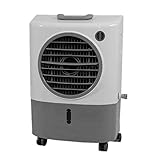
Overview:
Hessaire’s MC18M is a compact 1,300 CFM portable cooler for spaces up to 500 sq. ft., featuring a 4.8-gallon tank and ABS resin build. It’s engineered for simplicity in bedrooms, small offices, or patios, emphasizing ease of use and portability.
What Makes It Stand Out:
Its patented axial propeller throws air farther than competitors, while the hi-density XeL50 media optimizes airflow. The ultra-lightweight ABS body (less fragile than metal) and 50% energy savings versus ACs make it a stealth efficiency champion.
Value for Money:
An affordable entry point into evaporative cooling. Saves significantly on electricity long-term, and the 4.8-gallon tank balances runtime and portability. Lacks timers/remotes but excels as a reliable basic unit.
Strengths and Weaknesses:
Strengths: Lightweight and portable; energy-efficient (50% savings); durable ABS resin; simple operation; quiet for its class (53.4 dB). Weaknesses: Only 2 speed settings; limited 500 sq. ft. coverage; no oscillation; basic design.
Bottom Line:
Perfect for budget-conscious users in small, dry spaces needing straightforward, economical cooling. Not for large areas, but a dependable starter cooler with proven efficiency.
5. POWIFY 10.6 Gal Evaporative Air Cooler, 3000 CFM Swamp Cooler with 4 Ice Packs, 12H Timer, 3 Speeds & 3 Modes, 35" Portable Fast Cooling Fan for Patio, Bedroom, Garage, Backyard

Overview:
The POWIFY cooler merges robust specs (3,000 CFM, 10.6-gallon tank) with smart features like a 12-hour timer and 4 ice packs. Designed for patios or bedrooms, it uses copper motors and evaporative tech for eco-friendly cooling up to 700 sq. ft.
What Makes It Stand Out:
Dual remotes (one spare), 120° 4-way oscillation, and a detachable stackable design are unique. The 3 wind modes (including variable airflow), auto-fill support, and lockable wheels enhance versatility beyond typical coolers.
Value for Money:
Priced mid-to-high, it justifies cost with premium extras: spare remote prevents obsolescence, auto-fill saves effort, and the large tank enables near-weekly runtime. Beats single-remote models in longevity-focused value.
Strengths and Weaknesses:
Strengths: Dual remotes; 4-way oscillation; detachable for storage; auto-fill compatible; 3 customizable wind modes. Weaknesses: Tall (35") design risks tipping; 10.6-gallon weight hampers mobility; ineffective in humidity.
Bottom Line:
A feature-rich choice for tech-savvy users wanting customization and convenience. Ideal for patios or bedrooms in dry climates, though its size demands stable placement.
6. Swamp Cooler,1800 CFM Air Cooler with 5.3 Gal Water Tank,120° Swing,Remote Control,12H Timer,6 Ice Packs,2 Modes,3 Speeds,Evaporative Cooler for Bedroom,Home,Office,Cool Grey

Overview: This compact evaporative cooler targets bedrooms and small offices with 1800 CFM airflow and a 5.3-gallon tank. Its 120° swing, remote control, and dual cooling modes offer adaptable comfort for spaces up to 550 sq. ft.
What Makes It Stand Out: The inclusion of six ice packs extends cooling duration beyond 15 hours, while the natural breeze mode mimics outdoor airflow. UL/FCC-certified copper motor ensures durability, and tool-free maintenance (removable grille/pad) simplifies upkeep compared to competitors.
Value for Money: Priced mid-range, it outperforms basic fans and avoids AC installation costs. The energy-efficient design (using 70% less power than AC) and portability via caster wheels justify its cost for personal-space cooling in dry climates.
Strengths and Weaknesses: Pros: Quiet operation, intuitive dual controls (remote/touch), excellent humidity control for small rooms. Cons: Limited coverage for large areas; ice packs require freezer pre-chilling; less effective in high humidity.
Bottom Line: Ideal for singles or couples in apartments seeking affordable, eco-friendly cooling. Skip if you need whole-house coverage or live in consistently humid regions.
7. AKIRES 4800CFM Swamp Coolers,Portable Evaporative Air Cooler for 970 Sq.ft of Space,with Continuous Auto Fill,10.6-Gal Water Tank,120°Oscillation,3 Ice Packs,Cooling Fan for Outdoor,Indoor Use(41IN)

Overview: Designed for large spaces (up to 970 sq. ft), this industrial-grade cooler delivers 4800 CFM airflow with a massive 10.6-gallon tank. Its continuous auto-fill feature and triple-intake panels target workshops, patios, and open-plan homes.
What Makes It Stand Out: The 4-in-1 composite ice curtain boosts cooling efficiency while filtering air, and continuous hose-fill capability eliminates manual refills. Four lockable casters and 120° oscillation ensure stable, wide-area coverage unmatched in its class.
Value for Money: Higher upfront cost is offset by energy savings (vs. AC) and minimal maintenance. The auto-fill system and large tank reduce long-term effort, making it cost-effective for commercial or frequent outdoor use despite the premium price.
Strengths and Weaknesses: Pros: Exceptional coverage, robust for humid climates, effortless mobility. Cons: Bulky design impractical for small rooms; auto-fill requires outdoor hose access; assembly slightly complex.
Bottom Line: A powerhouse for garages, warehouses, or large patios. Best for dry climates—avoid if space is limited or humidity exceeds 50%.
8. VAGKRI 35" Evaporative Air Cooler, 2800CFM Swamp Cooler, 120°Oscillation Air Cooler with Remote Control, 24H Timer, 3 Modes & Wind Speeds for Outdoor Indoor Use, 9.2Gallon

Overview: This 2800 CFM cooler covers 900 sq. ft with a 9.2-gallon tank, targeting both indoor (ventilated) and outdoor use. Triple cooling pads, remote control, and 24-hour timer cater to versatile cooling needs in living rooms or gardens.
What Makes It Stand Out: Unique bottom auto-fill system enables uninterrupted cooling, while three integrated cooling pads accelerate evaporation. The 24H timer and dual ice packs provide extended chill, outperforming single-pad rivals in speed and efficiency.
Value for Money: Competitive pricing for its coverage and auto-fill innovation. Saves time versus manual-refill models and slashes energy bills—ideal for users prioritizing “set-and-forget” convenience in dry, spacious environments.
Strengths and Weaknesses: Pros: Rapid cooling, excellent oscillation range, easy mobility. Cons: Requires open windows indoors; ice packs need pre-freezing; remote range limited to 15 ft.
Bottom Line: Top choice for medium-large homes in arid zones. Not suitable for sealed rooms—opt for AC if humidity control is critical.
9. Hessaire MC61M 5,300 CFM 3-Speed Portable Evaporative Cooler

Overview: A heavy-duty 5,300 CFM cooler built for industrial settings, featuring a 14.6-gallon tank and 3-panel intake. Targets warehouses, workshops, and large open areas with noise-minimized, high-velocity airflow.
What Makes It Stand Out: Industry-leading coverage (5,300 CFM) and an 80% larger evaporation surface reduce refill frequency. Molded polypropylene resin construction ensures quiet operation (under 60 dB), while the simple “fill-plug-switch” design prioritizes reliability over tech features.
Value for Money: Premium pricing reflects commercial durability. Outlasts consumer models in harsh environments, with energy costs 50% lower than AC—justifiable for businesses needing all-day cooling in dry climates.
Strengths and Weaknesses: Pros: Unmatched airflow for large spaces, minimal maintenance, ultra-quiet. Cons: No remote/timer; heavy (45 lbs); ineffective in humidity; basic controls.
Bottom Line: Essential for contractors or large workshops. Overkill for homes—choose smaller models if portability or smart features matter.
10. Feculs Portable Air Conditioners No Windows Needed, 3-IN-1 Swamp Cooler, Evaporative Air Cooler, 4 Modes & 3 Speeds, 2-Gal Water Tank for Long Cooling, Max 20 FT/S Remote Control, 12 Hours Timer

Overview: A compact 320 sq. ft cooler emphasizing convenience: no-window installation, 4 modes, and whisper-quiet operation (46-56 dB). Targets small bedrooms with its 2-gallon tank and 12-hour timer.
What Makes It Stand Out: True ventless design (no hoses/window kits) and sleep-mode lighting make it ideal for renters. The 20-ft remote range and 65W energy draw undercut AC costs, while four modes (including Nature) personalize airflow.
Value for Money: Budget-friendly for tight spaces, but the small tank requires frequent refills. Serves as a supplemental cooler—worthwhile if you need quiet, portable relief but not a primary cooling solution.
Strengths and Weaknesses: Pros: Effortless setup, ultra-quiet, low energy use. Cons: Tiny water capacity; weak cooling beyond 300 sq. ft; ineffective in humidity.
Bottom Line: Perfect for studio apartments or offices. Avoid for larger rooms—supplement with fans if temperatures soar.
Understanding Evaporative Cooling for Workshop Realities
How Swamp Coolers Actually Work (Beyond the Hype)
Evaporative coolers don’t generate cold air; they cool existing air through a simple, natural process. Warm, dry air is pulled through water-saturated cooling pads. As the water evaporates, it absorbs heat energy from the air, resulting in a noticeable temperature drop (typically 15-40°F depending on humidity). The cooled, slightly more humid air is then circulated by a powerful fan into your space. This process is highly energy-efficient compared to refrigerant-based AC, using a fraction of the electricity, making it ideal for workshops where running costs add up.
Why Garages Pose Unique Cooling Challenges
Garage workshops differ drastically from living spaces. They often have large, uninsulated doors and walls that absorb and radiate intense heat. Dust, sawdust, metal shavings, and fumes from projects are constant concerns. The space might be partially open (with the door up) or completely sealed, impacting airflow. Humidity levels can fluctuate wildly depending on location and ventilation. Standard coolers designed for bedrooms or patios frequently struggle with these harsh conditions, leading to poor performance, rapid wear, or even damage to sensitive tools and projects.
The Critical Role of Ambient Humidity
This is the make-or-break factor for evaporative cooling effectiveness. Swamp coolers thrive in dry air (low relative humidity, ideally below 60%). In arid regions, they deliver dramatic cooling. However, in humid climates, the air already holds significant moisture, drastically reducing the evaporation rate and cooling potential. Attempting to use one in high humidity can make the garage feel muggy and uncomfortable, potentially increasing moisture levels around stored tools and materials. Always assess your local climate’s typical summer humidity before investing.
Essential Features for Garage Workshop Durability
Robust Construction for Workshop Abuse
Your cooler will face dust, potential bumps from equipment, and possibly corrosive elements. Prioritize units built with rugged, impact-resistant plastics (like polypropylene) over flimsy materials. Avoid coolers with excessive exposed metal that can rust. Look for designs that minimize crevices where sawdust and grime can accumulate, making cleaning difficult. A sturdy base with large, lockable casters is non-negotiable for easy movement around tools and workbenches.
Advanced Filtration for Dusty Environments
Standard swamp coolers often have minimal dust protection, a major flaw in workshops. Seek models featuring multi-stage filtration systems. A pre-filter (often a simple mesh screen) catches large debris like wood chips and leaves. Crucially, look for a secondary, high-capacity dust filter designed to trap fine particulates like sawdust and metal shavings before they reach and clog the delicate cooling pads. This significantly extends pad life and maintains cooling efficiency.
Heavy-Duty Cooling Pads Engineered for Longevity
Cooling pads are the heart of the system. Standard aspen pads are inexpensive but clog quickly with workshop dust and degrade faster. Opt for rigid cellulose pads (like CELDEK) or, even better, polymer honeycomb pads. These offer superior dust resistance, maintain structural integrity longer in demanding conditions, provide more consistent cooling, and are easier to clean. While an initial investment, durable pads save money and hassle in the long run for a workshop environment.
Performance Metrics That Actually Matter
Calculating Required Cooling Capacity (CFM)
Don’t guess – calculate! Cooling capacity is measured in Cubic Feet per Minute (CFM) of airflow. A common starting point is 20-40 CFM per square foot of workshop space, but garages often need the higher end due to heat gain. Multiply your garage’s length x width x height to get cubic footage. Divide by 2-3 minutes (aiming for 20-30 air changes per hour) to estimate needed CFM. For example, a 20x20x8 ft garage (3,200 cu ft) needs roughly 1,066 - 1,600 CFM. Undersized units will struggle; oversized units waste energy.
Optimizing Airflow Patterns for Workspace Layout
It’s not just about raw CFM. Consider where the cooled air needs to go. Units with multi-directional louvers or oscillating fans provide better coverage in irregularly shaped workshops than fixed-direction blowers. For long, narrow garages, a unit placed near one end blowing down the length often works better than center placement. Avoid positioning the cooler directly behind large obstacles like workbenches or vehicles that block airflow.
Water Tank Capacity vs. Runtime Trade-offs
Larger water tanks mean less frequent refilling, a huge convenience during long projects. However, bigger tanks add weight and bulk. Assess your typical workshop session length. If you work for 4+ hours straight, prioritize a tank of 20+ gallons. For shorter sessions, 10-15 gallons might suffice. Consider models with easy-fill ports and low-water indicators. Remember, dusty environments can increase water consumption as evaporation works harder.
Smart Setup and Operation Strategies
Strategic Placement for Maximum Effectiveness
Location is critical. Place the cooler near an open door or window to ensure a constant supply of fresh, dry intake air – evaporative coolers require this airflow to function properly. Never place it in a completely sealed room. Position it to blow cooled air directly over your primary work area. Avoid corners where airflow stagnates. Keep it away from walls (at least 2-3 feet) to prevent recirculating the same humidified air.
Managing Humidity Levels in the Workshop
While beneficial in dry climates, the added moisture can be problematic. Monitor humidity with a simple hygrometer. If levels creep above 50-55% and the air feels clammy, increase ventilation – open more doors/windows opposite the cooler to expel moist air. Be mindful of moisture-sensitive materials (like certain woods or electronics) and consider dehumidifiers for storage areas if persistent high humidity is an issue, though this is less common in typical garage settings.
Combating Dust Ingress During Operation
Keep doors/windows used for intake air as clean as possible. Consider installing simple mesh screens over larger openings to catch larger debris before it enters the cooler. Run the dust filter consistently. In extremely dusty conditions (e.g., major sanding projects), it might be wise to pause cooler operation or ensure maximum exhaust ventilation to prevent excessive dust from being pulled through the system.
Integrating with Existing Ventilation Systems
If your garage has exhaust fans (e.g., in the roof or high on a wall), use them in conjunction with the swamp cooler. The swamp cooler provides cool, moist intake air near the floor; the exhaust fan pulls hot, stale air out from the top. This creates a powerful cross-ventilation effect, significantly improving overall cooling efficiency and air quality throughout the space.
Maintenance: Non-Negotiables for Workshop Longevity
Deep Cleaning Cooling Pads Beyond the Basics
Workshop dust demands more frequent and thorough pad cleaning than residential use. Don’t just rinse; remove pads periodically (monthly during heavy use) and soak them in a mild vinegar solution or专用 cooler cleaner to dissolve mineral deposits and embedded grime. Rinse extremely well. For rigid or honeycomb pads, a gentle brush can help dislodge stubborn particles without damaging the structure. Never use harsh chemicals.
Flushing the Water Reservoir to Prevent Scaling
Mineral buildup from hard water is a major enemy, forming scale inside the tank and on pump components. Drain and completely flush the reservoir with fresh water at least weekly during peak season. Perform a deeper descaling every few weeks using a manufacturer-approved cleaner or white vinegar solution. Residual scale reduces efficiency and can damage the pump.
Inspecting and Maintaining the Water Pump
The pump is vital for circulating water to the pads. Listen for unusual noises (grinding, clicking) which indicate potential failure. Ensure the pump intake isn’t clogged with debris – clean the strainer regularly. Verify consistent water flow across all pads during operation; uneven flow means a blockage or pump issue needing attention. Lubricate moving parts if specified by the manual.
Winterizing Procedures for Off-Season Storage
Leaving water in the system over winter guarantees damage from freezing. At season’s end, completely drain all water from the tank, pump lines, and pads. Run the fan for 30-60 minutes to thoroughly dry the interior, especially the pads and pump housing. Store pads separately in a dry place if possible. Cover the unit securely to prevent dust and pests from entering during storage.
Safety and Practical Considerations
Electrical Safety in the Workshop Environment
Garages often have older wiring or limited outlets. Ensure your cooler’s wattage is compatible with the circuit (check the manual and your breaker/fuse rating). Use a heavy-duty, outdoor-rated extension cord only if absolutely necessary and sized correctly for the amperage and distance. Avoid running cords across high-traffic areas where they can be tripped over or damaged. Consider having a dedicated GFCI outlet installed by an electrician for safety and convenience.
Noise Levels and Workshop Concentration
Cooler fan noise varies significantly. Basic models can be quite loud (60+ dB), making conversation or concentration difficult. Look for units specifically marketed as “quiet operation” or check decibel (dB) ratings – aim for 55 dB or lower for a more pleasant workspace. Position the unit as far from your primary workbench as practical while still maintaining good airflow to the area.
Security Implications of Open Airflow
Swamp coolers require open windows or doors for intake air, potentially compromising garage security. Be mindful of what’s visible or accessible from outside. Use this as an opportunity to review your overall garage security – ensure valuable tools are locked away in cabinets, and consider security screens on necessary openings if safety is a major concern in your area.
Frequently Asked Questions
How do I know if a swamp cooler will work in my specific garage location?
Determine your area’s average summer relative humidity. If it consistently stays below 60% (especially below 50%), evaporative cooling will be highly effective. Above 65-70%, its cooling power diminishes significantly, and it may add uncomfortable moisture. Check historical weather data for your zip code.
Can I use a swamp cooler effectively if my garage door is partially open?
Yes, partial openings are often ideal. You need sufficient cross-ventilation – an intake path for dry air (like an open door section or window) and an exhaust path for warm, moist air (another open section or high vent). Complete sealing prevents proper operation, while excessive opening reduces efficiency.
Will the added moisture from a swamp cooler damage my tools or projects?
In typical dry-climate workshop use, the added humidity is usually beneficial and well within safe levels for most metals and woods. However, monitor with a hygrometer. If humidity consistently exceeds 55-60% near sensitive items (e.g., pianos, certain electronics, or moisture-prone woods), increase exhaust ventilation or consider localized dehumidification for storage.
How often do I really need to clean the cooling pads in a dusty garage?
Expect to clean pads much more frequently than in a home – potentially weekly during heavy workshop use (sanding, cutting). Look for reduced airflow or a musty smell as signs. Deep cleaning (soaking with cleaner) should be done monthly. Dusty environments drastically shorten pad lifespan compared to cleaner settings.
Is it safe to run a swamp cooler overnight in an unattended garage?
Generally, yes, if the unit is in good condition and placed safely away from flammables. Ensure the water reservoir is full to prevent pump burnout. However, never leave any electrical appliance running unattended for extended periods without considering fire risk; periodic checks are prudent. Ensure proper ventilation remains open.
Can swamp coolers help reduce stuffy workshop odors?
Yes, indirectly. By constantly pulling in fresh outside air and expelling indoor air, they significantly improve overall ventilation, which dilutes and removes odors from paints, solvents, or welding fumes much faster than a stagnant garage. They don’t “neutralize” odors like an air purifier, but increased airflow is highly effective.
What’s the biggest mistake people make when using swamp coolers in garages?
The most common critical error is using it in a completely sealed space. Swamp coolers require a continuous supply of fresh, dry intake air (openings) to function. Sealing the garage traps humidified air, drastically reducing cooling and making the space feel muggy. Ensure at least 1-2 square feet of open area per 1000 CFM of cooler capacity.
Do I need special plumbing for a swamp cooler in my garage?
Most portable workshop models are designed for manual filling – you simply pour water into the tank. This is usually the most practical solution. Some larger, permanently installed units can connect to a hose for auto-fill, but this adds complexity and isn’t necessary for typical portable workshop coolers.
How does a swamp cooler compare to a standard box fan for workshop cooling?
A box fan only moves air; it doesn’t lower the actual air temperature. On very hot days, it just blows hot air around. A properly sized swamp cooler actively reduces the air temperature by 15-40°F through evaporation, providing genuine cooling relief, especially in dry conditions. The energy cost difference is minimal.
Will a swamp cooler work if I’m running welding equipment or other heat-generating tools?
Yes, and it’s often very beneficial. While the cooler combats ambient heat, it won’t eliminate the intense localized heat right at the welding arc or engine. However, by lowering the overall workshop temperature, it significantly improves your comfort and endurance during prolonged, heat-intensive tasks, making the environment more tolerable.
See Also
- 10 Affordable Swamp Coolers That Don’t Sacrifice Quality in 2026
- Stop Hot Garages with the 10 Best Garage Evaporative Coolers This Year
- 10 Must-Have Swamp Coolers for Energy-Efficient Cooling in 2026
- 10 Best Value Swamp Coolers for Hot Climates in 2026
- 10 Essential Garage Evaporative Coolers Every Workshop Owner Needs in 2026