Table of Contents
Imagine coming home to a perfectly comfortable temperature without wasting a single watt of energy all day. For eco-conscious homeowners, that dream is increasingly within reach—but only if you navigate the smart thermostat landscape with your eyes wide open. These devices promise to slash energy bills and reduce carbon footprints, yet many buyers discover too late that their shiny new gadget doesn’t actually deliver meaningful savings. The truth? A smart thermostat’s eco-impact hinges far more on thoughtful selection, proper setup, and consistent usage than on flashy marketing claims. Choosing the wrong model or skipping critical compatibility checks can turn your sustainability investment into an expensive paperweight.
Beyond mere convenience, today’s climate urgency demands we scrutinize every tool claiming to aid our green transition. Smart thermostats sit at the intersection of home comfort and environmental responsibility, but their true value emerges only when they seamlessly integrate with your existing system and adapt to your life. This isn’t about chasing the latest gadget trend; it’s about making a strategic decision that aligns with long-term energy conservation goals. Let’s cut through the hype and focus on the practical, often overlooked factors that transform a smart thermostat from a simple gadget into a genuine force for sustainable living.
Top 10 Smart Thermostats for Eco-Conscious Homes
Detailed Product Reviews
1. ecobee Smart Thermostat Essential - Energy Star Certified programmable Wi-Fi Thermostat - Works with Siri, Alexa, and Google Assistant

Overview: The ecobee Essential is an entry-level smart thermostat focused on core energy savings and smart home integration. It automates temperature adjustments based on your schedule and occupancy to reduce heating and cooling costs without complex features. What Makes It Stand Out: Its primary strength is broad HVAC compatibility (85% of systems) and seamless integration with major voice assistants (Alexa, Google, Siri). The intuitive color touchscreen and free app provide remote control and energy tracking, while ENERGY STAR certification validates its efficiency claims of up to 23% annual savings. Value for Money: Positioned as an affordable smart thermostat, it delivers solid core functionality. However, the lack of a included Power Extender Kit (PEK) for homes without a C-wire is a drawback, as purchasing it separately adds cost, slightly diminishing its value proposition compared to competitors bundling similar solutions. Strengths and Weaknesses: Strengths: Reliable scheduling, strong voice assistant support, user-friendly app, ENERGY STAR certified savings. Weaknesses: PEK sold separately (essential for many installations), no advanced features like occupancy radar or air quality monitoring, basic display compared to higher-end models. Bottom Line: A competent, budget-friendly entry into smart thermostats for basic scheduling and voice control, ideal for compatible systems. Its value is slightly reduced by the mandatory PEK add-on for many users; consider if core features suffice.
2. ecobee Smart Thermostat Enhanced - Programmable Wifi Thermostat - Works with Siri, Alexa, Google Assistant - Energy Star Certified - Smart Home
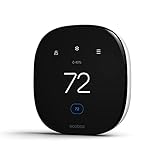
Overview: The ecobee Enhanced builds significantly on the Essential, targeting users seeking smarter automation and a more comprehensive out-of-the-box experience. It emphasizes predictive comfort and deeper system integration for greater efficiency. What Makes It Stand Out: Key differentiators include built-in radar for precise occupancy detection (pre-heating/cooling before arrival) and automatic humidity-based adjustments. Crucially, it includes the Power Extender Kit (PEK) and trim kit, ensuring DIY compatibility with 90% of systems right away, unlike the Essential. Value for Money: The inclusion of the PEK (often a $30+ add-on) makes this a much stronger value than the Essential. The radar occupancy sensing and humidity control offer tangible comfort and potential efficiency gains beyond basic scheduling, justifying the step-up in price for most users seeking a feature-rich thermostat. Strengths and Weaknesses: Strengths: PEK included, advanced radar occupancy sensing, humidity adjustment, learning capabilities, robust app control, high system compatibility. Weaknesses: No room sensors included (unlike Premium), air quality monitoring absent, slightly higher price than basic models. Bottom Line: An excellent mid-range choice offering significant smart features and hassle-free installation. The included PEK and radar tech provide exceptional value, making it the sweet spot for most seeking a powerful, user-friendly smart thermostat.
3. ecobee Smart Thermostat Premium with Smart Sensor and Air Quality Monitor - Programmable Wifi Thermostat - Works with Siri, Alexa, Google Assistant

Overview: The ecobee Premium represents the pinnacle of ecobee’s lineup, integrating advanced comfort, air quality monitoring, and smart home security features into a premium package designed for ultimate home management. What Makes It Stand Out: It uniquely bundles a SmartSensor for multi-room temperature balancing and a built-in air quality monitor (with filter change alerts) alongside radar occupancy sensing. The premium build (metal siding, vibrant display) and integration with ecobee’s doorbell camera for video door viewing set it apart as a holistic home hub. Value for Money: While the highest-priced ecobee, the inclusion of the $50 SmartSensor and PEK, plus the valuable air quality features, enhances its value. It justifies the cost for users prioritizing comprehensive air quality management, multi-room comfort, and premium aesthetics, though budget-conscious buyers may find the Enhanced sufficient. Strengths and Weaknesses: Strengths: Includes SmartSensor & PEK, advanced air quality monitoring, premium build/display, radar sensing, doorbell camera integration, comprehensive comfort management. Weaknesses: Highest price point, air quality features may be redundant for some, essential smart features overlap significantly with the Enhanced model. Bottom Line: The top-tier choice for those demanding the ultimate in comfort control, air quality awareness, and premium design. Its bundled sensor and air monitor deliver strong value for the price, ideal for discerning homeowners.
4. Amazon Smart Thermostat – Save money and energy - Works with Alexa and Ring - C-wire required

Overview: Amazon’s Smart Thermostat offers a streamlined, Alexa-centric approach to home temperature control, focusing on simplicity, energy savings, and deep integration within the Amazon smart home ecosystem. What Makes It Stand Out: Its deepest integration with Alexa is key – enabling automatic temperature adjustments based on presence detection using Echo devices or the Smart Air Quality Monitor, plus voice control and away/sleep routines. The focus on securing utility rebates via Amazon’s process is also notable. Value for Money: Its low upfront cost is appealing, but the mandatory C-wire requirement excludes many older homes without modification. While ENERGY STAR savings ($50/year estimate) are solid, the rebate process adds complexity, and the lack of advanced features like room sensors or air quality monitoring limits its value against similarly priced ecobee models. Strengths and Weaknesses: Strengths: Very affordable, seamless Alexa integration, simple design, potential for utility rebates, ENERGY STAR certified. Weaknesses: Requires C-wire (no included solution), lacks room sensors or air quality features, limited third-party ecosystem compatibility beyond Amazon/Ring, rebate process can be cumbersome. Bottom Line: A solid, budget-friendly option only for homes with a C-wire and deep investment in Alexa. Its ecosystem lock-in and hardware requirement make it less versatile than competitors; ideal for simple Alexa-centric setups.
5. Sensi Smart Thermostat, 100 Years Of Expertise, Wi-Fi, Data Privacy, Programmable, Easy DIY Install, Works With Alexa, Energy Star Certified, Mobile App, ST55
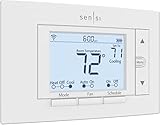
Overview: The Sensi ST55 leverages Emerson’s HVAC heritage to deliver a privacy-focused, user-friendly smart thermostat emphasizing straightforward installation, reliability, and core energy-saving features. What Makes It Stand Out: Sensi’s strongest selling point is its explicit commitment to data privacy – it won’t sell your information. The design mimics traditional thermostats (buttons, standard size) for easy wall replacement, and its app-guided DIY install works without a C-wire in most cases, minimizing installation hassle. Value for Money: Offering reliable ENERGY STAR savings (approx. 23%) and strong privacy at a competitive price, it provides good value. The focus on simplicity and avoiding wall damage appeals to renters or those disliking complex tech, though it lacks the advanced automation of top ecobee models. Strengths and Weaknesses: Strengths: Strong privacy policy, easy DIY install (no C-wire usually needed), traditional thermostat look/feel, reliable scheduling, HVAC usage reports. Weaknesses: Less sophisticated automation (e.g., no radar, basic occupancy), interface feels dated, limited smart home ecosystem depth compared to ecobee/Amazon. Bottom Line: A trustworthy, privacy-conscious choice for users prioritizing simple installation, traditional operation, and data security over cutting-edge smart features. Excellent value for straightforward, reliable smart thermostat functionality.
6. meross Smart Thermostat for Home, WiFi Thermostat Works with Matter, Alexa, Apple Home, Google Assistant, App & Voice Control, 7x24h Scheduling, Energy Saving, C-Wire Required

Overview: The meross Smart Thermostat is a Matter-compatible HVAC controller designed for broad home integration, supporting 95% of standard systems like heat pumps and furnaces—but requires checking C-wire compatibility and excludes electric baseboards.
What Makes It Stand Out: Its seamless Matter protocol integration enables local, low-latency control across Apple Home, Alexa, Google Assistant, and SmartThings, eliminating app overload. The 7x24 scheduling and real-time energy usage tracking in the meross app provide granular efficiency customization.
Value for Money: Priced mid-range, it undercuts premium brands while delivering robust Matter support and energy-saving analytics. Though C-wire dependency may necessitate installation costs, long-term HVAC bill reductions justify the investment for compatible homes.
Strengths and Weaknesses: Strengths: Universal Matter compatibility, detailed energy reports, smart alerts for maintenance, and flexible scheduling. Weaknesses: C-wire mandatory for many setups, excludes electric baseboard heaters, and lacks advanced features like geofencing.
Bottom Line: An excellent choice for Matter ecosystem adopters seeking reliable scheduling and cross-platform voice control, provided your HVAC system meets compatibility requirements—ideal for tech-savvy homeowners prioritizing integration over installation simplicity.
7. Google Nest Thermostat - Smart Thermostat for Home - Programmable Wifi Thermostat - Snow

Overview: This ENERGY STAR-certified Nest Thermostat (Snow finish) automates home comfort with AI-driven scheduling and remote control, targeting energy-conscious users with mostly C-wire-free installation.
What Makes It Stand Out: Its “Auto-Schedule” learns routines in days and adjusts temperatures when you’re away, while Savings Finder proactively suggests efficiency tweaks. Direct ENERGY STAR certification and utility rebates enhance its eco-appeal.
Value for Money: Competitive pricing is bolstered by potential rebates and verified energy savings. Though it lacks Matter support, seamless Google Home integration and no-C-wire operation (in most homes) reduce setup hurdles versus rivals.
Strengths and Weaknesses: Strengths: Intuitive learning algorithms, strong energy-saving proof, no-C-wire flexibility, and remote access via Google Home app. Weaknesses: No Matter protocol, limited third-party platform support, and no filter-life alerts.
Bottom Line: Highly recommended for Google ecosystem users wanting hassle-free energy savings, though Matter adopters should consider alternatives—best for those valuing simplicity and proven efficiency over broad smart-home compatibility.
8. Google Nest Thermostat - Smart Thermostat for Home - Programmable Wifi Thermostat - Charcoal
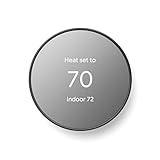
Overview: Identical to the Snow model but in Charcoal finish, this ENERGY STAR-certified thermostat uses AI to optimize heating/cooling, requiring minimal setup for most 24V HVAC systems.
What Makes It Stand Out: The signature “Farsight” display shows time/temp from across the room, while Auto-Schedule and Home/Away Assist eliminate manual programming. ENERGY STAR validation and rebate eligibility underscore its efficiency credentials.
Value for Money: Matches the Snow variant’s value—mid-priced with utility incentives offsetting cost. Strong long-term savings potential outweighs the lack of Matter support, especially for Google-centric households.
Strengths and Weaknesses: Strengths: Elegant design, effortless learning capabilities, no-C-wire operation (typically), and robust app ecosystem. Weaknesses: No Matter integration, limited voice assistant compatibility beyond Google, and absent maintenance reminders.
Bottom Line: A top pick for Google users seeking a sleek, self-programming thermostat with proven energy savings—opt for Charcoal purely for aesthetics, as functionality is identical to the Snow model.
9. meross Smart Thermostat for Home, WiFi Thermostat Works with Matter, Alexa, Apple Home, Google Assistant, App & Voice Control, 7x24h Scheduling, Energy Saving, C-Wire Required

Overview: Mirroring Product #6, this meross thermostat delivers Matter-enabled HVAC control for 95% of systems, emphasizing energy tracking and voice compatibility—but mandates C-wire verification pre-purchase.
What Makes It Stand Out: True Matter support ensures reliable local processing across Apple, Alexa, and Google platforms without cloud dependency. The meross app’s real-time energy consumption dashboard and customizable 7-day schedules enhance user control.
Value for Money: Offers premium Matter functionality at a budget-friendly price. Installation costs for C-wire may apply, but the thermostat pays for itself through reduced bills, outperforming non-Matter alternatives in versatility.
Strengths and Weaknesses: Strengths: Cross-platform Matter integration, detailed usage analytics, and comprehensive smart alerts (filter/system checks). Weaknesses: C-wire essential for many setups, incompatible with electric baseboards, and no geofencing.
Bottom Line: A compelling Matter-focused option for multi-ecosystem homes needing reliable scheduling and energy insights—prioritize compatibility checks to avoid installation issues.
10. vine Smart Thermostat for House, WiFi Thermostats for Home Compatible with Alexa and Google Assistant, 7day x 8period Programmable, Energy Star Certified, C-Wire Required

Overview: The vine Thermostat is an Energy Star-certified, C-wire-dependent unit with 7-day/8-period scheduling, targeting users seeking Alexa/Google voice control and basic automation at an entry-level price.
What Makes It Stand Out: Its standout feature is the QR-code pre-purchase compatibility check, minimizing installation errors. Child lock and filter-change reminders add practicality, while dual-app support (Vine/Smart Life) offers flexibility.
Value for Money: Budget-friendly with strong core functionality, though less polished than meross or Nest. Energy savings justify cost for compatible systems, but limited platform integration (no Matter) reduces long-term appeal.
Strengths and Weaknesses: Strengths: Easy compatibility verification, child lock, affordable price, and reliable voice control. Weaknesses: Only 90% HVAC compatibility, no Matter support, and basic app interface lacking advanced analytics.
Bottom Line: A solid budget pick for Alexa/Google users needing straightforward scheduling and essential alerts—ideal for renters or cost-focused buyers, but skip if Matter integration or deep energy insights are priorities.
Understanding Compatibility: The Foundation of Efficiency
Electrical System Requirements
Before falling for sleek interfaces or voice control promises, verify your home’s wiring compatibility. Many older homes lack a common “C-wire,” essential for continuous power to modern smart thermostats. While some models offer workarounds like power extender kits, these add complexity and potential failure points. A missing C-wire can lead to frequent battery replacements or erratic behavior, undermining both convenience and energy savings. Consult your existing thermostat’s wiring diagram or enlist a qualified HVAC technician to assess your system upfront—skipping this step risks costly returns or compromised performance.
HVAC System Integration
Your smart thermostat must communicate flawlessly with your heating, ventilation, and air conditioning (HVAC) system. Compatibility isn’t just about physical wires; it involves understanding your system type (e.g., single-stage, multi-stage, heat pump, or dual-fuel) and ensuring the thermostat supports its specific protocols. Mismatched systems can cause short-cycling (frequent on/off cycles), uneven heating/cooling, or even damage to your HVAC unit. Check manufacturer compatibility lists against your system’s model number—don’t rely solely on installer assurances, as mismatched installations are a leading cause of inefficiency.
Smart Home Ecosystem Alignment
Consider how the thermostat interacts with your broader smart home platform. Does it natively integrate with your voice assistant (like Google Assistant or Amazon Alexa) without requiring complex bridge devices? Will it trigger other energy-saving actions, such as dimming lights when “Away” mode activates? Seamless ecosystem integration prevents fragmented control and enables truly automated, energy-conscious routines. Prioritize devices with open APIs or proven compatibility with your existing hubs to avoid future obsolescence as your smart home evolves.
Multi-Zone System Considerations
Homes with multiple HVAC zones present unique challenges. A single smart thermostat won’t optimize whole-house efficiency if it only controls one zone. Look for systems offering multi-thermostat coordination or dedicated zoning controllers that sync schedules across zones based on occupancy and weather. Managing zones intelligently—like reducing heating in unoccupied bedrooms while maintaining comfort in living areas—is where significant energy savings materialize, but it requires hardware designed for this complexity from the outset.
Essential Features for Genuine Energy Savings
Adaptive Learning Capabilities
True adaptive learning goes beyond simple schedule programming. The most effective models analyze your manual adjustments, occupancy patterns, and even local weather forecasts over weeks to create a hyper-personalized temperature schedule. Crucially, they should allow easy overrides without “forgetting” learned preferences, adapting dynamically to your changing routine. Avoid thermostats that demand rigid schedules; real life is unpredictable, and your device must accommodate that while still optimizing efficiency.
Precise Geofencing Technology
Geofencing uses your smartphone’s location to trigger “Away” or “Home” modes automatically. However, not all implementations are equal. Effective geofencing requires adjustable radius settings to prevent false triggers (e.g., stopping the AC while you’re just taking out the trash). Look for models that use multiple location data points for accuracy and offer “arrival prediction” to start conditioning your home just before you get back, avoiding unnecessary runtime. Poorly tuned geofencing wastes more energy than it saves.
Detailed Energy Usage Reporting
Transparency is key to understanding your savings. The best devices provide clear, visual breakdowns of heating and cooling runtime, comparing your usage to previous periods or local benchmarks. They should highlight specific opportunities for improvement, such as “Your system ran 30% longer than average during hot afternoons—consider raising the setpoint by 2°F.” Vague “energy score” metrics without actionable insights are largely meaningless for driving real behavioral change.
Weather Intelligence Integration
Advanced models pull hyperlocal weather data to pre-emptively adjust settings. For instance, anticipating a sudden cool front might delay turning on the AC, or sensing high humidity could trigger earlier dehumidification cycles for greater comfort at higher temperatures. This proactive adjustment prevents the system from playing catch-up, reducing strain on your HVAC and smoothing energy demand spikes that burden the grid.
Utility Program Participation
Many local energy providers offer rebates or bill credits through demand-response programs. Compatible smart thermostats can automatically participate by slightly adjusting temperatures during peak grid stress events (with your permission), often without noticeable comfort impact. Verify if your utility partners with specific thermostat brands and understand the opt-in/opt-out process—this can unlock significant financial incentives while supporting grid stability.
Installation and Setup: Where Savings Begin
Professional Installation vs. DIY
While DIY installation seems appealing, improper setup is a major cause of inefficiency. Complex wiring errors or incorrect system configuration can lead to constant compressor short-cycling, drastically increasing energy use. For heat pumps, dual-fuel systems, or homes without a C-wire, professional installation by an HVAC technician familiar with smart thermostats is strongly recommended. The upfront cost often pays off through optimized performance and avoided damage.
Strategic Placement Matters
Thermostat location significantly impacts accuracy and efficiency. Avoid placing it near drafts, direct sunlight, heat-generating appliances (like ovens or TVs), or exterior doors. A hallway on an interior wall, roughly 5 feet above the floor, is typically ideal. An incorrectly placed thermostat senses false temperatures, causing the system to overwork—negating potential savings. Take time to evaluate placement during installation; it’s harder to correct later.
Initial Configuration Discipline
The setup process is critical. Rushing through occupancy detection calibration or ignoring seasonal adjustment prompts cripples learning capabilities. Dedicate time to accurately input your typical weekday/weekend schedules and manually adjust temperatures for the first 1-2 weeks to “teach” the system your preferences. Skipping this training phase leaves the thermostat guessing, leading to comfort compromises and wasted energy.
Maximizing Sustainability Impact
Leveraging Scheduling for Off-Peak Savings
Understanding your utility’s time-of-use (TOU) rates allows strategic scheduling. Program higher cooling setpoints during expensive peak hours (e.g., late afternoon) and pre-cool your home slightly during cheaper off-peak morning hours. Some advanced thermostats automate this by integrating directly with TOU rate schedules, shifting energy use to when renewable sources are more abundant on the grid.
Humidity Control Synergy
In humid climates, managing moisture is as crucial as temperature for comfort and efficiency. Look for thermostats that integrate with whole-home dehumidifiers or control HVAC fan cycles to optimize dehumidification. Running the AC primarily for dehumidification at higher setpoints (e.g., 78°F with low humidity) often uses less energy than setting it to 72°F while battling moisture, reducing overall load.
Long-Term System Health Monitoring
The most sophisticated models provide diagnostic alerts for potential HVAC issues, like abnormally long runtimes or restricted airflow. Early detection of problems like a failing blower motor or dirty filter prevents your system from working inefficiently (and expensively) for weeks or months. Proactive maintenance driven by these insights extends equipment life and sustains peak efficiency.
Frequently Asked Questions
Frequently Asked Questions
How much can I realistically save on energy bills with a smart thermostat? Most users see 10-15% annual savings on heating and cooling costs through optimized scheduling and reduced runtime, though results vary significantly based on climate, home insulation, HVAC efficiency, and user engagement with the device’s features.
Do I need a C-wire for a smart thermostat to work properly? While some models function without a C-wire using power-stealing techniques or rechargeable batteries, a dedicated C-wire provides stable, continuous power essential for reliable operation, advanced features like Wi-Fi, and preventing system strain—highly recommended for optimal performance and longevity.
Can a smart thermostat really reduce my carbon footprint? Yes, by minimizing unnecessary HVAC runtime and enabling participation in utility demand-response programs, smart thermostats directly reduce household electricity/gas consumption. When powered by a grid increasingly using renewables, these efficiency gains translate to lower carbon emissions.
How does geofencing actually save energy compared to manual scheduling? Geofencing eliminates human error in remembering to adjust settings when leaving or returning home. It ensures conditioning only occurs when needed based on real-time occupancy, preventing energy waste from prolonged “Away” periods or premature “Home” mode activation.
Are there hidden costs beyond the thermostat purchase price? Potential costs include professional installation (especially for complex systems), optional power extender kits for missing C-wires, and potential HVAC service if compatibility issues arise. Rebates from utilities often offset the initial purchase cost significantly.
Will a smart thermostat work with my older HVAC system? Many do, but compatibility is not guaranteed. Older systems (especially non-digital controls or certain heat pumps) may lack necessary wiring or communication protocols. Always verify compatibility using your HVAC model number before purchasing.
How long does it take for a smart thermostat to “learn” my schedule? True adaptive learning typically requires 1-2 weeks of consistent manual adjustments. During this period, the thermostat observes your preferences and refines its schedule. Initial schedules set during setup provide a baseline, but learning improves over time with usage.
Can smart thermostats help improve indoor air quality? Indirectly, yes. By optimizing HVAC runtime and enabling alerts for filter changes or system issues, they support better airflow management. Some advanced models integrate with air quality sensors to trigger ventilation when pollutants rise, improving health without excessive energy use.
What happens during a power outage? Most smart thermostats have internal batteries preserving settings for several hours. Upon power restoration, they revert to a basic safety schedule (e.g., 60°F in winter, 85°F in summer) to prevent pipe freezing or extreme heat until connectivity resumes and the regular schedule reloads.
Is the data collected by smart thermostats secure? Reputable brands use encryption for data transmission and storage. Review the manufacturer’s privacy policy regarding data usage (e.g., anonymized grid data for utility programs). Ensure your home Wi-Fi network uses strong passwords and WPA2/WPA3 encryption to protect device access.
See Also
- The 10 Best Smart Thermostats Every Renter Needs This Year
- The 10 Best Smart Thermostats Every First-Time Homeowner Needs This Year
- 10 Essential Thermostats with Sensors Every Smart Home Owner Needs in 2026
- Why Voice-Controlled Smart Thermostats Are Revolutionizing Home Comfort in 2026
- The 10 Best Remote Controls for Thermostats Every First-Time Homeowner Needs This Year