Table of Contents
Summer heat turning your compact living space into an oven? You’re not alone. Many of us rely on portable air conditioners for targeted cooling without the commitment of a window unit or central AC, especially in apartments, home offices, or studios where space is tight. Single-hose models, often praised for their simplicity and lower upfront cost, seem like the perfect solution for small rooms. But navigating the sea of options while avoiding costly mistakes requires knowing exactly what to look for beyond just the BTU rating.
Choosing the wrong portable AC can lead to frustration: inadequate cooling, sky-high energy bills, or constant noise disrupting your peace. Single-hose units present unique challenges compared to their dual-hose counterparts, particularly in efficiency and room pressurization. This guide cuts through the marketing hype, focusing on the critical features and considerations specifically for single-hose portable air conditioners in confined spaces. Forget fleeting “best of” lists; we’ll equip you with the lasting knowledge to pick the ideal unit that actually delivers comfort without draining your wallet or sanity.
Top 10 Single Hose Portable Air Conditioners
Detailed Product Reviews
1. 8,000 BTU Portable Air Conditioners, Quiet Portable Cooling AC Unit Up to 350 Sq.Ft. with Dehumidifier, 24H Timer, Sleep Modes, 3 in-1 AC Unit with Remote Control, for Bedroom, Room, Office,Apartment

Overview: This portable air conditioner delivers 8,000 BTU cooling for spaces up to 350 sq.ft., featuring a compressor system, dehumidifier, and fan in one unit. Designed for bedrooms or offices, it includes a 24-hour timer, sleep mode, and remote control.
What Makes It Stand Out: Its standout traits are the high CEER 6.2 energy efficiency, 44-pt daily dehumidification, and tool-free window installation. The large LED display and washable filter enhance usability, while 64 dB sleep mode ensures quiet operation.
Value for Money: Priced competitively for its cooling capacity, it outperforms smaller units in coverage and humidity control. Though pricier than basic models, the energy savings and 3-in-1 functionality justify the cost for medium rooms.
Strengths and Weaknesses: Strengths include robust cooling, easy mobility via caster wheels, and intuitive remote control. Weaknesses are the limited 23-ft remote range and the need for drain piping in high-humidity areas during dry mode.
Bottom Line: Ideal for bedrooms up to 350 sq.ft., this efficient, feature-rich unit earns strong recommendation for its balance of power, quiet operation, and user-friendly design.
2. Uhome Portable Air Conditioner, 8000 BTU Compact AC Unit with Cooling, Dehumidifier, Fan, Remote Control and Window Mount Kit Included, White

Overview: A compact 8,000 BTU portable AC targeting rooms up to 200 sq.ft., offering cooling, dehumidification, and fan functions. It includes a remote, window kit, and emphasizes quiet operation below 55 dB for bedrooms or offices.
What Makes It Stand Out: The ultra-quiet 55 dB operation and self-evaporating design (no bucket) differentiate it. The washable filter and 40-pt dehumidification add convenience, while the digital touch panel simplifies adjustments.
Value for Money: Best suited for small spaces, it’s affordable but limited by its 200 sq.ft. coverage—less versatile than competitors covering 350+ sq.ft. The price aligns with entry-level portables, though BTU efficiency lags slightly.
Strengths and Weaknesses: Strengths are whisper-quiet performance, easy filter maintenance, and straightforward setup. Weaknesses include undersized room coverage, ambiguous humidity-triggered compressor behavior, and no explicit drainage solution for high humidity.
Bottom Line: Recommended only for very small rooms under 200 sq.ft. where silence is critical; overlook for larger spaces due to coverage limitations.
3. DREO Portable Air Conditioners, 8000 BTU ASHRAE (5000 BTU DOE) Smart AC Unit for Bedroom with Drainage-free Cooling, 45dB Quiet, APP/Voice/Remote, Portable AC for Room Indoors, AC318S

Overview: This smart 8,000 BTU ASHRAE (5,000 BTU DOE) unit cools up to 500 sq.ft. with app/voice control, a drainage-free system, and ultra-quiet 45 dB operation. Designed for tech-savvy users seeking bedroom comfort.
What Makes It Stand Out: Patented noise isolation (45 dB), true drainage-free operation under 90% humidity, and smart integration (Alexa/Google/Home) are exceptional. The “sleep curve” app feature customizes cooling for rest cycles.
Value for Money: Premium-priced but justified by smart capabilities and near-silent performance. Outshines budget models in innovation, though the ASHRAE/DOE BTU discrepancy requires buyer awareness for accurate comparisons.
Strengths and Weaknesses: Strengths include groundbreaking quietness, app versatility, and effective self-evaporation. Weaknesses are the confusing BTU rating, limited drainage-free efficacy in extreme humidity, and potential app dependency.
Bottom Line: Highly recommended for tech-oriented users prioritizing silence and smart features; verify room size against DOE-rated BTU for realistic expectations.
4. Portable Air Conditioner, 1800 BTU for Rooms, Quiet Operation Bedroom Air Cooler with Sleep Mode and Remote Control, Low power consumption, Cools for 110 Sq Ft
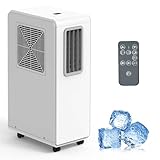
Overview: A minimal 1,800 BTU personal cooler for spaces up to 110 sq.ft., functioning as an air cooler, dehumidifier, and fan. Focused on bedside use with ultra-quiet sleep mode and remote control.
What Makes It Stand Out: Its 38–44 dB noise level is exceptional for nighttime use, while the 3.5L tank enables extended runtime. The compact size and 10–14°C cooling delta suit personal microenvironments like desks or single beds.
Value for Money: Affordable for its niche role, but ineffective as a primary room AC. Best for supplemental cooling—value hinges on needing ultra-quiet personal comfort, not whole-room solutions.
Strengths and Weaknesses: Strengths are whisper-quiet operation, long runtime, and remote convenience. Weaknesses include severely limited cooling capacity (not a true AC), no compressor-based dehumidification, and minimal temperature reduction.
Bottom Line: Only recommend for personal spot-cooling in tiny areas; avoid for room-wide cooling due to underpowered performance.
5. Black+Decker 10000 BTU Portable Air Conditioner Unit, Remote, LED Display, Window Vent Kit, 4 Caster Wheels, White

Overview: A high-capacity 10,000 BTU ASHRAE (5,800 BTU DOE) unit for rooms up to 450 sq.ft., featuring 3-in-1 functionality, remote control, and eco-friendly R410a refrigerant. Targets larger spaces with mobility-focused design.
What Makes It Stand Out: Broad 450 sq.ft. coverage and R410a refrigerant set it apart. The slide-out washable filter, auto-evaporation, and dual handles with casters enhance practicality for room-to-room use.
Value for Money: Competitive for its scale, though real-world cooling aligns closer to its 5,800 DOE BTU rating. Offers solid value for large rooms but requires verifying actual coverage against specs.
Strengths and Weaknesses: Strengths include strong airflow, easy mobility, and reliable build quality. Weaknesses are ambiguous noise-level data and potential overstatement of 450 sq.ft. efficacy in extreme heat.
Bottom Line: Recommended for large rooms under 400 sq.ft. needing robust cooling; confirm DOE BTU suitability before purchase for realistic performance expectations.
6. AKIRES 10000 BTU Portable Air Conditioners,3-IN-1 Portable AC Unit With Fan & Dehumidifier,Remote Control,24H Timer, Sleep Modes,Cools Room Up To 450 sq.ft,Suitable for Bedroom, Room, Office,Apartment

Overview:
This 10,000 BTU (ASHRAE) portable AC cools spaces up to 450 sq. ft., featuring cooling, fan, and dehumidification modes. Ideal for bedrooms, offices, or apartments, it promises rapid cooling between 62°F–86°F with a self-evaporating system to minimize manual drainage. Installation is marketed as a 10-minute process.
What Makes It Stand Out:
Its standout features include a 1.2L/H dehumidification rate, ultra-quiet sleep mode (<50 dB), and seamless mobility via 360° casters. The self-evaporating system significantly reduces drainage frequency, while the dual drainage ports (middle/bottom) accommodate high-humidity scenarios without interrupting operation.
Value for Money:
Priced competitively for its 10,000 BTU capacity, it outperforms smaller units in coverage and humidity control. The inclusion of a full window kit, remote, and timer justifies the cost versus basic models, though premium smart features (e.g., app control) are absent, keeping it accessible for budget-conscious buyers.
Strengths and Weaknesses:
Strengths: Efficient cooling for medium-large rooms; exceptional dehumidification; quiet operation; tool-free installation; versatile drainage options.
Weaknesses: SACC rating (6,000 BTU) may cool slower than ASHRAE suggests; remote requires separate batteries; window kit compatibility limited to standard slides.
Bottom Line:
A reliable, feature-rich choice for cooling and dehumidifying spaces up to 450 sq. ft. Its ease of use and low-maintenance drainage make it ideal for renters or offices, though verify SACC performance expectations.
7. 12,000 BTU Portable Air Conditioner Cools Up to 500 Sq.Ft, 3-IN-1 Energy Efficient Portable AC Unit with Remote Control & Installation Kits for Large Room, Campervan, Office, Temporary Space

Overview:
This 12,000 BTU (ASHRAE) unit cools areas up to 500 sq. ft. using R32 refrigerant, with cooling, dehumidification, and fan modes. ETL-certified and energy-efficient, it targets large rooms, campervans, or offices, operating between 61°F–88°F. Its self-evaporating system minimizes drainage needs.
What Makes It Stand Out:
The R32 refrigerant enhances eco-efficiency and cooling speed, while smart sensors enable auto-swing and precise temperature control. The comprehensive installation kit fits most sliding windows, and the 23-ft-range remote simplifies operation. Continuous drainage via included hose eliminates manual emptying in humid conditions.
Value for Money:
At its price point, the higher BTU capacity and R32 technology offer superior cooling for large spaces compared to 10,000 BTU models. The inclusion of a washable filter and versatile window kit adds long-term value, though the lack of app control may deter tech-focused users.
Strengths and Weaknesses:
Strengths: Powerful cooling for 500 sq. ft.; energy-efficient R32 refrigerant; no daily drainage; child lock and auto-mode; easy mobility.
Weaknesses: Remote batteries not included; window kit may require minor adjustments; dehumidification mode necessitates hose connection.
Bottom Line:
An excellent investment for large or high-heat spaces seeking robust, low-maintenance cooling. Its efficiency and capacity justify the cost, especially for temporary or multi-use environments like campervans.
8. Midea 10,000 BTU ASHRAE (7,100 BTU SACC) Portable Air Conditioner, Smart Control, Cools up to 300 Sq. Ft., with Dehumidifier & Fan mode, Easy- to-use Remote Control & Window Installation Kit Included

Overview:
Midea’s 10,000 BTU (ASHRAE) portable AC targets rooms up to 300 sq. ft., offering cooling, fan, and dehumidification. It emphasizes smart connectivity via app and voice control (Alexa/Google), with a 24-hour timer and washable filter. Installation suits windows 26.5–48 inches wide.
What Makes It Stand Out:
True smart integration sets it apart: control via app or voice commands, plus scheduling for energy savings. The compact design includes a pre-battery remote and intuitive LED display. The washable filter ensures air quality, while the conservative 300 sq. ft. rating aligns closely with its SACC performance.
Value for Money:
Priced higher than non-smart competitors, it’s justified for tech-savvy users prioritizing convenience. The smaller room coverage (vs. 450 sq. ft. claims elsewhere) reflects realistic SACC output, avoiding overpromising. Long-term savings from scheduling offset the premium.
Strengths and Weaknesses:
Strengths: Seamless smart-home integration; accurate room sizing; easy setup; excellent air filtration; reliable brand support.
Weaknesses: Limited to 300 sq. ft. (less than competitors); app dependency for full features; no continuous drainage option.
Bottom Line:
Highly recommended for small spaces and smart-home enthusiasts. Its honest performance metrics and tech features deliver premium value, though larger rooms require higher-BTU alternatives.
9. EUHOMY 10,000 BTU Portable Air Conditioners Up to 450 sq.ft, 3-1 Standing Smart Cooling AC with Remote, Dehumidifier, Fan, Air Conditioner Cools Room, 3 Modes, 24-hour timer, LED Display, Bedroom

Overview:
EUHOMY’s 10,000 BTU (ASHRAE) unit cools up to 450 sq. ft. with three modes (cooling, dehumidifier, fan) and a 16-ft airflow range. It includes a 24-hour timer, sleep mode, and ETL certification. Installation is designed for standard sliding windows but has specific size constraints.
What Makes It Stand Out:
The 350 m³/h airflow ensures rapid cooling across large spaces, while the sleep mode reduces noise to 52–54 dB. Dual drainage ports and a humidity-focused dehumidifier (51 pints/day) stand out. The remote enables °C/°F switching and sleep activation from 23 feet.
Value for Money:
It competes well on price for 450 sq. ft. coverage, with robust dehumidification and quiet operation. However, the window kit’s limitation (requires trimming for 25.6–36-inch windows) adds minor hassle. Better value than premium brands but less refined than Midea’s smart features.
Strengths and Weaknesses:
Strengths: Strong airflow and cooling range; effective dehumidification; energy-saving auto-shutoff; user-friendly remote.
Weaknesses: Window kit incompatibility with mid-size windows; drainage hose mandatory in dry mode; sleep mode noise slightly higher than rivals.
Bottom Line:
A solid budget-friendly option for medium-large rooms needing aggressive cooling and dehumidification. Ideal for bedrooms or garages, but verify window dimensions before purchase.
10. MEPTY Portable Air Conditioners, 10000 BTU Portable AC Unit with Dehumidifier, Sleep Mode, 24H Timer, Cools Room up to 450 sq.ft, Room Air Conditioners with Self-evaporation System for Bedroom

Overview:
MEPTY’s 10,000 BTU portable AC cools rooms up to 450 sq. ft. with cooling, dehumidifying, and fan modes. It features a self-evaporation system, sleep mode with auto-temperature adjustment, and 24-hour timer. Safety protections include anti-frozen and water-full auto-shutoff.
What Makes It Stand Out:
Its sleep mode uniquely raises temperature by 1°F incrementally to save energy overnight. The self-evaporation system minimizes drainage, while compressor delay restart and water-full alarms enhance durability. Washable filters and tool-free installation add user convenience.
Value for Money:
Offers exceptional value with comprehensive safety features and low maintenance at a mid-range price. Outshines similarly priced units with its energy-saving sleep algorithm and reliable self-evaporation. Lacks smart features but excels in core functionality for bedrooms or offices.
Strengths and Weaknesses:
Strengths: Intelligent sleep mode; minimal drainage needs; robust safety protections; easy two-week filter cleaning; versatile room compatibility.
Weaknesses: No app/smart control; remote lacks °C/°F toggle; window kit may not seal perfectly on non-standard windows.
Bottom Line:
A top pick for safety-conscious users prioritizing hassle-free, energy-efficient cooling. Perfect for bedrooms where quiet, reliable operation matters most—skip if you demand smart connectivity.
Understanding Single-Hose Portable ACs for Compact Spaces
Why Single-Hose Makes Sense for Small Rooms
Single-hose portable air conditioners extract warm indoor air, cool it, and expel the resulting hot exhaust outside through a single flexible hose. For very small rooms (typically under 300 square feet), this simpler design often suffices. They are generally more affordable, easier to install with basic window kits, and take up less physical space than dual-hose models. The reduced complexity can also mean fewer potential points of failure for the DIY user.
The Core Efficiency Challenge Explained
The fundamental drawback of single-hose units lies in physics. As the unit pulls warm room air over the evaporator coil to cool it, it simultaneously pushes all the hot exhaust air outside through the single hose. This creates negative pressure inside the room. To equalize, cooler (but often more humid) air gets sucked in from outside through any available gaps – doors, windows, electrical outlets. This infiltration significantly reduces overall cooling efficiency, especially in very hot or humid climates, as the unit constantly fights incoming warm air.
Sizing: The Non-Negotiable Starting Point
Selecting the correct cooling capacity, measured in BTUs (British Thermal Units), is paramount. Undersized units will run incessantly without cooling the room, wasting energy. Oversized units cool too quickly, failing to adequately dehumidify the air, leading to a clammy, uncomfortable environment. For small rooms (100-300 sq ft), the typical range is 5,000 to 8,000 BTUs. Always calculate based on your room’s exact size, ceiling height, sun exposure (south/west-facing windows add 10%), number of occupants, and heat-generating appliances. Manufacturer charts are a starting point, but err slightly on the higher side if your room has significant heat load factors.
Key Features to Prioritize for Small Room Comfort
Noise Levels: Quieter is Crucial in Close Quarters
Noise tolerance is critical in a small room where you’re likely within a few feet of the unit. Look for models specifically advertising low decibel (dB) ratings, ideally below 50 dB on their lowest fan setting – comparable to a quiet conversation. Check reviews mentioning noise performance, as advertised figures can sometimes be optimistic. Units with sleep modes that further reduce fan speed and compressor noise are highly valuable for bedrooms.
Energy Efficiency Ratio (EER) Matters More Than You Think
While single-hose units are inherently less efficient than dual-hose or window units due to the negative pressure issue, a higher Energy Efficiency Ratio (EER) still translates to lower operating costs. The EER is calculated as BTUs divided by watts consumed. Aim for the highest EER possible within your budget and BTU range for a small room. Even a difference of 1-2 points can add up significantly over a summer of frequent use. Look for the yellow EnergyGuide label for standardized comparisons.
Smart Controls and Programmability Enhance Usability
Basic on/off timers are standard, but advanced programmability offers real benefits in small spaces. Look for 24-hour timers, multiple fan speeds, adjustable thermostats (not just “high/low” cooling), and eco-modes that optimize runtime. Remote controls are almost essential for units placed across a small room. Wi-Fi connectivity, while not essential, allows for convenient adjustment from your phone and integration with smart home systems, adding significant convenience.
Compact Design and Maneuverability
Footprint and weight are critical in tight spaces. Measure your intended location carefully. Look for units with a narrow depth if placing against a wall near furniture. Integrated handles and smooth-rolling casters (preferably 360-degree swivel) make repositioning for cleaning, storage, or optimizing airflow much easier within confined areas. Consider where the exhaust hose exits – side or rear discharge might suit your window setup better.
Dehumidification Capability: A Hidden Benefit
Portable ACs inherently dehumidify as they cool. For small, potentially damp rooms (like basements or sunrooms), a unit with a dedicated dehumidification mode (running the fan/compressor without active cooling) is a valuable bonus. Check the rated water removal capacity (pints per day) if humidity is a major concern, even if you primarily use it for cooling.
Installation and Operation Nuances for Single-Hose Units
Mastering the Window Kit Installation
A proper, airtight window installation is non-negotiable for single-hose efficiency. Leaks around the kit drastically worsen the negative pressure problem, sucking in more hot outdoor air. Choose kits with flexible foam panels or high-density rubber seals that conform well to your window frame. Ensure the kit blocks the entire window opening above/beside the hose path. Temporary fixes like cardboard or towels are ineffective and unsafe. Practice installation before peak heat hits.
Managing the Exhaust Hose Effectively
Keep the exhaust hose as short and straight as possible. Each bend and extra foot of hose reduces airflow and efficiency. Never kink the hose. Ensure the outdoor end has clearance (several inches) from walls or obstructions to allow hot air to disperse freely. Blocking the outdoor end (e.g., by stuffing it into a tight hole) creates backpressure, straining the compressor and reducing cooling output significantly. Consider the hose length included – longer isn’t better for performance.
The Importance of Proper Ventilation Strategy
Understand that single-hose units require some makeup air. While you want to seal the window kit tightly, do not seal the room airtight otherwise. Slightly crack an interior door or another window opposite the AC unit to provide a controlled path for replacement air. This reduces the negative pressure and the amount of hot, humid outdoor air pulled in through random leaks, improving overall efficiency and comfort. Avoid placing the unit directly in a doorway.
Maintenance and Longevity Considerations
Tackling Condensate Management Simply
Single-hose units in typical home humidity generate condensation. Most have internal tanks that auto-evaporate most moisture using exhaust heat, but in very humid conditions, a drain hose or manual tank emptying might be needed. Look for models with a clear indicator light for tank fullness. For small rooms, auto-evaporation is usually sufficient, but understand the mechanism. Avoid units requiring frequent manual draining unless you’re diligent.
Filter Access and Cleaning Frequency
Easy access to the air filter is vital for maintaining airflow and efficiency. In small rooms where the unit might run constantly, filters get dirty faster. Choose models where the filter is readily accessible without tools, often behind a front grille. Washable filters are standard; clean them at least every two weeks during heavy use. Blocked filters drastically reduce cooling and increase energy consumption.
Storage Solutions for Off-Seasons
Consider where you’ll store the unit when not in use. Compact designs are easier to tuck away in closets or under beds. Ensure the exhaust hose can be neatly coiled and secured, often with built-in storage hooks. Protect the unit from dust with a breathable cover. Proper storage extends the unit’s lifespan significantly.
Maximizing Performance and Minimizing Drawbacks
Strategic Placement Within the Room
Position the unit away from walls and furniture (at least 20 inches on all sides, especially the rear/exhaust) for optimal airflow. Place it near the window where the hose exits to minimize hose length. Avoid direct sunlight on the unit itself. For the best cooling distribution in a small room, central placement is often ideal, but prioritize the shortest, straightest hose run to the window.
Complementing with Fans for Even Cooling
A small oscillating fan placed strategically in the room works wonders with a portable AC. It helps circulate the cooled air more evenly, preventing cold spots near the unit and warm spots elsewhere, allowing you to potentially set the AC thermostat slightly higher for energy savings. Ceiling fans are also excellent complements.
Understanding Realistic Expectations
Be realistic: single-hose portables won’t cool a small room as powerfully or efficiently as a properly sized window unit or mini-split. They are best suited for moderate climates or as supplemental cooling. Don’t expect to maintain 68°F (20°C) in a 100°F (38°C) heatwave in a poorly insulated room. Focus on achieving a comfortable, livable temperature reduction efficiently.
Frequently Asked Questions
How do I stop my single-hose portable AC from making my room feel stuffy?
The stuffiness is often due to humidity. Ensure your unit is correctly sized (not oversized) and the filter is clean. Run it continuously on a lower setting rather than cycling on/off. Consider using a standalone dehumidifier alongside it if humidity is severe, or slightly crack an interior door for better air exchange.
Can I vent a single-hose portable AC through a dryer vent?
Generally, no. Dryer vents are designed for low-pressure, intermittent exhaust and often have long, restrictive bends. The continuous, higher-pressure exhaust from an AC can cause backpressure, reduce efficiency significantly, potentially overheat the unit, and create a fire hazard due to lint buildup. Always use a dedicated, short, straight window vent kit.
Why is my single-hose AC blowing warm air?
Common causes include a dirty air filter restricting airflow, the exhaust hose kinked or blocked, the window kit poorly sealed (allowing hot air recirculation), the unit being undersized for the room, or low refrigerant (requiring professional service). Check the filter and hose first.
Do single-hose portable ACs bring in outside air?
No, they do not intentionally bring in outside air. However, the negative pressure they create sucks in unconditioned outside air through cracks and gaps in the room’s envelope (windows, doors, outlets) to replace the air being exhausted. This is the core efficiency drawback.
How often should I empty the water tank?
With auto-evaporation (common in single-hose units), you typically shouldn’t need to empty a tank regularly in average humidity. Only in very high humidity might a “full tank” indicator light come on, requiring draining via the hose or manual tank. Consult your manual.
Are single-hose units cheaper to run than dual-hose?
Not necessarily. While often cheaper to buy, single-hose units are generally less energy efficient due to the negative pressure effect, meaning they may consume more electricity to cool the same small space over time compared to a properly sized dual-hose unit. Check the EER rating.
Can I use a single-hose AC in a room with no windows?
Venting is absolutely essential. Without a window (or potentially a sliding door or specially designed wall sleeve), you cannot safely vent the hot exhaust. Using it without proper venting will rapidly overheat the room and the unit, creating a fire hazard. It’s not feasible.
What’s the ideal temperature setting for energy savings?
Set the thermostat to the highest temperature you find comfortable, typically between 75°F and 78°F (24°C - 26°C). Every degree lower significantly increases runtime and energy consumption. Use fans to create a wind-chill effect allowing a higher thermostat setting.
Why is my portable AC so loud on the highest setting?
High fan and compressor noise on max setting is normal operation as the unit works hardest. If noise seems excessive compared to expectations, ensure it’s on a level, stable surface, the exhaust hose isn’t vibrating against the window, and the air filter is clean. Some inherent noise is unavoidable.
How can I improve the efficiency of my single-hose portable AC?
Key steps: Ensure perfect window kit sealing, minimize exhaust hose length and bends, keep filters clean, use ceiling/floor fans for air circulation, close curtains/blinds on sunny windows, only cool the occupied room, and set the thermostat higher with fans for comfort.
See Also
- Why Single Hose Portable Air Conditioners Are Still a Smart Choice for Small Spaces in 2026
- 10 Best Mini Split Air Conditioners for Small Rooms This Year
- 10 Best Dual Hose Portable Air Conditioners for Fast Room Cooling This Year
- 10 Expert-Recommended Single Hose Portable Air Conditioners for Easy Setup in 2026
- 10 Expert-Recommended Single Hose Portable Air Conditioners for Easy Installation in 2026