Table of Contents
Working in a chilly workshop isn’t just uncomfortable—it can grind productivity to a halt and even compromise safety when fingers get stiff handling tools. Mechanics know the frustration of wrestling with stubborn bolts in freezing conditions, where a simple task becomes a battle against the cold. The right heating solution isn’t a luxury; it’s essential equipment for maintaining workflow, protecting sensitive tools from temperature swings, and ensuring personal well-being during those long winter shifts. Forget space heaters meant for living rooms; the demanding environment of an auto shop requires something built tougher, smarter, and specifically designed to handle the unique challenges of grease, drafts, and constant movement.
Choosing the wrong heater can lead to wasted money, frequent replacements, or worse—serious safety hazards in a space filled with flammable materials. You need a unit that delivers robust, targeted warmth without becoming a fire risk near solvents or oil spills. This guide cuts through the marketing noise to focus on the critical features mechanics must prioritize. We’ll explore the engineering and safety standards that matter most in a professional setting, helping you invest in reliable warmth that won’t quit when you need it most. Understanding these fundamentals ensures you select a heater that integrates seamlessly into your workflow, providing consistent, safe heat season after season.
Top 10 Shop Fan Heaters
Detailed Product Reviews
1. Dura Heat EUH1465 Electric Forced Air Heater with Pivoting Base 5,120 BTU, Yellow

Overview:
This rugged 1,500W forced-air heater targets workshops and garages with its durable steel build and pivoting base. It prioritizes straightforward, no-frills heating for small commercial or DIY spaces where durability matters most.
What Makes It Stand Out:
Its standout feature is the heavy-duty steel construction, engineered for harsh environments like garages. The pivoting base allows directional heat control, while dual modes (heat/fan-only) and a built-in thermostat offer practical flexibility uncommon in budget heaters.
Value for Money:
Priced accessibly, it delivers exceptional durability for the cost—outlasting plastic-bodied competitors. While lacking advanced features like remote control, its steel chassis and reliable PTC ceramic heating justify the investment for users needing a workhorse heater in demanding settings.
Strengths and Weaknesses:
Strengths: Extremely robust steel housing; pivoting base for targeted warmth; overheat protection; simple thermostat control.
Weaknesses: Limited to basic settings (no low-heat option); yellow color may not suit all decors; thermostat precision is functional but not refined.
Bottom Line:
Ideal for budget-conscious users needing a tough, reliable heater for garages or workshops. Skip if you require nuanced temperature control or multi-room portability.
2. Techni Home Industrial Electric Forced Air Heater with Ceramic Heating Element, Adjustable Tilt, Overheat Protection, Portable Shop Garage Heater for Indoor/Outdoor Use, 1500W

Overview:
This versatile 1,500W ceramic heater blends industrial durability with user-friendly features. Designed for workshops, garages, and even outdoor job sites, it emphasizes efficient heat distribution and adaptable operation.
What Makes It Stand Out:
Three distinct modes (fan/low/high) provide year-round utility, while the adjustable tilt angle directs heat precisely. The ceramic element ensures rapid, even warmth without excessive energy drain—a rarity in portable heaters at this price.
Value for Money:
Offers premium ceramic efficiency at a mid-range cost. Competitors often charge more for comparable safety (overheat/tip-over protection) and tilt functionality. Energy-saving potential via thermostat control further enhances long-term savings in drafty spaces.
Strengths and Weaknesses:
Strengths: True multi-mode versatility; precise thermostat; sturdy tilt mechanism; excellent heat consistency; safe for indoor/outdoor use.
Weaknesses: Power cord lacks storage wrap; no carry handle; ceramic element requires careful handling to avoid damage.
Bottom Line:
A top pick for users seeking adaptable, efficient heating across seasons. Choose this over basic models if you value thermostat accuracy and targeted warmth.
3. Comfort Zone Utility Space Heater, 1500W Electric Garage Heater with Adjustable Thermostat, Fan/Low/High Heat Settings, Tip-Over & Overheat Protection, Milkhouse Style, ETL Listed

Overview:
This 1,500W “milkhouse” styled heater combines classic utility with modern safety. Tailored for garages and workshops, it focuses on essential performance and robust protection in a compact, ETL-listed package.
What Makes It Stand Out:
Dual safety systems (tip-over switch + overheat protection) exceed basic standards, providing peace of mind in high-traffic areas. The simple dial controls and fan/low/high settings prioritize ease of use, especially with gloves on.
Value for Money:
Exceptionally affordable for its safety certifications and thermostat functionality. While less feature-rich than pricier models, it outperforms budget heaters in reliability—making it a smart buy for infrequent workshop use.
Strengths and Weaknesses:
Strengths: Excellent safety suite; intuitive controls; compact milkhouse design; reliable ETL certification; quiet operation on low.
Weaknesses: Limited heat directionality (fixed vents); no tilt adjustment; thermostat range is narrower than competitors.
Bottom Line:
Perfect for DIYers needing a safe, no-nonsense garage heater. Avoid if you require adjustable airflow direction or advanced temperature precision.
4. Vornado Velocity HD (2025) Garage Space Heater with Fan, Tilt Head, Advanced Safety Features, Glove-Friendly Controls, Removable Pre-Filter, 6-Foot Power Cord, 2 Speeds, Shop Heater, Black

Overview:
Vornado’s premium 1,500W Velocity HD leverages proprietary “Velocity Tuned Heat” tech for powerful, far-reaching warmth in large workshops. It merges industrial durability with thoughtful ergonomic design.
What Makes It Stand Out:
Its aerodynamic airflow pushes heat 10x farther than standard heaters (albeit louder), while the removable pre-filter combats dust in dirty environments. Glove-friendly controls and a 6-foot cord with wrap enhance workshop practicality.
Value for Money:
Priced higher but justifies cost through longevity (steel build + filter) and unmatched heat distribution. The energy-efficient two-speed system reduces runtime vs. single-speed rivals, offering savings in large, poorly insulated spaces.
Strengths and Weaknesses:
Strengths: Superior heat projection; dust-resistant filter; cool-touch housing; secure cord wrap; intuitive tilt head.
Weaknesses: Noticeably louder operation; no thermostat (only manual settings); premium price may deter casual users.
Bottom Line:
Worth the splurge for professionals needing consistent, wide-area heating in dusty workshops. Not ideal for quiet home offices.
5. Comfort Zone Hard-Wired Ceiling Mount Garage Space Heater with Remote, 7,500 Watt, 240 Volt, Fan-Forced, Overheat Protection, Digital Thermostat, 12-Hour Timer, Ideal for Garage & Workshop, CZ230ERBK

Overview:
This 7,500W hardwired ceiling heater eliminates floor clutter for large spaces (up to 1,250 sq. ft.). Designed for permanent installation in garages or warehouses, it prioritizes space efficiency and remote-controlled precision.
What Makes It Stand Out:
Ceiling mounting frees floor space—a game-changer for crowded workshops. The digital thermostat with remote control and 12-hour timer enables granular scheduling, while heavy-gauge steel ensures resilience in harsh conditions.
Value for Money:
High upfront cost (including professional installation) is offset by exceptional coverage and energy efficiency in large areas. Far more cost-effective than multiple portable units for workshops over 800 sq. ft., though impractical for renters.
Strengths and Weaknesses:
Strengths: Maximizes floor space; precise digital controls; robust steel build; remote operation; ideal for large zones.
Weaknesses: Requires hardwiring (no plug-in option); installation complexity; overkill for small spaces; higher electricity demand (240V).
Bottom Line:
The definitive solution for permanent workshop heating where floor space is precious. Only consider if you own the space and need whole-room coverage.
6. Comfort Zone Hard-Wired Ceiling Mount Garage Electric Space Heater, Fan-Forced, 5,000 watt, 240 volt, Overheat Protection, Thermal Cut-Out Switch, Ideal for Workshop & Garage, ETL Compliant, CZ220

Overview: This hardwired 5,000W commercial heater mounts securely to ceilings, delivering powerful forced-air heating for garages, workshops, and warehouses up to 500 sq. ft. Its 240V design requires professional installation but eliminates cords and maximizes floor space. What Makes It Stand Out: The ceiling-mount design is its key differentiator, freeing valuable floor area. Heavy-gauge steel construction ensures durability in harsh environments, while adjustable louvers and mounting angles enable precise heat targeting. The dual-knob thermostat offers intuitive temperature control and quick on/off functionality, complemented by essential overheat protection and a power indicator light. Value for Money: Priced competitively for commercial-grade heating, it justifies its cost through robust build quality, efficient space utilization, and reliable performance in demanding settings. While installation adds expense, the long-term durability and elimination of floor-space competition offer superior value over portable alternatives for permanent workshop setups. Strengths and Weaknesses: Strengths: Space-saving ceiling mount; exceptional steel durability; precise directional heat control; reliable overheat safety; efficient 240V operation. Weaknesses: Requires hardwiring (professional install needed); lacks remote thermostat; fixed 5,000W output (less energy-efficient for smaller spaces); no portability. Bottom Line: An excellent, durable solution for permanent heating in workshops and garages where floor space is premium. Ideal for users prioritizing reliability and overhead installation, though the need for professional wiring is a consideration for DIYers.
7. Porairot Floor Drying Air Mover Blower with Warm & UV Lamp, 3-Speed High-Velocity Fan for Home, Garage, Workshop

Overview: This versatile 3-speed air mover combines high-velocity airflow with warm air and UV lamp functions, targeting rapid floor and surface drying in garages, workshops, and homes. It’s designed for year-round use in moisture-prone or post-cleaning scenarios. What Makes It Stand Out: The dual-mode system (cool airflow + warm drying) and integrated UV lamp for sanitization set it apart. The 185° oscillation ensures wide coverage, while the removable washable dust filter maintains air quality and prolongs motor life—features uncommon in basic shop fans. Value for Money: Offers exceptional versatility at a mid-range price. The UV sanitation and warm-dry function justify a slight premium over standard blowers, eliminating the need for separate drying tools. Its durability and portability make it cost-effective for both DIYers and contractors tackling wet floors or flood restoration. Strengths and Weaknesses: Strengths: Unique UV sanitization + warm-air drying; 3-speed control for precision; wide 185° oscillation; washable filter; portable with carry handles. Weaknesses: UV lamp effectiveness for deep sanitization is unproven; warm mode less powerful than dedicated heaters; filter requires regular cleaning; not designed for primary heating. Bottom Line: A highly practical, multi-functional tool for drying and air circulation. Best for users needing rapid moisture removal with added sanitization benefits, though it shouldn’t replace a dedicated space heater for warmth.
8. Shinic 2 Packs Electric Garage Heaters, 1500W/750W Ceiling Mounted Heater Radiant Heaters with Halogen Light, 90 Degree Rotation, 5 Mode Settings, Space Heater for Garage, Shop, Large Room and Patio
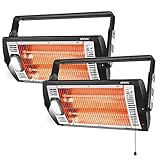
Overview: This twin-pack of 1,500W ceiling-mounted radiant heaters uses quartz tubes for instant, directional heat, ideal for spot-warming workspaces. Each unit includes a halogen work light and offers five operational modes via pull-chain switch. What Makes It Stand Out: The integrated halogen work light is a standout feature, providing task illumination alongside heating—perfect for dim garages. The 90° rotation allows precise heat targeting, and the dual heat/light modes (e.g., heat-only or heat+light) offer unmatched flexibility for workshop functionality in a space-saving ceiling design. Value for Money: Excellent value given the 2-pack configuration, halogen light utility, and robust radiant heating. At this price point, getting two durable units with versatile settings surpasses single-unit competitors. The energy-efficient spot-heating reduces costs versus warming entire spaces. Strengths and Weaknesses: Strengths: Dual-purpose (heat + task lighting); instant radiant warmth; space-saving ceiling mount; flexible 5-mode settings; 90° adjustable angle; cost-effective twin pack. Weaknesses: Halogen bulbs have shorter lifespans; radiant heat only warms objects/people in line-of-sight; limited to localized areas; no thermostat for automatic temp control. Bottom Line: A smart investment for workshops needing focused heat and better lighting. Highly recommended for mechanics or hobbyists, but less suitable as whole-room heating due to its radiant-only design.
9. Dura Heat 240V Electric Industrial Garage, Workshop, Warehouse, Construction Heater, Wall/Ceiling Mount, 12,800 BTU, 3,750 Watt Forced Air Heater, Overheat Protection - Ideal for Garage & Workshop

Overview: This hardwired 3,750W (12,800 BTU) industrial heater delivers forced-air warmth for spaces up to 500 sq. ft. Designed for wall or ceiling mounting, it’s built for permanent installation in workshops, garages, and construction sites requiring robust, no-frills heating. What Makes It Stand Out: Its high-wattage 240V forced-air system provides rapid, consistent heat distribution in uninsulated areas—a rarity at this price. The dual mounting options (wall/ceiling) maximize installation flexibility, while ETL compliance and overheat protection ensure safety in demanding environments. Value for Money: Represents strong value as a straightforward, high-output workhorse. It undercuts pricier commercial units while offering comparable heating capacity and essential safety features. The lack of a thermostat is a trade-off, but the efficient 240V operation keeps running costs reasonable for its class. Strengths and Weaknesses: Strengths: Powerful 3,750W heating for large zones; versatile wall/ceiling mounting; durable industrial build; essential overheat protection; efficient 240V operation. Weaknesses: Requires professional hardwiring; no thermostat (manual on/off only); basic design lacks modern features like remote control; limited to 500 sq. ft. Bottom Line: A reliable, high-capacity solution for contractors or shop owners needing dependable heat in raw spaces. Best for those prioritizing raw power and safety over smart features, with professional installation required.
10. Comfort Zone CZ290 NEMA 6-30P 4,800-Watt Fan-Forced Industrial Heater, Integrated Thermostat Control, Heavy Gauge Steel, Carry Handle with Rubber Feet and Overheat Protection, Red

Overview: This portable 4,800W industrial heater combines powerful fan-forced heating with an integrated thermostat, designed for flexible use in garages, workshops, or job sites. Its 240V NEMA plug and carry handle enable easy movement between locations. What Makes It Stand Out: The rare combination of portability (via handle/rubber feet) and a precise built-in thermostat sets it apart from fixed-mount competitors. The heavy-gauge steel construction ensures durability, while the cord-wrap feature enhances transport safety—ideal for contractors needing adaptable, controlled heat. Value for Money: Justifies its price with thermostat convenience and rugged portability. It’s more versatile than hardwired units for multi-location use, and the thermostat improves energy efficiency versus manual-only models. Rubber feet and steel build add longevity, offsetting the initial cost. Strengths and Weaknesses: Strengths: Integrated thermostat for precise control; highly portable with handle/cord wrap; durable steel housing; stable rubber feet; essential overheat protection; strong 4,800W output. Weaknesses: Requires 240V outlet (NEMA 6-30P); heavy for frequent lifting; red finish may not suit all decors; fan noise at high speed. Bottom Line: The top choice for mobile professionals needing thermostat-controlled heat on the go. Highly recommended for workshops or construction sites where flexibility and consistent warmth are critical, despite the weight and outlet requirement.
Understanding the Unique Demands of a Mechanic’s Workspace
The environment inside an auto repair shop presents challenges most standard heaters simply can’t handle. Recognizing these specific demands is the first step toward choosing the right equipment.
The Draft Factor in Large, Open Bays
Workshop bays are notorious for drafts caused by constant door openings for vehicle entry and exit. Standard convection heaters struggle immensely in these conditions, as rising warm air is instantly pulled toward the draft source. Fan-forced heaters are essential here, actively propelling heated air across the space to overcome air movement and deliver warmth directly to where mechanics are working, rather than letting it pool uselessly near the ceiling.
Combating Flammable Material Risks
The presence of gasoline, solvents, oils, and hydraulic fluids creates an environment where ignition sources must be meticulously controlled. Heaters intended for shop use must incorporate multiple layers of safety beyond basic household models. This isn’t just about compliance; it’s about preventing catastrophic incidents where a simple tip-over or overheating event could have devastating consequences near volatile substances.
Durability Against Physical Abuse and Debris
Workshops are high-impact zones. Tools get dropped, carts get bumped, and metal shavings or abrasive dust are constant companions. A shop heater needs a rugged, industrial-grade housing—typically heavy-gauge steel—that can withstand accidental impacts, resist corrosion from chemicals and moisture, and prevent debris from clogging critical components like air intakes or fan blades. Flimsy plastic housings are a non-starter.
Essential Performance Features for Professional Workshops
Raw heating power is just the starting point. For a mechanic’s shop, specific performance characteristics determine whether a heater will be a reliable asset or a constant source of frustration.
Wattage Requirements vs. Bay Size and Insulation
Underpowered heaters are a common mistake. Calculating the necessary wattage depends heavily on your specific bay size, ceiling height, and insulation quality. A poorly insulated 20x30 foot bay with 14-foot ceilings needs significantly more power (often 15,000+ watts) than a smaller, well-insulated space. Don’t rely on square footage alone; factor in heat loss through walls, doors, and high ceilings to avoid investing in a unit that can never achieve the desired temperature.
The Critical Role of Adjustable Thermostats
A simple on/off switch is inadequate for precise workshop comfort. A high-quality, adjustable thermostat (preferably digital with a remote sensor option) allows mechanics to set and maintain an exact temperature. This prevents constant manual adjustments, avoids overheating the space (wasting energy), and ensures the heater cycles on only when necessary, extending its lifespan and reducing operating costs significantly.
Fan Speed Control for Targeted Warmth
The ability to adjust fan speed is crucial. Lower speeds provide gentler, quieter background heat for general bay warming, while higher speeds blast concentrated warmth directly onto a mechanic working under a vehicle hood or in a specific repair zone. This versatility ensures the heater adapts to the task at hand, maximizing efficiency and comfort without overwhelming noise when full power isn’t needed.
Non-Negotiable Safety Mechanisms for Workshop Use
Safety isn’t a feature to compromise on in a professional automotive environment. Certain mechanisms are absolutely mandatory, not optional extras.
Tip-Over Switches: A Last Line of Defense
A robust, sensitive tip-over switch is non-negotiable. If the heater is accidentally knocked over—a common occurrence in busy shops—the switch must instantly cut all power to the heating elements. Look for units where this mechanism is physically robust and tested to stringent standards, ensuring it functions reliably even after repeated impacts or exposure to shop grime.
Overheat Protection Beyond the Basics
While most heaters have basic thermal cutoffs, shop-specific models need enhanced overheat protection. This includes sensors monitoring critical points like the fan motor housing and heating element core. If airflow is blocked (e.g., by a dropped rag or tool), or if internal components exceed safe temperatures due to dust buildup, the heater must shut down before reaching dangerous levels, preventing potential fire hazards.
Cool-Touch Exterior Design for High-Traffic Areas
Mechanics move quickly and often carry tools. A heater with an exterior housing that remains cool to the touch—even during extended operation—is vital to prevent accidental burns on arms or clothing. This is especially important for units mounted at waist or chest height where contact is more likely. Look for designs emphasizing heat dissipation away from the outer casing.
Power Source and Installation Considerations
How the heater connects to power and where you place it significantly impacts its effectiveness and safety in a dynamic shop environment.
Understanding Voltage Requirements (120V vs. 240V)
Wattage dictates voltage needs. Units under 5,000 watts typically run on standard 120V household circuits, but most serious shop heaters (7,500W and above) require a dedicated 240V circuit. Attempting to run a high-wattage 240V heater on a 120V circuit is dangerous and will trip breakers. Verify your shop’s electrical capacity before purchasing; installing a new 240V circuit might be necessary for optimal performance.
Cord Management and Length for Flexible Placement
A long, durable power cord (10+ feet) with a reinforced, abrasion-resistant jacket is essential for maneuverability around vehicles and equipment. Integrated cord storage hooks prevent tripping hazards. Avoid units with flimsy, short cords that force you to use extension cords constantly—this is a major fire risk. If extension cords must be used occasionally, they need to be heavy-duty, short, and rated for the heater’s full amperage.
Optimal Placement Strategies for Maximum Efficiency
Positioning is key. Mount heaters high on walls or columns (if designed for it) to maximize heat distribution and keep them out of the way of traffic and vehicles. Avoid placing them directly behind large equipment where airflow is blocked. For portable units, ensure a clear zone (at least 3 feet) on all sides, especially the rear intake and front exhaust, for proper airflow and safety. Never place a heater where it could be hit by a rolling jack or tool cart.
Build Quality and Long-Term Reliability Factors
In a shop environment, longevity is directly tied to the materials and construction. Skimping here guarantees frequent replacements.
Industrial-Grade Metal Housing Advantages
The housing should be made from thick, powder-coated steel, not thin plastic or cheap metal. Powder coating resists chipping from impacts and provides corrosion resistance against shop chemicals, moisture, and road salt tracked in on vehicles. This robust construction protects internal components and ensures the heater maintains structural integrity despite daily knocks and bumps.
Heating Element Technology: Quartz vs. Ceramic vs. Metal Sheathed
Different elements offer trade-offs. Metal-sheathed (calrod) elements are the most common in industrial settings—durable, relatively inexpensive, and effective. Ceramic elements heat up and cool down very quickly, offering responsive temperature control but can be more fragile. Quartz tubes provide intense, immediate radiant heat but are generally less durable in high-impact environments. For general shop bay heating, robust metal-sheathed elements often provide the best balance of durability and performance.
Sealed Motor and Fan Assembly for Dust Resistance
The fan motor is the heater’s heart. Look for units where the motor and fan assembly are effectively sealed against dust, metal shavings, and fine abrasive particles common in workshops. Unsealed motors quickly fail as debris causes overheating or bearing wear. An IP (Ingress Protection) rating of at least IP20 (basic dust protection) is advisable, though higher ratings are better for particularly dirty shops.
Operational Practicalities for Daily Use
Beyond core heating and safety, features affecting noise, portability, and control impact daily usability in a professional setting.
Noise Level Expectations During Operation
Shop heaters are inherently noisier than residential units due to powerful fans moving large air volumes. However, excessive noise is disruptive. Understand that higher fan speeds will be loud (comparable to a shop vacuum on low), but lower settings should be manageable for conversation. Look for models specifically designed with noise-reduction features in the fan housing or blade design if working in close proximity is frequent.
Portability Features vs. Permanent Mounting
Consider workflow. Wheeled bases with sturdy casters (preferably locking) offer flexibility to move heat where it’s needed most—under a truck, beside a diagnostic station. However, wall or ceiling mounting saves floor space and eliminates tripping hazards. Choose based on whether your heat needs are consistently stationary or frequently shift locations within the bay. Ensure any mounting hardware is robust and included.
User-Friendly Controls and Visibility
Controls should be intuitive and accessible, even with gloves on. Large, tactile buttons or dials are preferable to tiny touchscreens that might malfunction with oily fingers. A clear, backlit display (for digital thermostats) is crucial for reading settings in dimly lit bays or at a glance from across the shop. Avoid overly complex control panels that slow down operation.
Maintenance Requirements for Peak Performance
A shop heater that isn’t maintained becomes inefficient and potentially unsafe. Factor in the upkeep needed for long-term reliability.
Regular Cleaning of Air Intakes and Exhausts
Dust, lint, and fine metal particles will accumulate rapidly in air pathways. Blocked intakes starve the fan, causing overheating and reduced output. Blocked exhausts prevent warm air from dispersing. Establish a routine (e.g., weekly during heavy use) to vacuum or blow out intake grilles, exhaust vents, and the area around the heating elements using compressed air. Always unplug and let the unit cool completely first.
Inspecting and Replacing Air Filters (If Applicable)
Some higher-end models incorporate washable air filters to protect the internal components. While not universal, if your heater has one, inspect it monthly and clean it according to the manufacturer’s instructions. A clogged filter severely impacts airflow and efficiency. Never operate the heater without its filter if one is designed to be used.
Annual Professional Inspection for Critical Safety Components
Beyond basic cleaning, schedule an annual check by a qualified technician, especially for permanently installed units. They can verify the functionality of critical safety switches (tip-over, overheat), inspect wiring integrity for signs of heat damage or abrasion, check fan motor bearings, and ensure all safety certifications remain valid. This proactive step prevents minor issues from becoming major hazards.
Cost Considerations Beyond the Initial Price Tag
The sticker price is just the beginning. True value lies in operational costs and longevity within the harsh shop environment.
Evaluating Long-Term Energy Efficiency
While all electric resistance heaters are 100% efficient at point-of-use (all electricity becomes heat), effective efficiency matters. A heater with a precise thermostat avoids overheating the space. A powerful enough unit reaches the desired temperature faster and cycles off sooner. Proper placement ensures heat goes where needed. Investing in features that optimize runtime (like good thermostats and adequate wattage) saves significant money on electricity bills over the heater’s lifespan compared to an underpowered or poorly controlled unit that runs constantly.
Total Cost of Ownership: Durability vs. Replacement Cycles
A cheaper heater made with inferior materials might cost half as much upfront but could fail within a season or two due to dust ingress, impact damage, or motor burnout. A more robust, industrial-grade model might cost more initially but last 5-10 years with proper maintenance. Calculate the cost per year of operation—factoring in purchase price, expected lifespan, and energy use—to see which option truly offers better value for your demanding shop.
Warranty Coverage Specifics for Commercial Use
Scrutinize the warranty terms. Many standard warranties are voided if the heater is used in a commercial or industrial setting. Seek out manufacturers offering explicit commercial or industrial warranties (e.g., 1-3 years). Pay attention to what’s covered—does it include motor failure or just parts? A strong warranty from a company confident in their product’s durability for shop use is a valuable indicator of quality and reduces long-term risk.
Integration with Existing Shop Systems
Your heater shouldn’t operate in isolation. Consider how it fits into your overall workshop environment and systems.
Compatibility with Shop Ventilation Systems
Heaters and exhaust systems (like roof vents or downdraft tables) interact. Powerful exhaust can create negative pressure, pulling cold air in and making the heater work harder. Coordinate heater placement and operation with ventilation schedules. Some advanced systems can even integrate temperature controls with ventilation for optimal air quality and comfort, though this is less common in standard shops.
Impact on Humidity and Air Quality
Electric fan heaters don’t directly add moisture, but warming cold, dry winter air can significantly lower relative humidity inside the shop. Extremely dry air can be uncomfortable and potentially static-sensitive. While not a primary function, some mechanics notice improved comfort with a heater that doesn’t excessively dry the air compared to radiant heaters. Be mindful that any heater can stir up settled dust if not properly maintained.
Frequently Asked Questions
Frequently Asked Questions
What’s the minimum safe distance a shop heater should be from vehicles or workbenches? Maintain at least 3 feet of clearance on all sides, especially the rear (air intake) and front (exhaust), to ensure proper airflow and prevent fire hazards from contact with flammable materials or blocking vents.
Can I safely use an extension cord with my shop fan heater? It’s strongly discouraged. If absolutely necessary for very short durations, use only a heavy-duty, short (under 6ft), 12-gauge or thicker cord rated for the heater’s full amperage. Never use undersized or coiled cords, as they overheat and cause fires. Direct plug-in is always safest.
How do I know if my shop’s electrical system can handle a high-wattage heater? Check the heater’s required voltage and amperage. Consult a licensed electrician to verify your circuit breaker size, wiring gauge, and available capacity. High-wattage heaters (7500W+) almost always require a dedicated 240V circuit; don’t guess with your electrical system.
Are oil-filled radiators suitable for mechanic shop use? Generally, no. They rely on slow convection heating, which is ineffective in drafty shop bays. They also lack the powerful fan-forced airflow needed to push heat across large spaces and often don’t have the rugged industrial build or critical safety certifications required for shop environments.
What does an IP rating mean for a shop heater, and what’s sufficient? IP (Ingress Protection) ratings indicate resistance to dust and moisture. For typical auto shops, IP20 (protection against solid objects >12mm, basic dust protection) is the minimum. Higher ratings like IP23 (spray water resistance) offer more protection in very wet or wash bay areas.
Why does my shop heater make a clicking sound when it turns on or off? This is usually normal thermal expansion/contraction of metal components (heating elements, housing) as they rapidly heat up or cool down. A single, soft click is typical. Loud, repeated clicking or buzzing could indicate an electrical issue and should be checked.
How often should I clean my shop fan heater? Perform basic intake/exhaust cleaning weekly during peak winter use. A more thorough internal cleaning (vacuuming/blowing out dust from elements and fan) should be done monthly in dusty environments. Always unplug and cool the unit completely first.
Is it safe to leave a shop heater running unattended overnight? Never leave any portable electric heater running unattended or while sleeping. Even with safety features, malfunctions can occur. For overnight bay heating, consider permanently installed, hardwired unit designed for continuous operation with enhanced safety certifications, installed by a professional.
What’s the biggest mistake mechanics make when choosing a shop heater? Underestimating the required wattage for their specific bay size and insulation level, leading to a unit that runs constantly but never achieves a comfortable temperature, wasting energy and straining the heater.
Can shop heaters be used in areas with flammable fume exposure, like near paint booths? Absolutely not. Standard electric fan heaters are not rated for use in atmospheres containing flammable vapors, gases, or dust (Class I, II, or III hazardous locations). Only intrinsically safe or explosion-proof heaters specifically certified for those environments are permitted, and they are vastly different units.