Table of Contents
That first breath of frigid air hitting your face as you swing open the workshop door in January is a feeling no DIY enthusiast or tradesperson should have to endure. Your workspace, meant to be a haven for creation and productivity, transforms into an icy obstacle course where stiff fingers fumble with tools, metal surfaces feel like they’ll stick to your skin, and the simple act of concentrating becomes a battle against shivering. It’s not just uncomfortable; it actively hinders your work, slows you down, and can even make handling materials or tools more dangerous. When you’re trying to fix a car, build a cabinet, or tackle any project requiring precision, a cold environment is the enemy of efficiency and quality.
Generic heating advice often falls short in these demanding, often drafty, and uniquely configured shop spaces. What works for a cozy living room simply won’t cut it where high ceilings, large doorways, concrete floors, and fluctuating activity levels are the norm. You need a solution specifically engineered to combat the harsh realities of a workshop – something powerful enough to cut through the chill but intelligent enough to operate safely amidst tools, materials, and potential hazards. This guide cuts through the marketing fluff to focus on the essential features and considerations that truly matter when selecting a fan heater capable of transforming your cold workspace into a functional, comfortable environment, ensuring you stay warm, safe, and focused on the task at hand.
Top 10 Shop Fan Heaters
Detailed Product Reviews
1. Dura Heat EUH1465 Electric Forced Air Heater with Pivoting Base 5,120 BTU, Yellow

Overview:
This rugged 1,500W PTC ceramic heater targets garages, workshops, and commercial spaces with quick, focused warmth. Its steel construction and pivoting base offer durability and directional flexibility for small areas.
What Makes It Stand Out:
The pivoting steel base allows precise heat redirection without repositioning the unit, ideal for targeted workspace heating. Combined with dual heat/fan settings and a built-in thermostat, it provides adaptable warmth while maintaining a compact, industrial profile. The yellow finish enhances visibility in cluttered environments.
Value for Money:
Priced competitively for its durability and BTU output, it outperforms basic fan heaters in toughness. While lacking advanced features like remote control, its straightforward design ensures reliability for under $50, making it a cost-effective choice for no-frills workshop heating.
Strengths and Weaknesses:
Strengths: Extremely durable steel build; pivoting base for directional control; overheat protection; simple thermostat operation.
Weaknesses: No low-heat setting; limited to small spaces (under 150 sq. ft.); lacks portability features like a handle.
Bottom Line:
A dependable, budget-friendly heater for mechanics or DIYers needing spot heating in compact, rugged environments. Its durability and pivot function justify the price, though larger spaces require more powerful alternatives.
2. Techni Home Industrial Electric Forced Air Heater with Ceramic Heating Element, Adjustable Tilt, Overheat Protection, Portable Shop Garage Heater for Indoor/Outdoor Use, 1500W

Overview:
This versatile 1,500W ceramic heater delivers efficient, even heat for workshops, garages, or home offices. Its industrial design prioritizes safety and adaptability across indoor/outdoor settings with three operational modes.
What Makes It Stand Out:
The ceramic heating element ensures rapid, energy-efficient warmth without excessive drying, while the adjustable tilt mechanism directs heat precisely. Three settings (fan/low/high) enable year-round use—circulating cool air in summer or intense heat in winter—unlike single-mode competitors.
Value for Money:
At a mid-range price point, it surpasses basic heaters with its ceramic efficiency and tilt functionality. Though pricier than ultra-budget models, the energy savings from precise temperature control and dual heat settings offer long-term value for frequent users.
Strengths and Weaknesses:
Strengths: Energy-efficient ceramic tech; flexible tilt and three heat modes; robust safety features; suitable for indoor/outdoor use.
Weaknesses: Bulky for tight spaces; cord storage is minimal; no thermostat lock for shared environments.
Bottom Line:
An excellent investment for workshops needing adaptable, efficient heating. Its ceramic performance and tilt versatility make it worth the premium over simpler models, especially for year-round utility.
3. Comfort Zone Utility Space Heater, 1500W Electric Garage Heater with Adjustable Thermostat, Fan/Low/High Heat Settings, Tip-Over & Overheat Protection, Milkhouse Style, ETL Listed

Overview:
This 1,500W utility heater combines classic “milkhouse” styling with modern safety for garages and workshops. ETL-listed and packed with essential protections, it delivers reliable warmth for residential or light commercial use.
What Makes It Stand Out:
Dual safety systems—tip-over and overheat protection—provide peace of mind in high-traffic areas. The adjustable thermostat and three settings (fan/low/high) allow fine-tuned comfort, while the ETL certification guarantees rigorous safety compliance often missing in budget models.
Value for Money:
Priced affordably under $40, it outperforms similarly priced heaters with superior safety credentials and thermostat precision. Though lacking premium features like remote control, its reliability and certified build justify the cost for homeowners prioritizing security.
Strengths and Weaknesses:
Strengths: Comprehensive safety (tip-over + overheat); precise thermostat; ETL-listed; intuitive low/high/fan settings.
Weaknesses: Basic steel housing scratches easily; no tilt adjustment; short power cord (5 ft).
Bottom Line:
A top choice for safety-conscious users in homes or small workshops. Its certified protections and thermostat accuracy offer exceptional value, though industrial users may desire sturdier construction.
4. Vornado Velocity HD (2025) Garage Space Heater with Fan, Tilt Head, Advanced Safety Features, Glove-Friendly Controls, Removable Pre-Filter, 6-Foot Power Cord, 2 Speeds, Shop Heater, Black

Overview:
Vornado’s Velocity HD merges high-velocity airflow with workshop durability for garages and job sites. Its “Velocity Tuned Heat” technology pushes warmth farther than standard heaters, though with increased noise.
What Makes It Stand Out:
Advanced aerodynamics deliver wider heat dispersion (up to 35% farther), while glove-friendly controls and a removable pre-filter enhance usability in dusty environments. The 6-foot cord with wrap and non-slip base cater specifically to mobile workshop needs.
Value for Money:
Priced at a premium (~$80), it justifies cost through superior heat distribution and workshop-specific design. The pre-filter extends motor life in dirty spaces, reducing long-term maintenance costs versus cheaper models that clog faster.
Strengths and Weaknesses:
Strengths: Unmatched heat reach; workshop-tough design; easy-cleaning pre-filter; excellent cord management.
Weaknesses: Noticeably louder (10dB higher) than competitors; only two heat speeds; no thermostat.
Bottom Line:
Ideal for large, drafty workshops where heat spread matters most. Despite noise trade-offs, its durability and performance make it a worthwhile splurge for serious DIYers or contractors.
5. Comfort Zone Hard-Wired Ceiling Mount Garage Space Heater with Remote, 7,500 Watt, 240 Volt, Fan-Forced, Overheat Protection, Digital Thermostat, 12-Hour Timer, Ideal for Garage & Workshop, CZ230ERBK

Overview:
This 7,500W hardwired ceiling heater eliminates floor clutter for large spaces (up to 1,250 sq. ft.). Designed for permanent installation in garages or warehouses, it features digital controls and remote operation.
What Makes It Stand Out:
Ceiling mounting frees floor space—a rarity among reviewed models—while the 240V system delivers commercial-grade power. The remote-controlled digital thermostat and 12-hour timer enable precision heating from across the room, unmatched by portable units.
Value for Money:
Higher upfront cost (including professional installation) is offset by superior coverage for large areas. It outperforms multiple portable heaters in efficiency for 500+ sq. ft. spaces, making it economical for workshops where floor space is premium.
Strengths and Weaknesses:
Strengths: Massive coverage (1,250 sq. ft.); space-saving ceiling mount; remote digital controls; heavy-gauge steel durability.
Weaknesses: Requires 240V wiring (not plug-and-play); complex installation; overkill for small garages.
Bottom Line:
Essential for large workshops or warehouses needing unobtrusive, powerful heating. Despite installation hurdles, its coverage and remote features deliver unmatched value for dedicated commercial spaces.
6. Comfort Zone Hard-Wired Ceiling Mount Garage Electric Space Heater, Fan-Forced, 5,000 watt, 240 volt, Overheat Protection, Thermal Cut-Out Switch, Ideal for Workshop & Garage, ETL Compliant, CZ220

Overview:
This hardwired 5,000W ceiling-mount heater targets workshops and garages needing robust, space-saving heating. Designed for 240V circuits, it eliminates floor clutter while delivering powerful forced-air warmth for poorly insulated spaces up to 450 sq. ft.
What Makes It Stand Out:
Its overhead installation maximizes floor space, while heavy-gauge steel construction ensures durability in harsh environments. Precise heat direction via adjustable louvers and a dual-knob thermostat offers targeted comfort. The integrated thermal cut-off switch and ETL compliance provide critical safety for unattended operation.
Value for Money:
Priced mid-range for commercial-grade units, it justifies cost through hardwiring (reducing long-term energy waste) and industrial resilience. Cheaper plug-in models lack its coverage and build quality, though installation requires an electrician.
Strengths and Weaknesses:
Strengths: Exceptional space efficiency; durable steel housing; precise directional airflow; reliable overheat protection.
Weaknesses: Mandatory hardwiring increases setup complexity/cost; 240V requirement limits DIY installation; lacks portability.
Bottom Line:
Ideal for permanent workshop/garage setups needing efficient, obstruction-free heating. Avoid if you require plug-and-play convenience or lack 240V wiring. A solid investment for serious DIYers or small workshops prioritizing safety and space.
7. Porairot Floor Drying Air Mover Blower with Warm & UV Lamp, 3-Speed High-Velocity Fan for Home, Garage, Workshop

Overview:
This versatile 3-speed blower combines high-velocity airflow with a warm mode and UV lamp, targeting moisture removal in garages, workshops, and flood-damaged homes. It’s designed for drying floors, carpets, and workspaces year-round.
What Makes It Stand Out:
The dual-mode system (cooling/warm airflow) and UV lamp for mold prevention are unique. The 185° oscillation ensures wide coverage, while the removable dust filter maintains performance. Portability via carry handles suits multi-location use.
Value for Money:
Competitively priced against single-function dryers, its UV feature adds mold mitigation value rarely seen at this tier. While not a primary heater, the warm mode accelerates drying better than fans alone, offering practical versatility for wet-area maintenance.
Strengths and Weaknesses:
Strengths: UV lamp combats mold; 3-speed flexibility; wide oscillation; washable filter; highly portable.
Weaknesses: Warm mode provides mild heat (not for room warming); UV effectiveness unverified for large spaces; noisy at high speed.
Bottom Line:
A smart buy for contractors or homeowners needing rapid drying with mold resistance. Skip if you require substantial heating—the warm setting is supplementary. Best for moisture emergencies, not primary climate control.
8. Shinic 2 Packs Electric Garage Heaters, 1500W/750W Ceiling Mounted Heater Radiant Heaters with Halogen Light, 90 Degree Rotation, 5 Mode Settings, Space Heater for Garage, Shop, Large Room and Patio
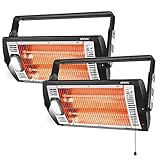
Overview:
This twin-pack of 1,500W radiant heaters combines instant quartz heating with integrated halogen work lights. Ceiling-mounted for space efficiency, it targets spot heating in garages, workshops, or patios via directional infrared warmth.
What Makes It Stand Out:
The dual-function design (heater + task light) is exceptional. Five modes—including independent light/heat settings and dual-bulb radiant heat—allow tailored use. The 90° rotation focuses warmth precisely, while the halogen light enhances nighttime visibility.
Value for Money:
Bundling two units at a mid-range price delivers significant value for dual-workstation setups. Radiant heating is more efficient than forced-air for spot warming, saving energy versus whole-room heaters. Cheaper single units lack the light integration.
Strengths and Weaknesses:
Strengths: Halogen work light adds utility; instant radiant heat; space-saving ceiling mount; versatile 5-mode control; cost-effective twin pack.
Weaknesses: No thermostat (manual pull-chain); limited to spot heating; halogen bulbs may require replacement; minimal safety features beyond basic cut-off.
Bottom Line:
Perfect for mechanics or hobbyists needing localized warmth and task lighting. Avoid for whole-garage heating—ideal as a supplemental solution where precision matters more than ambient temperature.
9. Dura Heat 240V Electric Industrial Garage, Workshop, Warehouse, Construction Heater, Wall/Ceiling Mount, 12,800 BTU, 3,750 Watt Forced Air Heater, Overheat Protection - Ideal for Garage & Workshop

Overview:
A no-frills 3,750W forced-air heater built for industrial use, delivering 12,800 BTU to spaces up to 500 sq. ft. Hardwired for 240V, it prioritizes raw heating power over convenience in warehouses, workshops, or construction sites.
What Makes It Stand Out:
Its industrial-grade simplicity stands out: minimal features focus solely on high-output heating. The wall/ceiling mount flexibility and overheat protection ensure reliable operation in demanding, unheated environments where durability trumps finesse.
Value for Money:
Among the most cost-effective per-watt options here. While lacking smart controls, its robust build justifies the price for professionals needing “set and forget” heating in large, drafty spaces where efficiency matters less than output.
Strengths and Weaknesses:
Strengths: High heating capacity for size; industrial durability; straightforward installation; effective overheat safety.
Weaknesses: Zero thermostat or adjustable settings; basic heat distribution; requires 240V hardwiring; no portability.
Bottom Line:
A workhorse for contractors or large workshops needing brute-force warmth. Not for home garages—choose only if you prioritize output over control and already have 240V infrastructure.
10. Comfort Zone CZ290 NEMA 6-30P 4,800-Watt Fan-Forced Industrial Heater, Integrated Thermostat Control, Heavy Gauge Steel, Carry Handle with Rubber Feet and Overheat Protection, Red

Overview:
This portable 4,800W forced-air heater features a NEMA 6-30P plug for 240V circuits, targeting garages and workshops needing movable high-power heating. Its integrated thermostat and heavy-duty steel build balance performance with user control.
What Makes It Stand Out:
The rare combination of portability (carry handle, rubber feet) and 240V power sets it apart. The precise thermostat avoids energy waste, while the steel housing withstands job-site abuse. The wrap-around cord storage enhances mobility versus hardwired rivals.
Value for Money:
Priced higher than plug-in 120V heaters but justified by 240V efficiency and durability. It outperforms cheaper models in coverage (450 sq. ft) and longevity, making it cost-effective for frequent use despite the initial outlay.
Strengths and Weaknesses:
Strengths: True portability with 240V power; responsive thermostat; rugged steel construction; excellent safety suite; easy storage.
Weaknesses: NEMA plug requires compatible outlet (not standard household); heavy for frequent lifting; limited to 240V circuits.
Bottom Line:
The top pick for mobile 240V heating where workshops lack fixed wiring. Essential for contractors moving between sites—but useless without a NEMA 6-30 outlet. A versatile powerhouse worth the investment for professionals.
Understanding Your Workshop Heating Needs
Before diving into specifications, it’s crucial to accurately assess the unique demands of your specific workspace. This foundational step prevents overspending on unnecessary power or, worse, underestimating the challenge and ending up with an ineffective heater.
Calculating Required Heating Capacity
The cornerstone of effective heating is matching the heater’s output to your space. Measured in British Thermal Units (BTUs) or watts, capacity must account for more than just square footage. Consider ceiling height (high ceilings require significantly more power), insulation quality (concrete walls and metal roofs offer minimal insulation), the number and size of doors/windows (major sources of heat loss), and typical outdoor temperatures in your region. A simple online BTU calculator is a good starting point, but always add a 20-30% buffer for workshops due to their inherent heat loss characteristics.
Evaluating Workshop Layout and Obstacles
Your shop’s physical layout dramatically impacts heat distribution. Open bays with clear sightlines allow heat to travel easily, while workshops filled with workbenches, storage racks, vehicles, or machinery create barriers that block airflow and create cold spots. Consider the optimal placement for a heater – often centrally located but away from direct obstruction – and whether you might need multiple units or models designed for directional airflow to overcome layout challenges.
Identifying Primary Usage Patterns
Are you heating the entire space for long durations, or do you primarily need spot heating for a specific workbench? Do projects happen sporadically throughout the day, or is the shop occupied continuously for hours? Understanding your typical usage – short bursts versus all-day operation – influences decisions about thermostat precision, timer functions, and the importance of rapid warm-up times versus sustained, lower-level heat.
Critical Performance Features for Workshop Heaters
Not all fan heaters are created equal, especially when tasked with warming demanding workshop environments. Prioritizing the right performance characteristics ensures reliable, effective heat where you need it most.
Heating Element Type and Efficiency
The core heating element significantly impacts performance and longevity. Ceramic elements heat up and cool down rapidly, offering responsive temperature control and generally higher energy efficiency. They often feel less “blasty” than some alternatives. Metal wire elements (like nichrome) are typically less expensive but can take longer to reach optimal temperature and may not modulate heat as precisely. Infrared elements provide radiant heat that warms objects directly rather than the air, excellent for spot heating but less effective for overall space warming in drafty shops. Evaluate which technology aligns best with your primary heating goals.
Fan Power and Airflow Design
A workshop heater needs serious airflow muscle to push warm air effectively across distances and around obstacles. Look for models specifying high cubic feet per minute (CFM) ratings. More crucially, examine the airflow design: oscillating vents significantly improve heat distribution by sweeping warm air across a wider area, preventing stagnant cold zones. Directional louvers that allow manual aiming provide additional flexibility for targeting specific work areas.
Thermostat Precision and Range
A basic on/off thermostat is often insufficient for workshop comfort. Look for models offering precise, adjustable thermostats (e.g., adjustable in 1-2 degree increments) with a wide operating range, ideally capable of maintaining temperatures as low as 40-45°F (5-7°C) for milder days and up to 90°F (32°C) for deep freezes. This precision prevents the heater from cycling on and off too frequently, leading to more consistent comfort and potential energy savings.
Essential Safety Mechanisms for Hazardous Environments
Workshops present unique fire and safety hazards – flammable materials, sawdust, potential for tipping, and proximity to tools. Safety features aren’t optional extras; they are non-negotiable requirements for any shop heater.
Tip-Over Switch Reliability
This is arguably the most critical safety feature. A robust, internal tip-over switch must instantly cut all power the moment the heater is knocked off balance or falls over. Ensure the mechanism is well-integrated and tested to stringent standards; a flimsy switch offers false security. Verify this feature is explicitly mentioned and emphasized in the product specifications.
Overheat Protection Systems
Continuous operation, blocked air intakes (e.g., by dust or debris), or placement too close to combustibles can cause dangerous overheating. A reliable secondary overheat protection sensor should automatically shut down the heater if internal temperatures exceed safe limits, independent of the main thermostat. This dual-layer protection is vital for unattended operation.
Cool-Touch Housing and Exterior Design
Workshop environments are busy and cluttered. A heater with a housing that remains cool to the touch, even during extended operation, is essential to prevent accidental burns on skin or damage to nearby materials (like plastic storage bins or wiring). Look for models specifically advertising cool-touch exteriors and designs that minimize exposed hot surfaces.
Durability and Construction for Demanding Conditions
A workshop heater faces dust, potential impacts, moisture (from snow/mud on boots), and general wear-and-tear. It needs to be built like the tools you rely on, not like delicate household appliances.
Rugged Housing Materials
Flimsy plastic casings won’t survive a workshop. Prioritize heaters constructed with durable, high-impact materials. Metal housings (often powder-coated steel) offer superior resistance to dents, scratches, and accidental kicks compared to plastic. Check for reinforced corners and grilles designed to withstand bumps.
Dust and Debris Resistance
While not typically IP-rated like outdoor tools, workshop heaters should have design features to mitigate dust ingress. Look for sealed heating element compartments, strategically placed air intakes that are less prone to clogging, and easily accessible filters (if applicable) that can be cleaned regularly. Avoid models with large, exposed grilles directly over the heating element.
Cord and Plug Quality
The power cord is a frequent point of failure. A thick, abrasion-resistant cord with a robust strain relief where it enters the unit is crucial. The plug should be substantial and feel securely molded. Consider the cord length needed for your shop layout to avoid risky extension cord use – longer is generally better, but ensure it’s neatly storable.
Operational Convenience and Control Features
Beyond raw heat and safety, features that enhance usability make a significant difference in daily workshop comfort and efficiency, especially when your hands might be dirty or gloved.
Remote Control Functionality
Being able to adjust the temperature, turn the heater on/off, or set timers without leaving your workbench is a major convenience. A reliable remote control eliminates unnecessary trips across a cold shop. Ensure the remote has intuitive buttons and a good range, ideally working through minor obstructions.
Digital Display and Interface
Clear, easy-to-read displays (often backlit) are essential, especially in low-light workshop conditions. Buttons should be large enough to operate with gloves on and provide positive tactile feedback. Avoid overly complex menus; basic functions (power, temp up/down, mode, timer) should be readily accessible.
Programmable Timers and Scheduling
The ability to set the heater to turn on 15-30 minutes before you typically arrive at the shop (so it’s warm when you walk in) or to turn off automatically after you leave is invaluable for both comfort and energy savings. More advanced scheduling options offer greater control over heating patterns aligned with your specific workshop hours.
Installation and Portability Considerations
How the heater integrates into your shop space affects both its effectiveness and your daily workflow. Flexibility is often key in dynamic workshop environments.
Mounting Options: Floor, Wall, or Ceiling
Most shop heaters are designed for floor placement, but stability is paramount. Look for wide bases and low centers of gravity. Some robust models offer wall-mounting kits, freeing up valuable floor space and potentially improving heat distribution – but ensure secure installation into studs. Ceiling-mounted options exist for large industrial spaces but are less common for typical home/garage shops.
Weight and Maneuverability
Consider how often you might need to move the heater. While heavier units often imply more durability, they can be cumbersome. Models with sturdy, large-diameter wheels (ideally swiveling casters) and integrated carry handles make repositioning significantly easier, whether for cleaning, seasonal storage, or targeting heat to different project areas.
Cord Management Solutions
A long power cord is necessary but creates a tripping hazard. Effective cord wrap hooks or storage compartments built into the heater base keep the cord neatly contained when not in use and prevent it from becoming a snag point during operation.
Energy Efficiency and Operating Costs
While powerful heat is the priority, the ongoing cost of running a heater for hours in an inefficient space can be substantial. Understanding efficiency factors helps manage long-term expenses.
Understanding Wattage vs. Real-World Consumption
Heaters convert nearly 100% of electrical energy into heat, so a 1500W heater always uses 1500W when running. However, features like precise thermostats and timers reduce the total runtime needed to maintain comfort, effectively lowering energy consumption. Focus on how intelligently the heater manages its power, not just the peak wattage.
The Impact of Thermostat Accuracy
A heater with a poor thermostat might cycle on for long periods, overheating the space before shutting off, only to let the temperature plummet again. A precise thermostat maintains the set temperature with minimal fluctuation, meaning the heater runs in shorter, more efficient bursts, reducing overall energy use compared to a unit that causes large temperature swings.
Zone Heating Strategy
Instead of futilely trying to heat the entire vast, leaky workshop to a tropical 70°F, focus on heating your immediate work area. Using a powerful, directional fan heater to create a warm “bubble” around your bench or work zone is far more energy-efficient than attempting whole-space heating. This targeted approach leverages the heater’s capabilities where they matter most.
Noise Levels in the Workshop Environment
A heater shouldn’t drown out your radio, podcast, or the sound of your tools. While some fan noise is inevitable, excessive or grating noise is disruptive in a space where concentration is key.
Decibel Ratings and Realistic Expectations
Manufacturers sometimes list decibel (dB) ratings, but these are often measured under ideal lab conditions. Look for user reviews specifically mentioning noise levels in real workshop settings. Understand that higher heat settings inherently produce more fan noise; the critical factor is whether the noise is a constant, comfortable hum or an annoying whine or rattle.
Fan Motor Quality and Design
Higher-quality, brushless DC motors tend to run quieter and smoother than cheaper, noisier AC motors. Heaters designed with sound-dampening materials or airflow paths that minimize turbulence will also operate more quietly. Pay attention to descriptions of the sound – “quiet hum” is good, “loud drone” or “high-pitched whine” is problematic.
Managing Noise Perception
Placement matters. Positioning the heater slightly away from your primary workbench, possibly behind a workbench leg or storage unit, can help dampen the sound reaching your ears without significantly impeding airflow. Using oscillation can also disperse the sound more evenly rather than having a concentrated noise source.
Integration with Workshop Ventilation
Heating a space doesn’t negate the need for proper air quality, especially when using certain tools or solvents. Understanding how heater operation interacts with ventilation is important for a healthy workspace.
Avoiding Interference with Exhaust Systems
Position your heater thoughtfully to avoid blowing warm air directly towards exhaust vents or doors you might open for ventilation. This prevents the heater from constantly fighting against the ventilation system, wasting energy. Ideally, place the heater away from primary air intake and exhaust points.
The Role of Air Circulation
While not a substitute for dedicated ventilation when fumes are present, the airflow from a fan heater does help circulate air within the space, preventing stagnant, cold pockets and promoting more even temperatures. This inherent circulation can be a minor benefit for general air movement, though it doesn’t replace proper exhaust for hazardous fumes.
Balancing Heat and Air Changes
If you need to run ventilation fans (e.g., for dust collection or fume extraction), be aware that this constantly introduces cold outside air. You’ll need a heater with sufficient capacity to compensate for this increased heat loss. Factor potential ventilation runtime into your initial BTU calculation.
Making the Final Selection for Your Unique Space
Synthesizing all the factors – your specific space, safety needs, durability requirements, and desired features – is the final step towards choosing the right heater. It’s about finding the optimal balance for your reality.
Prioritizing Your Non-Negotiables
Make a shortlist of absolute must-haves based on your workshop assessment. For most, this includes robust tip-over and overheat protection, adequate BTU/wattage, and cool-touch housing. Beyond that, rank what matters most: Is precise thermostat control critical? Is remote operation a game-changer? Is ultra-quiet operation essential? Let your priorities guide the final decision.
Reading Between the Lines of Specifications
Don’t just look at the headline numbers (e.g., “1500W”). Scrutinize the details: What type of 1500W element? What’s the actual CFM airflow? What’s the thermostat’s adjustment range and precision? How is the safety system described (vague terms like “safety features” are red flags)? Reliable brands provide specific, technical details about their safety and performance mechanisms.
Considering Long-Term Value Beyond the Price Tag
The cheapest heater might seem appealing, but in a workshop environment, it could fail quickly, lack critical safety features, or be so inefficient you pay more in electricity over time. Investing in a well-built unit with proven safety, appropriate features, and durability for the harsh shop environment often provides significantly better long-term value and peace of mind than a budget model that becomes a hazard or disappointment.
Frequently Asked Questions
Frequently Asked Questions
Can I safely leave a shop fan heater running overnight or while I’m out of the workshop? While modern heaters with robust tip-over and overheat protection can be designed for unattended operation, it is strongly discouraged in a workshop environment due to the presence of flammable materials (solvents, sawdust, rags, fuel) and potential for accidental obstruction. Always turn off and unplug heaters when leaving the space unattended for extended periods or overnight.
How do I calculate the correct size heater for my garage or workshop? Start with square footage and multiply by 10 watts per square foot as a baseline. Then, add 25-50% more capacity for poor insulation (concrete walls, metal roof), high ceilings (over 8 feet), large unheated doors, or very cold climates. For example, a 20x20 ft (400 sq ft) uninsulated workshop in a cold zone might need 400 x 10 = 4000 watts, then add 40% (1600 watts) for a total of 5600 watts (approx. 19,000 BTU). Always prioritize safety features alongside capacity.
Are ceramic fan heaters better than oil-filled radiators for workshops? Generally, yes, for most workshop needs. Ceramic fan heaters provide rapid, forced-air heat ideal for spot heating and warming drafty spaces quickly. Oil-filled radiators offer silent, radiant heat but warm up very slowly and are less effective at distributing heat across large, open, or drafty workshops. The fast response of a fan heater is usually preferable in a dynamic workspace.
What safety certifications should I absolutely look for on a shop heater? Ensure the heater has been tested and certified by a nationally recognized testing laboratory (NRTL) such as UL (Underwriters Laboratories) or ETL (Intertek) specifically for the United States market. Look for the mark physically on the unit and in the product specifications. This certification verifies it meets essential electrical and fire safety standards.
Is it safe to use an extension cord with a shop fan heater? It is highly discouraged. Most shop heaters require significant power (often 1500W, drawing 12.5A on a 120V circuit). Extension cords, especially undersized or coiled ones, can overheat, melt, and cause fires. Always plug the heater directly into a properly rated wall outlet on a dedicated circuit if possible. If absolutely necessary, use the shortest possible heavy-duty (14-gauge or lower) cord rated for the heater’s amperage, but direct plug-in is safest.
Can a shop fan heater be used in a damp environment like a garage? Most standard indoor fan heaters are not rated for damp or wet locations. Moisture from snow, rain, or high humidity can damage the unit and create serious electrical shock hazards. If your garage is prone to dampness, look specifically for a heater explicitly rated for “damp locations” (though still not for direct water exposure) or consider alternative heating solutions designed for such environments. Never use a standard heater on a wet floor.
How important is an oscillating feature for a workshop heater? Oscillation is highly beneficial in most workshops. It actively distributes warm air across a wider area, preventing cold spots and ensuring more even heating throughout the space, especially important in layouts with obstacles. It reduces the need to manually reposition the heater frequently and makes the warmth feel less concentrated and “blasty” directly in front of the unit.
Why does my fan heater seem to cycle on and off frequently? Frequent cycling is usually caused by an oversized heater for the space (it heats up too quickly, overshoots the thermostat setting, then shuts off) or a poorly calibrated thermostat. Ensure you’ve correctly sized the heater for your workshop’s actual needs (including insulation factors). A heater with a more precise thermostat (adjustable in smaller increments) will cycle less frequently and maintain a more stable temperature.
Can fan heaters effectively heat a workshop with high ceilings? Yes, but it requires careful planning. Heat rises, so high ceilings create a significant challenge. Prioritize heaters with strong, directional airflow (high CFM) that can push warm air down and across the work area. Positioning the heater lower in the space and potentially using oscillation helps mix the air. You will likely need a higher BTU capacity than a standard-height room of the same footprint. Avoid pointing the heater straight up.
How do I clean and maintain my shop fan heater for optimal performance and safety? Unplug and let the heater cool completely. Regularly vacuum dust from the intake and exhaust grilles using a brush attachment. Wipe down the exterior with a damp cloth. Crucially, never insert objects into the vents. Check for any internal dust buildup (if accessible per the manual) and clean gently. Inspect the power cord for damage before each use. Follow the manufacturer’s specific maintenance instructions rigorously; neglecting dust buildup is a major fire risk and reduces efficiency.