Table of Contents
There’s nothing quite like the freedom of the open road in your RV—until the mercury soars and your cozy mobile haven transforms into a sweltering metal box. We’ve all been there: windows sealed against dust or insects, the sun beating down relentlessly, and that familiar trickle of sweat making its way down your back as the standard roof unit struggles valiantly but falls short. It’s in these moments that the dream of reliable, supplemental cooling shifts from a luxury to an absolute necessity for comfort and sanity on the road. Finding the right portable solution isn’t just about beating the heat; it’s about reclaiming the joy of your journey and ensuring your rig remains a true home away from home, no matter the forecast.
Choosing the wrong portable air conditioner for your RV can lead to frustration, wasted money, and even safety hazards like tripped breakers or inadequate ventilation. Unlike standard home units, RV-specific portables must contend with unique constraints: limited electrical capacity, compact and often awkward installation spaces, weight restrictions, and the constant challenge of venting hot air effectively in a mobile environment. This guide cuts through the marketing noise to focus on the essential features and considerations you must evaluate before making a decision. Forget fleeting “top 10” lists; we’re diving deep into the practical knowledge that ensures your investment delivers cool, comfortable relief trip after trip, year after year.
Top 10 Portable Air Conditioners for RVs
Detailed Product Reviews
1. BLACK+DECKER Smart Portable Air Conditioner, 12,000 BTU for Rooms up to 550 Sq. Ft., Smart Portable AC with Follow Me Remote and Window Kit, BPACT12WT, White

Overview: This 12,000 BTU (8,000 SACC) portable unit cools spaces up to 550 sq. ft., doubling as a dehumidifier and fan. It includes a window installation kit, top-mounted controls, and a full remote. What Makes It Stand Out: True smart integration sets it apart—Wi-Fi/app control, Alexa/Google Assistant voice commands, and the “Follow Me” remote that acts as a portable thermostat for precise zone cooling. The triple functionality (AC/dehumidifier/fan) adds versatility. Value for Money: Priced moderately for its class, it justifies cost through smart features absent in budget models. While evaporative coolers are cheaper, this delivers genuine refrigerant-based cooling, making it a better investment for high-humidity areas where swamp coolers fail. Strengths and Weaknesses: Strengths: Reliable cooling for large rooms, intuitive app control, effective dehumidification, and easy window setup. Weaknesses: Heavy unit (75 lbs), SACC rating lower than advertised BTU, and app connectivity can occasionally lag. Bottom Line: An excellent choice for tech-savvy users needing robust cooling in spacious rooms. Its smart capabilities and triple functionality offer strong value, though portability is limited by weight.
2. KEGIAN Windowless Portable Air Conditioners, 41" Cooling Fans that Blow Cold Air, Evaporative Air Cooler with 4Modes & 3Speeds, 12H Timer, Remote, 120° Oscillation, Tower Swamp Cooler for Bedroom

Overview: This 41-inch evaporative air cooler uses water and ice packs (no refrigerant) to cool rooms up to 350 sq. ft. It functions as a fan, humidifier, and “swamp cooler,” requiring no window exhaust hose. What Makes It Stand Out: Its windowless design and ultra-quiet operation (32dB sleep mode) are major draws. The 1.3-gallon tank plus four ice boxes enable 12–24 hours of cooling, while 500 CFM airflow and 120° oscillation ensure wide coverage without installation hassles. Value for Money: Highly cost-effective for dry climates, consuming only 80W (vs. 1,000W+ for traditional AC). It’s significantly cheaper to buy and operate than refrigerant-based units but ineffective in humidity above 50%. Strengths and Weaknesses: Strengths: Near-silent operation, energy efficiency, simple setup, and multi-functional use. Weaknesses: Cooling is limited to ambient temperature reduction (not true AC), requires frequent refills, and adds humidity—unsuitable for muggy environments. Bottom Line: Ideal for arid regions or well-ventilated spaces seeking quiet, low-cost supplemental cooling. Not a replacement for refrigerant AC in humid climates, but a superb budget-friendly fan alternative.
3. 8,000 BTU Portable Air Conditioners, Quiet Portable Cooling AC Unit Up to 350 Sq.Ft. with Dehumidifier, 24H Timer, Sleep Modes, 3 in-1 AC Unit with Remote Control, for Bedroom, Room, Office,Apartment

Overview: A compact 8,000 BTU unit designed for rooms up to 350 sq. ft., featuring cooling, dehumidifying, and fan modes. Includes a 24-hour timer, sleep mode, and window installation kit. What Makes It Stand Out: Its high CEER 6.2 efficiency rating ensures energy savings, while the 44-pt/day dehumidifier mode excels in damp spaces. Smooth casters and a washable filter enhance portability and maintenance for bedroom or office use. Value for Money: Priced competitively, it outperforms budget evaporative coolers in genuine cooling power. The energy efficiency and included window kit make it a smarter long-term buy than hoseless alternatives for moderate-sized rooms. Strengths and Weaknesses: Strengths: Effective dehumidification, quiet sleep mode (64 dB), easy mobility, and clear LED display. Weaknesses: Limited to 350 sq. ft., drain hose required for continuous dehumidifying, and remote range (23 ft) can be spotty. Bottom Line: A reliable, efficient solution for small-to-medium rooms needing authentic cooling and dehumidification. Best for apartments or bedrooms where true AC is essential, offering solid bang for buck.
4. CENSTECH Windowless Portable Air Conditioners with 4Modes & 3Speeds, 15H Timer for Smart Auto-off, 2Gal Tank for 20H Cooling, Evaporative Air Cooler 17FT Remote, 120° Swing Swamp Cooler No Hose Needed
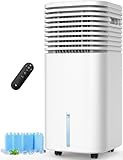
Overview: This 2-gallon evaporative cooler covers 300 sq. ft. with 1620 CFM airflow, featuring 4 modes, 3 speeds, and a 120° oscillating vent. It cools via water evaporation, requiring no exhaust hose. What Makes It Stand Out: The massive 2-gallon tank enables 20 hours of runtime, while the “3-second cooling” claim leverages its 27 ft/s airflow and wide 120° swing. Ultra-quiet operation (<45 dB) and 15-hour timer enhance sleep-friendly use. Value for Money: Excellent for low-humidity areas due to minimal energy use (80W) and zero installation costs. Cheaper upfront than refrigerant AC, but limited to evaporative cooling—making it a niche product for dry climates. Strengths and Weaknesses: Strengths: Long runtime, whisper-quiet performance, versatile airflow control, and large tank capacity. Weaknesses: No real temperature reduction (only perceived cooling), ineffective in humidity, and bulky design. Bottom Line: A top pick for dry climates needing extended, silent cooling without setup. Not a true AC alternative, but a cost-efficient evaporative solution for offices or bedrooms where humidity is low.
5. Shinco 8,000 BTU Portable Air Conditioner, AC Unit with Built-in Cool, Dehumidifier & Fan Modes for Room up to 350 sq.ft, Conditioner Remote Control, 24 Hour Timer, Installation Kit
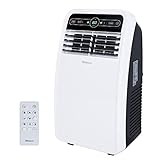
Overview: This 8,000 BTU (ASHRAE) unit cools spaces up to 200 sq. ft. (despite 350 sq. ft. claims), with cool/fan/dry modes, a 24-hour timer, and included window kit for quick setup. What Makes It Stand Out: Its self-evaporating dehumidifier mode (19.2L/day) eliminates bucket emptying, while the 55 dB sleep mode ensures quiet operation. Compact size and four casters enhance bedroom mobility. Value for Money: Budget-friendly for very small rooms, but its 4,550 SACC rating underdelivers for 350 sq. ft. claims. Better suited for closets or studios than advertised spaces—competes with entry-level portables on price alone. Strengths and Weaknesses: Strengths: Hassle-free dehumidifying, intuitive remote, and easy installation. Weaknesses: Overstated room coverage, weak airflow (200 m³/h), and noisy at higher fan speeds (62 dB). Bottom Line: A functional basic unit for tiny spaces under 200 sq. ft., but misleading capacity claims reduce its appeal. Only recommend for ultra-small rooms where true AC is needed on a tight budget.
6. DREO Portable Air Conditioners, 8000 BTU ASHRAE (5000 BTU DOE) Smart AC Unit for Bedroom with Drainage-free Cooling, 45dB Quiet, APP/Voice/Remote, Portable AC for Room Indoors, AC318S

Overview: The DREO AC318S is a smart 8000 BTU ASHRAE (5000 BTU SACC) portable air conditioner designed for bedrooms and quiet spaces, featuring drainage-free operation, ultra-quiet cooling, and extensive app/voice control capabilities. It targets users seeking seamless integration with smart home ecosystems and minimal maintenance. What Makes It Stand Out: DREO’s patented IceCool System ensures rapid cooling up to 14 ft away, while the True Drainage-Free System (via self-evaporation algorithm) eliminates manual draining under 90% humidity. Its standout feature is comprehensive smart control—Siri, Alexa, Google Home, and a dedicated app for monitoring humidity, setting sleep curves, and adjusting temps from 61°F–86°F. The 45dB noise level makes it exceptionally quiet for bedrooms. Value for Money: Priced competitively for its tier, it justifies cost through advanced tech: the drainage-free system saves long-term hassle, and smart features rival higher-end units. While similar-capacity models lack full app integration, DREO’s ecosystem adds premium value without a steep price hike. Strengths and Weaknesses: Strengths: Near-silent operation; true drainage-free convenience; robust smart controls; effective dehumidification. Weaknesses: Drain hose required above 90% humidity; app connectivity may occasionally lag; ASHRAE BTU rating (8000) overstates real-world cooling vs. DOE standard (5000 BTU). Bottom Line: Ideal for tech-savvy users prioritizing quiet, maintenance-free cooling in bedrooms. Its smart features and drainage innovation make it a top pick despite minor humidity limitations, offering excellent bang for the buck.
7. GarveeTech Portable Air Conditioner, 8,000 BTUs Room Air Conditioner, 3 in-1 Cooling AC Portable Air Conditioner with Fan & Dehumidifier, Standing Air Conditioner, Ventless Floor AC

Overview: The GarveeTech 8000 BTU ASHRAE portable AC delivers versatile cooling for rooms up to 350 sq ft, emphasizing easy installation and quiet performance. It’s built for users needing a straightforward, multi-functional unit without complex setup. What Makes It Stand Out: Its adjustable window panels (16–47 inches) guarantee compatibility with nearly any window, eliminating installation headaches. The 3-in-1 functionality (Cool/Fan/Dry modes) adapts to seasonal needs, while noise-reducing foam keeps operation at 50dB—ideal for sleep. The upgraded condenser minimizes drainage frequency, a rare perk in this segment. Value for Money: This unit excels as a budget-friendly workhorse. It matches pricier models in coverage and quietness but shines with universal window fit and reduced drainage needs. For renters or those avoiding permanent AC, it’s a cost-effective solution where competitors often skimp on installation flexibility. Strengths and Weaknesses: Strengths: Universal window compatibility; reliable 3-in-1 versatility; quiet 50dB operation; minimal drainage in moderate humidity. Weaknesses: Lacks smart controls/app; drainage still needed in high humidity; BTU cooling (ASHRAE) may not suit larger rooms per DOE standards. Bottom Line: A no-frills, highly practical choice for renters or small offices. Its installation ease and consistent performance make it a standout value, though tech enthusiasts might miss app integration.
8. Portable Air Conditioner, 2025 Upgraded 4-IN-1 Ultra-Quiet Design Portable AC Unit with 2 Cool Mist & Speeds1500ml Remote Control Air Conditioner Evaporative for Home,Office,Bedroom, Camping

Overview: This evaporative cooler (not compressor-based) offers 4-in-1 functionality (AC/fan/humidifier/night light) with USB power, targeting portable cooling for camping, desks, or small rooms. It’s designed for low-power, on-the-go use rather than whole-room cooling. What Makes It Stand Out: The unique evaporative design uses water mist (1500ml tank) for cooling—ideal for dry climates—and requires no exhaust hose. With 3 fan speeds, 2 mist modes, 90° adjustable airflow, and USB compatibility (power bank/car charger), it’s unmatched for mobility. The 8-hour runtime and ultra-quiet operation enhance versatility for camping or offices. Value for Money: At its modest price, it’s exceptional for supplemental cooling. While it won’t replace a compressor AC, the portability, mist function, and multi-scenario use (indoor/outdoor) deliver niche value. Cheaper than true ACs, it fills a gap for temporary or personal cooling where drainage/hoses are impractical. Strengths and Weaknesses: Strengths: True portability (USB-powered); silent operation; humidifies air; no installation/drainage; affordable. Weaknesses: Ineffective in high humidity; limited cooling power (not for large rooms); evaporative tech cools only via water evaporation, not refrigeration. Bottom Line: Perfect for camping, desks, or dry climates needing personal cooling, but not a primary AC solution. Its portability and multi-functionality justify the cost for targeted use cases.
9. OUTOHOME 5200BTU Portable Tent Air Conditioner for Camping Outdoor and Indoor Use, 400W Consumption Quiet Air conditoning For Truck RV Van and Car Cooling, Small AC for Garage and Pet(Grey)

Overview: The OUTOHOME 5200 BTU unit is a compact, compressor-based AC built for camping, RVs, vans, and small indoor spaces. Its 31-lb weight and metallic handle prioritize portability while delivering genuine refrigeration cooling. What Makes It Stand Out: Rapid 18°F cooling in 5 minutes (via GMCC compressor) and 400W energy efficiency stand out for outdoor use. Drainage-free operation below 70% humidity (with dehumidification mode) is rare in camping ACs. Its versatility shines across tents, trucks, garages, and pet spaces, with a quiet 46–50dB sleep mode. Value for Money: A premium investment for campers, but justified by its specialized design. Few competitors offer true compressor cooling in such a portable form (22.4” x 11.2” x 13.8”). While pricier than evaporative coolers, it delivers real AC performance where others fail—making it essential for hot, humid campsites. Strengths and Weaknesses: Strengths: Genuine refrigeration cooling; lightweight portability; effective dehumidification; low noise in sleep mode; multi-scenario use. Weaknesses: Drainage needed above 70% humidity; limited coverage (best for small spaces); higher cost than non-compressor alternatives. Bottom Line: The go-to solution for campers needing reliable, powerful cooling in mobile settings. Worth the splurge for serious outdoor enthusiasts despite the niche focus.
10. Portable Air Conditioners, 10000 BTU Portable AC up to 450 Sq.Ft, 3 in 1 AC Unit with Cool, Dehumidifier & Fan Modes, Remote Control & 24H Timer, AC Unit for Bedrooms, Living Rooms & Apartments

Overview: This 10,000 BTU portable AC targets larger rooms (up to 450 sq ft) with rapid cooling, emphasizing ease of use and year-round versatility for homes and apartments. What Makes It Stand Out: Its standout feature is claimed 3-minute cooling via an upgraded compressor—ideal for quick relief in living rooms or garages. The tool-free 10-minute setup (with universal window kit) and dual controls (remote + panel) cater to all users, including seniors. The 50dB noise level ensures quiet operation across all modes. Value for Money: Positioned as a mid-range powerhouse, it offers strong value for larger spaces. The 10,000 BTU rating (ASHRAE) provides wider coverage than Products 6–7, while the 3-in-1 functionality replaces separate dehumidifiers/fans. It’s competitively priced against similar-capacity units with comparable ease of installation. Strengths and Weaknesses: Strengths: High cooling capacity for large rooms; effortless setup; intuitive dual controls; reliable 3-in-1 use; quiet performance. Weaknesses: BTU rating likely inflated (per ASHRAE vs. DOE); drainage not addressed (implied as needed); no smart features. Bottom Line: A solid, user-friendly choice for cooling spacious areas quickly. Best for those prioritizing coverage and simplicity over smart tech, delivering robust performance at a fair price.
Understanding RV-Specific Cooling Needs
Why Standard Portable ACs Fall Short in RVs
Most portable air conditioners designed for houses simply aren’t built for the realities of RV life. They often require more electrical power (amperage) than a typical RV shore power connection or generator can reliably supply, especially when other appliances are running. Their size and weight can be cumbersome for storage in tight RV compartments, and their standard venting kits frequently lack the adaptability needed for diverse RV window and roof configurations. Furthermore, the noise levels common in residential units can be particularly intrusive in the close quarters of an RV interior.
The Critical Role of Supplemental Cooling
It’s vital to understand that a portable unit for an RV primarily serves as supplemental cooling. While a well-maintained roof-mounted AC handles the main cabin, a portable unit excels in specific scenarios: cooling a particularly hot bedroom area, providing relief in a slide-out room where airflow is poor, offering spot cooling in a home office nook, or even cooling an attached awning space during outdoor living. Recognizing this targeted role helps set realistic expectations and guides your selection towards units optimized for focused, efficient cooling rather than trying (and failing) to cool the entire RV.
Unique Environmental Challenges on the Road
RVs face environmental factors that stationary homes don’t. Constant exposure to direct sunlight on metal surfaces creates intense radiant heat gain. Travel vibrations can loosen components or connections over time. Dust and debris on unpaved roads can clog filters and vents more quickly. Additionally, the varying electrical sources – campground pedestal, generator, or inverter/battery bank – each present distinct power limitations and stability issues that your portable AC must accommodate to function safely and effectively.
Key Features to Prioritize in Your Selection
Calculating the Right Cooling Capacity (BTUs)
Choosing the correct British Thermal Unit (BTU) rating is paramount and directly tied to your specific cooling zone. Undersizing leads to constant running, poor cooling, and wasted energy. Oversizing causes short cycling, inadequate dehumidification (leaving the air feeling clammy), and unnecessary strain on your electrical system. Forget square footage alone; consider the volume of the space (length x width x height), the number of heat-generating appliances or people in that zone, the amount of direct sunlight hitting the RV, and the typical outside temperatures you encounter. A unit slightly oversized for the zone (not the whole RV) is often better than one that’s too small, but always cross-reference with your electrical capacity.
Navigating Electrical Requirements and Compatibility
This is arguably the most critical technical consideration. RV electrical systems are typically 30-amp or 50-amp services, often shared with the refrigerator, microwave, and other essentials. Portable ACs draw significant power, especially during startup (surge watts). You must know the unit’s running watts, surge watts, and required voltage (110V/120V is standard for RVs; 220V units are generally impractical). Crucially, ensure the unit’s total wattage draw leaves ample headroom on your circuit – ideally, it shouldn’t exceed 80% of the circuit’s capacity when other essential devices are running. Compatibility with generators (check generator wattage specs) and inverter systems (pure sine wave inverters are usually required) is equally important for off-grid cooling.
Venting System Flexibility and Ease of Installation
Effective venting of hot exhaust air is non-negotiable for cooling performance and safety. Standard window kits often don’t fit RV windows snugly or securely. Look for units offering versatile venting solutions: adjustable panels compatible with common RV window sizes (including curved or lift-style windows), potentially ceiling vent options for certain slide-outs, or even specialized kits for venting through an RV’s existing roof AC shroud (with proper modifications and seals). The installation process should be straightforward enough to set up and dismantle repeatedly without requiring tools or permanent modifications, especially crucial for frequent movers.
Noise Levels: A Make-or-Break Factor Inside
Noise perception is magnified in the confined, echo-prone space of an RV. Units operating above 50-55 decibels (dB) can be disruptive for sleeping, conversation, or watching TV. Pay close attention to the manufacturer’s noise ratings (in dB) for both cooling and fan-only modes. Look for features designed to reduce noise, such as insulated compressors, multiple fan speeds (allowing you to run quieter on mild days), and vibration-dampening feet. Reading user reviews specifically mentioning noise levels inside an RV or similar small space is highly recommended, as lab ratings don’t always reflect real-world acoustics.
Installation and Operational Considerations
Space Constraints and Strategic Placement
RV interiors are meticulously designed with every inch accounted for. Measure potential installation spots before purchasing. Consider not just the unit’s footprint but also the space needed for the hot air exhaust hose to run straight (bends reduce efficiency), clearance around the unit for air intake, and ease of access for filter cleaning. Common placement areas include under a dinette bench (with venting out a nearby window), in a closet (vented externally), or in a large slide-out compartment. Ensure the location doesn’t obstruct walkways, storage access, or emergency exits.
Weight and Portability for Storage
When not in use, you’ll need to store the unit. Factor in its dry weight (water tanks add significant weight when full) and whether it has sturdy handles or wheels suitable for maneuvering in tight RV storage bays. Units over 70-80 pounds become very difficult to lift and store safely in overhead compartments, which are common RV storage spots. Consider if the unit breaks down into manageable pieces for storage, though this often complicates setup.
Drainage Solutions for Continuous Operation
Most portable ACs collect condensation from the air. Units with a “self-evaporative” system use some of this water to cool the condenser, expelling most moisture through the exhaust hose – ideal for continuous cooling without constant emptying. However, in very humid conditions, a drain hose or internal tank may still be necessary. If choosing a unit requiring manual tank emptying, ensure the tank is easily accessible and removable. A continuous drain hose option (routing to an external drain or gray tank) is a significant convenience feature for extended use, but verify compatibility with your RV’s drainage points.
Power Management and Efficiency
Optimizing Performance on Limited Shore Power
When plugged into campground power (typically 30A or 50A), strategic power management is key. Run the portable AC on a dedicated circuit if possible. Avoid running high-draw appliances like electric heaters, coffee makers, or hair dryers simultaneously. Utilize timers or eco-modes on the AC unit to reduce runtime during the hottest part of the day when other campers might also be straining the pedestal. Understanding your RV’s total electrical load profile is essential to prevent nuisance tripping of breakers.
Generator Compatibility for Boondocking
Running a portable AC off a generator while off-grid demands careful planning. Generators must reliably handle the unit’s surge watts (often 1.5-2x running watts). Check your generator’s continuous and surge wattage ratings against the AC’s specifications. Smaller, inverter generators are popular for RVs but may struggle with AC startup surges; a unit specifically designed for lower surge requirements or compatible with “soft start” technology becomes highly valuable in this scenario. Always run the generator outside the RV for safety.
Inverter and Battery Bank Potential (With Caveats)
While appealing for silent, emission-free cooling, running a portable AC directly from a house battery bank via an inverter is extremely challenging. The high power draw (often 1000+ watts) depletes even large lithium batteries very quickly – think hours, not days. This approach is generally only feasible for very small, efficient units used sparingly during the day with a robust solar charging system actively replenishing the batteries. Thoroughly calculate your battery capacity (kWh) against the AC’s wattage draw to avoid deep discharging and damaging your batteries.
Maintenance and Longevity for Road Warriors
Simplified Filter Access and Cleaning Routine
Dust and road debris will clog filters rapidly. Units with easily accessible, tool-free filter compartments encourage regular cleaning – a critical task for maintaining efficiency, airflow, and indoor air quality. Washable mesh filters are standard; some higher-end models might include carbon or anti-allergen filters. Establish a habit of checking and cleaning filters at least weekly during heavy use seasons to prevent performance degradation and potential mold growth.
Preventing Mold and Mildew in Mobile Units
The combination of moisture, warmth, and potential stagnation makes portable ACs prone to mold inside the unit and hose. Always run the unit in fan-only mode for 15-30 minutes after cooling to dry out internal components before storage. Ensure the exhaust hose is completely drained and stored loosely coiled, not tightly kinked. Consider using a small desiccant pack inside the unit’s storage compartment during transit or long-term storage. Never store the unit while it’s still damp.
Durability Features for the Road
Look for construction details that signal roadworthiness: a sturdy, impact-resistant outer shell; secure internal component mounting to withstand vibration; reinforced hose connections; and high-quality casters or feet that won’t crack on uneven ground. Units designed with RV or “mobile” use in mind often incorporate these features more thoughtfully than standard residential models repurposed for travel.
Frequently Asked Questions
Frequently Asked Questions
Can I run a portable air conditioner on my RV’s 30-amp service alongside other appliances? Yes, but careful power management is essential. Calculate the total wattage of the AC unit (including surge) plus other running appliances. Stay below 80% of your 30-amp circuit’s capacity (around 2880 watts continuous) to avoid tripping breakers. Prioritize running the AC when high-draw items like the microwave or electric water heater are off.
How do I vent a portable AC in an RV window that doesn’t open traditionally? Specialized venting kits designed for RV windows are crucial. Look for adjustable panels that fit within the window frame, often using foam or flexible seals to block gaps around curved or limited-opening windows. Some kits utilize the existing roof AC shroud for exhaust, but professional installation guidance is recommended for this method.
Are dual-hose portable AC units worth the extra cost for RVs? Generally, yes. Dual-hose models draw intake air from outside for the condenser, rather than from the cooled room like single-hose units. This prevents the unit from creating negative pressure inside the RV, which can pull in hot, humid outside air through leaks, making the unit work less efficiently. The improved efficiency often justifies the higher initial cost and price in an RV environment.
Will a portable AC drain my RV house batteries too quickly? Running a standard portable AC directly from batteries via an inverter is usually impractical for extended periods. The high power draw (often 1000+ watts) will deplete even large lithium house batteries in just a few hours. This approach is only feasible for very short durations unless paired with a substantial solar charging system actively replenishing power.
How often should I clean the air filter in my RV portable AC? Check and clean the filter at least once a week during regular summer use. Road dust and higher particulate levels mean filters in RVs clog faster than in stationary homes. A visibly dirty or clogged filter significantly reduces cooling efficiency and airflow, so frequent cleaning is non-negotiable for optimal performance.
Can I use my portable AC to dehumidify my RV without cooling? Many portable AC units have a dedicated “Dry” or “Dehumidify” mode that primarily focuses on removing moisture from the air with minimal cooling effect. This is extremely useful in humid climates or during shoulder seasons when it’s muggy but not excessively hot, helping to prevent condensation and musty odors inside the RV.
What’s the main reason my portable AC isn’t cooling effectively in the RV? The most common culprits are inadequate venting (leaks in the exhaust hose setup allowing hot air back in), an undersized unit for the specific space it’s trying to cool, or insufficient electrical power causing the unit to underperform or cycle off. Always verify the venting seal, BTU rating suitability, and electrical supply first.
Is it safe to vent the hot air hose into an RV slide-out compartment? Venting hot exhaust air into an enclosed slide-out space is strongly discouraged. This traps extreme heat (often exceeding 120°F/49°C) inside a confined area, potentially damaging slide mechanisms, seals, or interior finishes, and creates a significant fire hazard. Hot air must always be vented directly outside the RV structure.
How do I prevent the exhaust hose from kinking and losing efficiency? Use a rigid or semi-rigid insulated duct specifically designed for portable ACs, as it holds its shape better than flexible plastic hose. Ensure the hose path has gentle curves, not sharp bends. Secure the hose along its run with minimal tension. Some kits include hose supports or brackets to maintain a straighter, more efficient airflow path out the window.
Can I leave my portable AC running unattended while boondocking on a generator? It’s generally safe to run a properly sized and installed portable AC on a generator while boondocking, but never leave the generator running unattended inside an enclosed space or near open windows/vents due to deadly carbon monoxide risk. Ensure the generator is placed well away from the RV (downwind and at least 20 feet), on stable, level ground, and monitor fuel levels to prevent unexpected shutdowns.
See Also
- How to Choose the 10 Best Mini Portable Air Conditioners for RVs in 2026
- 2026’s Top 10 Wi-Fi Enabled Portable Air Conditioners for Modern Homes
- The 10 Best Portable Air Conditioners for Bedrooms This Year
- We Tested 50 Portable Air Conditioners - Here are the 10 Best for Home Use
- Stop Noisy Cooling with the 10 Best Quiet Portable Air Conditioners This Year