Table of Contents
Summer heat can turn even the most comfortable spaces into sweltering chambers, leaving you desperately searching for relief beyond the reach of your central air conditioning. You’ve probably seen those tempting claims online: “AC-powered fans,” “portable units that cool like real air conditioning,” or “spot coolers for instant chill.” But navigating the crowded market of personal cooling solutions often leads to confusion and disappointment. Many products promise refrigerated air but deliver little more than a breeze over a damp pad, leaving you wondering if true, targeted cooling without a full HVAC system is even possible. Understanding the reality behind these technologies is the first crucial step to finding genuine comfort.
The truth is, most “cooling fans” marketed for spot cooling aren’t true air conditioners in the conventional sense. True refrigerant-based cooling requires a compressor, condenser, and evaporator – a complex system rarely found in compact, affordable fan units. Instead, the market is dominated by evaporative coolers (swamp coolers) and a smaller segment of actual portable spot coolers that do use refrigerants but require specific venting. Confusing these technologies leads to wasted money and ineffective cooling, especially in humid climates where evaporative methods fail. This guide cuts through the marketing hype, focusing squarely on the functional differences, realistic capabilities, and critical factors you must evaluate to choose a solution that genuinely lowers the temperature where you need it most, not just moves warm air around.
Top 10 Cooling Fans with Air Conditioning
Detailed Product Reviews
1. MEPTY 3-IN-1 Evaporative Air Cooler, Cooling Fans that Blow Cold Air with 120° Oscillation, 12H Timer,3 Speeds, Portable Swamp Cooler for Indoor Use, Windowless Portable Air Conditioners

Overview:
The MEPTY 3-in-1 Evaporative Air Cooler combines cooling, humidifying, and fan functions into a compact tower unit designed for personal indoor spaces. It targets users seeking affordable, energy-efficient climate control without installation hassles.
What Makes It Stand Out:
Its triple functionality (cooling fan, humidifier, and swamp cooler) and ETL safety certification are major highlights. The intuitive touch panel with auto-screen-off, 120° oscillation, 12-hour timer, and three specialized modes (Normal, Natural, Sleep) offer tailored comfort. The pull-out 1000ml water tank and copper motor enhance usability and durability.
Value for Money:
Priced competitively for its feature set, it undercuts traditional AC units while delivering solid performance in dry climates. The 80W low energy consumption and long-term motor reliability justify the cost, though it won’t match compressor-based AC cooling power.
Strengths and Weaknesses:
Strengths: Energy-efficient (80W), versatile 3-in-1 design, quiet sleep mode, ETL-certified safety, easy maintenance. Weaknesses: Limited cooling in high humidity, oscillation range narrower than competitors, water tank capacity could be larger for extended use.
Bottom Line:
Ideal for individuals in arid regions needing personalized, eco-friendly cooling. While not a full-room AC replacement, its versatility, safety, and low running costs make it a smart buy for bedrooms or small offices seeking comfort under $80.
2. DREO Portable Air Conditioners Fan, 40” Standing Fans that Blow Cold Air, Portable AC,80° Oscillating Evaporative Air Cooler,Removable Water Tank, Ice Packs, Remote Control, 4 Speeds, 7H Timer, Black

Overview:
This DREO evaporative cooler delivers powerful, quiet cooling for medium-sized rooms using cross-flow impeller technology. Its 40-inch tower design targets users wanting broad airflow coverage without excessive noise.
What Makes It Stand Out:
The ultra-quiet 35dB operation and 80° oscillation stand out, ensuring disturbance-free sleep. The 1,500 RPM motor generates 22 ft/s airflow, covering up to 13,000 cubic feet per hour. Removable components (water tank, cooling pad) simplify maintenance, while ice packs enhance cooling.
Value for Money:
Positioned as a mid-range option, it offers strong airflow and quietness rivaling pricier units. The removable parts reduce long-term upkeep costs, though evaporative coolers inherently work best in dry climates, limiting universal value.
Strengths and Weaknesses:
Strengths: Exceptionally quiet (35dB), wide oscillation (80°), high airflow capacity, easy-cleaning design, includes ice packs. Weaknesses: Cooling effectiveness drops in humidity, no built-in humidifier mode, remote control battery not included.
Bottom Line:
A top choice for noise-sensitive environments like bedrooms or offices in dry areas. Its robust airflow and maintenance-friendly design justify the price, but avoid if you live in humid regions where evaporative cooling falters.
3. JOUJBAIL Portable Air Conditioner,Cooling Fan with 3 Speeds &3 Modes,2-8H Timer,1000ml Water Tank, Remote Control,4 in 1 Humidifier, Air Conditioner,Fan,Night Light,Evaporative Air Cooler for Home

Overview:
The JOUJBAIL mini cooler is a compact, multi-functional desktop unit blending fan, humidifier, air cooler, and night light. Designed for personal use, it prioritizes portability and safety for homes with kids or pets.
What Makes It Stand Out:
Its unique 4-in-1 design (including a soft LED night light) and bladeless safety features are key differentiators. The Type-C charging port, remote control, and adjustable shutter for directional airflow enhance convenience. The 1000ml tank supports extended runtime.
Value for Money:
Excellent value for small-space users seeking versatility. The inclusion of Type-C charging (uncommon in this category) and multi-functional use justifies its budget price, though cooling power is limited to immediate proximity.
Strengths and Weaknesses:
Strengths: Ultra-portable (7.7” size), safe bladeless design, night light function, Type-C charging, easy-clean tank. Weaknesses: Very short effective range (≤3ft), cooling ineffective beyond desk-level, timer maxes at 8 hours.
Bottom Line:
Perfect for desk, nightstand, or travel use where personal micro-cooling is needed. Not for room cooling, but its safety, portability, and added features make it a worthwhile $30–$40 investment for targeted relief.
4. DREO Portable Air Conditioners Fan, 40” Standing Fans that Blow Cold Air, Portable AC,80° Oscillating Evaporative Air Cooler,Removable Water Tank, Ice Packs, Remote Control, 4 Speeds, 7H Timer, White

Overview:
Identical to Product #2 but in white, this DREO evaporative cooler offers the same robust performance in a sleeker aesthetic. It targets users prioritizing quiet operation and wide-area cooling for living spaces.
What Makes It Stand Out:
Mirroring Product #2, it excels with 35dB noise levels, 80° oscillation, and 13,000 CFM airflow. The removable water tank, cooling pads, and included ice packs ensure hassle-free maintenance and enhanced cooling during peak heat.
Value for Money:
Priced similarly to its black counterpart, it delivers identical value—ideal for those matching appliances to room decor. The energy efficiency and low upkeep costs maintain strong ROI, though humidity limitations apply.
Strengths and Weaknesses:
Strengths: Near-silent operation, powerful oscillation, high airflow volume, tool-free maintenance. Weaknesses: Humidity-dependent cooling, remote requires separate batteries, no smart features.
Bottom Line:
Choose this white variant if aesthetics matter; performance is identical to the black model. Highly recommended for dry-climate households needing quiet, effective spot cooling in bedrooms or living areas under $100.
5. NTMY Portable Air Conditioner Fan, Mini Evaporative Air Cooler with 7 Colors LED Light, 1/2/3 H Timer, 3 Wind Speeds and 3 Spray Modes for Your Desk, Nightstand, or Coffee Table
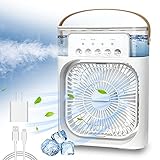
Overview:
The NTMY mini cooler is a USB-powered desktop unit emphasizing portability and ambiance with 7-color LED lighting. It’s engineered for immediate personal cooling and humidification within arm’s reach.
What Makes It Stand Out:
Its vibrant LED mood lighting and USB power flexibility (works with power banks) are unique. The 3H timer, adjustable 60° airflow direction, and dual wind/spray modes cater to personalized micro-climate needs on desks or picnic tables.
Value for Money:
An exceptional budget pick for ultra-portable cooling. USB operation slashes energy costs versus plug-in models, and the multi-functional design (cooling + humidifying + lighting) maximizes utility under $25.
Strengths and Weaknesses:
Strengths: USB-powered portability, romantic LED lighting, ultra-compact, low noise, easy tank removal. Weaknesses: Extremely limited range (≤4ft), short runtime on high settings, no remote control.
Bottom Line:
Best for students, travelers, or desk workers needing instant, localized cooling with style. Skip if you need room-wide cooling, but its charm, portability, and sub-$30 price make it a delightful summer essential.
6. 3-IN-1 Portable Air Conditioners, 5400mAh Built-In Battery Personal Evaporative Air Cooler Fan, Ice Packs & 1200ml Water Tank, 1-7h Timer & Remote, Mini Air Conditioner for Car Desktop Camping, Black
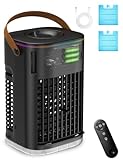
Overview: This compact evaporative cooler targets mobile cooling needs, combining a 5400mAh battery, ice packs, and a 1200ml tank for cordless operation in cars, campsites, or desks. It uses water evaporation and misting to lower ambient temperatures.
What Makes It Stand Out: The standout feature is its exceptional 9–15-hour battery life after a 3.5-hour USB-C charge, far exceeding competitors. Dual mist modes (enhanced with ice packs) promise 40% longer cooling, while 7-color LED lights double as mood lighting or a nightlight. The remote control and quiet 40dB operation add convenience.
Value for Money: Priced mid-range, it justifies cost through versatility—ideal for travelers needing reliable off-grid cooling. While basic fans are cheaper, the battery longevity and ice-pack integration offer superior functionality for camping or long commutes, avoiding frequent refills.
Strengths and Weaknesses: Strengths: Exceptional battery life; effective ice-pack+mist combo; remote control; versatile lighting; quiet operation. Weaknesses: Evaporative cooling ineffective in high humidity; 1200ml tank still requires refills for multi-day trips; mist may dampen nearby surfaces.
Bottom Line: A top pick for campers, drivers, or desk users prioritizing portability and battery endurance. Despite humidity limitations, its thoughtful design and robust runtime deliver excellent value for mobile cooling.
7. Portable Air Conditioners Cooling Fan, XAMATTS 3 Speeds Evaporative Mini Air Conditioner Portable, 700ml Portable AC Air Cooler, Personal Air Conditioner for Bedroom,Room,Office,Camping
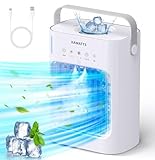
Overview: The XAMATTS cooler is a no-frills personal air conditioner designed for small spaces like bedrooms or offices. It uses evaporative cooling with a 700ml tank, triple misting, and USB-C power for energy-efficient spot cooling.
What Makes It Stand Out: Its 4-in-1 functionality (cooler, fan, humidifier, night light) and auto shut-off for low water levels enhance usability. The transparent tank window and lightweight carry handle improve practicality, while 9W power consumption ensures efficiency. The 13-hour runtime in low-mist mode is impressive for its size.
Value for Money: Budget-friendly without sacrificing essentials. It lacks a battery but excels as a stationary desk/bedroom unit. Cheaper than models with batteries, yet its misting efficiency and auto shut-off provide reliable daily use—ideal for cost-conscious buyers needing basic cooling.
Strengths and Weaknesses: Strengths: Ultra-energy efficient (9W); intuitive auto shut-off; compact and portable; 7-color LED light; quiet operation. Weaknesses: No built-in battery limits mobility; 700ml tank requires frequent refills; mist output less powerful than ice-enhanced rivals.
Bottom Line: A smart buy for stationary use in dry climates. Best for offices or bedrooms where USB-C power is accessible, offering solid cooling at an entry-level price with minimal maintenance.
8. Evaporative Air Cooler with Remote & Timer, 2200+ CFM Portable Fan That Blows Cold Air for Large Room, Home Office, Bedroom - 2.1Gal High-Capacity Tank, 3 Modes, Whisper Quiet 30dB & Sleep Mode

Overview: Engineered for larger spaces, this high-capacity cooler delivers robust airflow (2200+ CFM) with a massive 2.1-gallon tank, targeting families or open-plan rooms needing whole-room cooling.
What Makes It Stand Out: Triple-sided cooling pads and 28ft/s wind speed enable rapid “Arctic Air” cooling, while the 8L tank (plus ice packs) supports all-day use. The ultra-quiet 30dB sleep mode and 12-hour timer cater to undisturbed rest, and 110° oscillation covers wide areas.
Value for Money: Priced higher but justifiable for its scale. It outperforms smaller units in coverage and runtime, making it cost-effective for households. Cheaper than window AC units, yet it cools larger areas more effectively than personal coolers.
Strengths and Weaknesses: Strengths: Exceptional room coverage; massive tank minimizes refills; whisper-quiet sleep mode; effective ice-enhanced cooling; oscillation. Weaknesses: Bulky for travel; evaporative cooling ineffective in humidity; higher upfront cost.
Bottom Line: The premier choice for whole-room cooling in dry climates. Families or office users needing powerful, quiet, long-lasting relief will find it worth the investment despite size limitations.
9. BriteZen Portable Air Conditioners, 3 Wind Speed with Icy Mist Mode Portable AC Unit, 900ML Tank Evaporative Air Cooler Fan Blow Cold Air, Mini Cooling Fan with 2/4H Timer 7 Lights for Bedroom Office

Overview: A versatile mini-cooler blending fan, humidifier, and air cooler functions in a 2.3lb portable unit. Its 900ml tank, dual misters, and ice compatibility target small spaces like bedrooms or desks.
What Makes It Stand Out: The easy-clean detachable tank and anti-scale filter rods simplify maintenance—a rarity in budget models. Dual misting with ice cubes delivers intense “frosty” cooling, while the 2/4H timer auto-disables mist to prolong unit life. Colorful LEDs double as nightlights.
Value for Money: Mid-priced with standout durability features. The maintenance-friendly design reduces long-term hassles versus cheaper alternatives, and energy efficiency keeps running costs low. Ideal for renters or frequent movers needing reliable, hassle-free cooling.
Strengths and Weaknesses: Strengths: Effortless tank cleaning; anti-scale filters; strong icy-mist cooling; lightweight portability; auto mist shut-off. Weaknesses: Shorter runtime (6–7 hours); limited to personal-space cooling; no battery for true portability.
Bottom Line: Highly recommended for bedroom or office use where easy maintenance matters. Its thoughtful design balances performance and practicality, excelling as a low-fuss personal cooler.
10. Arctic Air Chill Zone Evaporative Cooler with Hydro-Chill Technology, Portable Fan with 4 Adjustable Speeds, 8-Hour Cooling, Fan for Bedroom, Living Room, Basement, Office & More

Overview: This compact cooler leverages “Hydro-Chill Technology” with dual cooling jets and a replaceable cartridge for efficient spot cooling in rooms up to 100 sq. ft., suitable for bedrooms or home offices.
What Makes It Stand Out: The replaceable evaporative cartridge enhances cooling efficiency over basic pads, while 4 fan speeds (including turbo) and directional vents offer precise airflow control. Its space-saving design and 8-hour runtime cater to clutter-free setups, and the auto-off timer adds convenience.
Value for Money: Affordable with innovative tech. The cartridge system provides better cooling than pad-only rivals at a similar price point, making it a savvy upgrade for those seeking stronger performance without high costs.
Strengths and Weaknesses: Strengths: Effective Hydro-Chill cartridge; 4 versatile speeds; ultra-compact footprint; energy-efficient; simple setup. Weaknesses: Cartridge replacements add cost; 8-hour max runtime lags behind larger tanks; minimal oscillation.
Bottom Line: A streamlined solution for small, dry spaces. Best for budget buyers wanting cartridge-enhanced cooling in tight quarters, though frequent cartridge changes may inconvenience some users.
Understanding Your Spot Cooling Options
Before investing, it’s vital to grasp the fundamental technologies available. They operate on entirely different principles, leading to vastly different results depending on your environment and needs. Knowing which type suits your situation prevents frustration and ensures you get actual cooling, not just a promise.
Evaporative Cooling: How It Actually Works
Evaporative coolers, often misleadingly called “swamp coolers” or “cool mist fans,” rely on a simple scientific principle: water absorbs heat as it evaporates. These units draw in warm air through water-saturated pads. As the air passes through the damp media, some water evaporates, absorbing heat energy from the air and lowering its temperature. The cooled, more humid air is then blown out. This process is highly effective only in hot, dry climates with low humidity. In humid conditions, evaporation slows dramatically, rendering the cooling effect minimal or nonexistent – you’ll just get a blast of warm, damp air.
Refrigerant-Based Spot Coolers: The Real Deal
True portable spot coolers function similarly to a window AC unit but are designed for targeted areas. They contain a compressor, refrigerant, condenser coil, and evaporator coil. Warm air from the room is drawn over the cold evaporator coil, where heat is absorbed by the refrigerant. The refrigerant then carries this heat outside (via an exhaust hose) where the condenser coil releases it. This process actively removes heat and humidity from the air, providing genuine temperature reduction regardless of the ambient humidity level. The critical requirement is venting the hot exhaust air outside, typically through a window or door kit.
Key Differences in Performance and Application
The performance gap between these technologies is significant. Evaporative coolers can lower air temperature by 15-40°F only in very dry conditions (below 50% relative humidity), but add substantial moisture to the air. Refrigerant-based spot coolers typically lower temperature by 10-25°F consistently, and dehumidify the air, making them effective in almost any climate. Evaporative units are generally cheaper, lighter, and quieter (no compressor), but their cooling is heavily climate-dependent. Refrigerant units are more expensive, heavier, require venting, and are louder due to the compressor, but deliver reliable, measurable cooling power where it’s needed.
Determining Your Actual Cooling Needs
Choosing the right spot cooler starts with a realistic assessment of the space and conditions you’re dealing with. Guessing the size or ignoring environmental factors is the most common reason for inadequate performance.
Calculating the Space Volume Accurately
Don’t just look at the square footage; calculate the cubic footage. Multiply the room’s length by its width by its ceiling height. A 10x10 foot room with 8-foot ceilings is 800 cubic feet. Higher ceilings significantly increase the volume that needs cooling. Spot coolers are rated in BTUs (British Thermal Units) per hour, indicating their cooling capacity. As a rough starting point, you need approximately 20-30 BTUs per cubic foot for moderate cooling in a well-insulated space, but this is highly variable. Underestimating volume is the fastest path to an overwhelmed, ineffective unit.
Assessing Ambient Conditions Realistically
Your local climate is non-negotiable. If you live in a humid region (consistently above 50-60% humidity), evaporative coolers are largely ineffective. Measure the typical humidity in the specific spot you want to cool – basements or sunrooms can differ from outdoor readings. Consider heat sources too: a server rack, large windows with direct sun, or kitchen appliances dramatically increase the cooling load beyond just the room size. Ignoring these factors means even a correctly sized unit might struggle.
Defining Your Cooling Goal Clearly
Be specific about what “cool” means to you. Do you need to drop the temperature from 90°F to 78°F for comfort, or just take the edge off from 85°F to 80°F? Are you cooling a person sitting at a desk, or the entire workshop? Spot coolers are designed for localized relief, not whole-house climate control. Setting realistic expectations based on the unit’s capacity and your defined zone prevents disappointment. True spot cooling often means feeling comfortable within a 3-6 foot radius of the unit.
Essential Features to Evaluate Beyond BTU Rating
While BTU capacity is crucial, numerous other features significantly impact usability, efficiency, and long-term satisfaction. Don’t get fixated solely on the cooling power number.
The Critical Importance of Exhaust Venting
For refrigerant-based spot coolers, venting is mandatory. The unit must expel the hot air generated during the cooling process. Most use a single-hose system: it draws room air over the evaporator (cooling your space), but also uses some of that cooled room air to cool the condenser, then vents that warmed air outside. This creates negative pressure, pulling in hot outside air through leaks, slightly reducing efficiency. Dual-hose models (one for intake, one for exhaust) are more efficient as they use outside air solely for condenser cooling, maintaining neutral room pressure, but are bulkier and less common. Ensure the included window kit is robust and adaptable to your setup.
Noise Levels: A Make-or-Break Factor
Spot coolers, especially refrigerant-based ones with compressors, generate significant noise – often 50-60+ decibels, comparable to a loud conversation or dishwasher. This can be disruptive in bedrooms, home offices, or quiet workshops. Check decibel (dB) ratings carefully; lower is better. Consider where the unit will be placed relative to seating/sleeping areas. Some models offer “quiet mode” settings that reduce fan speed (and cooling output) for nighttime use. Don’t rely solely on marketing terms like “whisper-quiet”; seek verified dB ratings.
Water Management Systems Explained
Evaporative coolers require a water reservoir that needs frequent refilling. Look for easy-fill designs, large tank capacities (reducing refill frequency), and clear water level indicators. Many also have auto-shutoff when empty. Refrigerant-based spot coolers generate condensation as they dehumidify. Higher-end models have a condensate pump to automatically eject this water, while basic models collect it in a tank requiring manual emptying (often multiple times daily in humid conditions). Self-evaporative technology uses some condensate to cool the condenser, reducing (but rarely eliminating) the need for tank emptying – a significant convenience factor.
Portability and Placement Flexibility
True spot cooling often means moving the unit between locations (home office to workshop, bedroom to living room). Weight matters – refrigerant units can be 50-80+ lbs. Robust, sturdy caster wheels (preferably swivel casters) are essential. Consider the unit’s footprint; will it fit under a desk or in a cramped corner? Hose length and flexibility impact placement distance from a venting point. Compact designs with integrated handles enhance maneuverability. Don’t underestimate how crucial easy movement is for practical, everyday use.
Optimizing Performance and Efficiency
Getting the most out of your spot cooler involves smart setup and usage habits. Proper operation maximizes cooling effect while minimizing energy waste and noise.
Strategic Placement for Maximum Impact
Position is everything. For refrigerant-based units, place the exhaust hose as short and straight as possible to the venting point; bends and long hoses reduce efficiency. Keep the unit away from walls and obstructions on the intake side (usually the rear/sides) to ensure good airflow. Point the output directly towards the area you want to cool (e.g., your chair or workbench), not at a wall. Avoid placing it near heat sources like direct sunlight through windows, ovens, or electronics. Elevating the unit slightly can sometimes improve air distribution.
Managing Airflow and Sealing the Space
Spot coolers work best in relatively contained areas. Close doors to unused rooms to concentrate cooling. Seal obvious gaps around windows and doors near the unit to prevent cooled air from escaping and hot air from infiltrating. For refrigerant units using single-hose venting, the negative pressure created will draw in some hot outside air; sealing the room as much as possible mitigates this. Using the spot cooler in conjunction with ceiling fans can help distribute the cooled air more effectively throughout a small zone.
Energy Consumption Considerations
Spot coolers, particularly refrigerant models, consume significant electricity (often 500-1500+ watts). Check the unit’s estimated yearly operating cost or Energy Efficiency Ratio (EER) if available; a higher EER indicates better efficiency (more cooling per watt). Use timers or programmable thermostats to run the unit only when needed. Lowering the fan speed setting when maximum cooling isn’t required saves energy. Remember, running a spot cooler in a large, open, or poorly sealed space is incredibly inefficient – focus it on the smallest practical zone.
Addressing Common Challenges and Limitations
No spot cooling solution is perfect. Being aware of potential drawbacks upfront allows you to plan for them and manage expectations.
Humidity’s Role in Cooling Effectiveness
This cannot be overstated, especially for evaporative coolers. High humidity (above 60%) severely cripples evaporative cooling. Even refrigerant-based units struggle more in very humid conditions because dehumidifying requires extra energy, slightly reducing their net cooling capacity. If you live in a humid climate, an evaporative cooler is likely a poor investment; prioritize a refrigerant-based spot cooler. Understanding your local dew point can provide even better insight than just relative humidity.
The Reality of “Whole Room” Cooling Claims
Manufacturers often tout cooling capacities for rooms much larger than the unit can realistically handle. A 10,000 BTU spot cooler might be advertised for “up to 450 sq. ft.,” but this assumes ideal conditions (low heat load, good insulation, moderate climate). In reality, for effective spot cooling where you feel a significant temperature drop, focus on cooling a much smaller zone – perhaps 100-200 sq. ft. max for that unit. Trying to cool a large, open area will result in marginal comfort at best and constant running, driving up energy costs.
Condensation and Water Handling Issues
Refrigerant spot coolers will produce water as they remove humidity from the air. Tank models require vigilance; forgetting to empty the tank causes automatic shut-off, leaving you in the heat. Self-evaporative systems reduce but rarely eliminate tank emptying needs, especially during prolonged use in high humidity. Units with condensate pumps offer the most hassle-free operation but add cost. Factor in how often you’re willing to manually deal with water based on your typical usage and humidity levels.
Maintenance Requirements for Longevity
Both types need regular upkeep. Evaporative cooler pads must be cleaned regularly (monthly or more often) to prevent mineral buildup and mold, and replaced seasonally or as needed. Refrigerant units require cleaning or replacing air filters (usually every few weeks during heavy use) to maintain airflow and efficiency; clogged filters drastically reduce performance and can cause icing. Condenser coils (on refrigerant units) need occasional vacuuming to remove dust. Neglecting basic maintenance leads to reduced cooling, higher energy bills, unpleasant odors, and shortened lifespan.
Making the Final Decision: Key Considerations Checklist
Synthesizing all the information, here’s a practical framework to guide your choice without relying on specific product lists.
Climate and Humidity: The Primary Filter
Start here. If your average summer humidity consistently exceeds 50-60%, eliminate evaporative coolers from consideration immediately. Your only viable option for genuine temperature reduction is a refrigerant-based spot cooler. If you live in a very dry climate (like the desert Southwest), evaporative coolers become a potentially effective and more energy-efficient choice, but verify local humidity patterns.
Space Size and Layout: Matching Capacity to Reality
Calculate your cubic footage accurately. Be brutally honest about the actual zone you need to cool effectively (not the whole house). Match this to the unit’s BTU rating, but apply a healthy dose of skepticism to manufacturer claims – err on the side of slightly higher capacity if your space has heat sources or poor insulation. Remember, spot cooling is localized; don’t expect uniform temperature throughout a large, open floor plan.
Venting and Installation Practicality
For refrigerant units, assess your venting options before buying. Do you have a suitable window or door nearby? Is the included kit compatible with your setup? Can you route the hose without excessive bends? If venting is impossible (e.g., in a basement with no windows), a refrigerant spot cooler is not feasible – evaporative might be an option if humidity is low, but its effectiveness will be limited without airflow exchange. This is a non-negotiable requirement for true AC performance.
Budget and Total Cost of Ownership
Consider both upfront cost and long-term expenses. Evaporative coolers are cheaper initially but ineffective in humidity. Refrigerant spot coolers cost more upfront, consume more electricity, and may require more maintenance. Factor in potential water handling costs (time for emptying tanks) and energy usage. A slightly more expensive unit with a condensate pump or higher EER might save significant hassle and money over time. Also, weigh the cost against alternatives like installing a mini-split in a critical room if spot cooling proves insufficient.
Frequently Asked Questions
Frequently Asked Questions
Can a spot cooler effectively lower the temperature in a very humid room? Yes, but only if it’s a refrigerant-based spot cooler (true AC). Evaporative coolers become ineffective as humidity rises above 50-60%. Refrigerant units actively remove heat and moisture, providing measurable cooling regardless of humidity, though dehumidifying very damp air slightly reduces their net cooling capacity.
Do I absolutely need to vent a portable spot cooler? Yes, for any refrigerant-based spot cooler, venting the hot exhaust air outside is mandatory. Without venting, the unit simply recirculates heat within the room, providing no net cooling and potentially making the space hotter. Evaporative coolers do not require venting but need a source of airflow exchange to work well.
How often will I need to empty the water tank on a refrigerant spot cooler? It varies significantly based on humidity levels, unit size, and runtime. In high humidity, you might need to empty it every 4-8 hours of continuous use. Units with self-evaporative technology or condensate pumps drastically reduce or eliminate manual emptying needs. Always check the tank level indicator regularly.
Are evaporative coolers a good replacement for air conditioning? Only in very specific, dry climates (like desert regions). They add significant moisture to the air, which is comfortable in arid conditions but makes humid environments feel muggier and less cool. They cannot lower the air temperature below the wet-bulb temperature, unlike refrigerant AC which can achieve much lower temperatures.
Will a spot cooler work in a basement? Refrigerant-based units can work well in basements if you have a viable venting option (e.g., a window well, bulkhead door, or dedicated vent pipe). Evaporative coolers are generally ineffective in basements due to typically higher humidity levels and lack of necessary airflow exchange.
How loud are portable spot coolers typically? Refrigerant-based models with compressors typically range from 50 to 65+ decibels – comparable to a loud conversation, dishwasher, or moderate rainfall. Evaporative coolers are generally quieter (40-55 dB), similar to a standard fan. Check specific decibel ratings, as noise can be disruptive in quiet spaces like bedrooms.
Can I use a spot cooler to cool multiple rooms? Spot coolers are designed for localized cooling within a single, relatively contained space. Trying to cool multiple connected rooms, especially with open floor plans, is highly inefficient and usually ineffective. The cooling effect diminishes rapidly with distance from the unit. Focus on cooling the specific zone where people are located.
Do spot coolers use a lot of electricity? Refrigerant-based spot coolers consume significant power, often 500-1500+ watts (similar to a window AC unit). Evaporative coolers use much less (50-150 watts, like a fan). Actual cost depends on your local electricity rate, runtime, and unit efficiency (EER). They are more efficient than cooling an entire house but less efficient than central AC for whole-home cooling.
Why is my spot cooler blowing warm air? Common causes include: a refrigerant unit’s exhaust hose is blocked or improperly vented (trapping hot air), dirty air filters restricting airflow, low refrigerant charge (requires professional service), or an evaporative cooler running out of water or having clogged pads. Check venting, filters, and water levels first.
Can a spot cooler help reduce my central AC bill? Yes, strategically. By cooling only the specific room you’re using (like a home office or bedroom) with a spot cooler, you can often raise the thermostat on your central system by several degrees. This reduces the runtime and energy consumption of the much larger, less efficient central unit, potentially offsetting the spot cooler’s energy use and lowering your overall bill.
See Also
- We Tested 50 Cooling Fans with Air Conditioning - Here are the 10 Best for Spot Cooling
- 10 Best Cooling Fans with Air Conditioning for Supplemental Cooling in 2026
- We Tested 50 Cooling Fans with Air Conditioning - Here are the 10 Best for Home Use
- 10 Best Cooling Fans for Hot Bedroom Nights This Year
- The 10 Best Heating & Cooling Fans for Seniors This Year