Table of Contents
Working in a cramped garage during winter months can transform even simple projects into miserable, finger-numbing experiences. Space constraints shouldn’t mean sacrificing comfort, and fortunately, modern heating technology has evolved to deliver powerful warmth without demanding precious square footage. Whether you’re tinkering with tools, pursuing hobbies, or just trying to keep your vehicles from freezing, finding the right heating solution for a tight garage requires understanding how compact designs maximize efficiency while minimizing their physical footprint.
The market offers numerous heating options specifically engineered for challenging spaces, but navigating the technical specifications and safety requirements can feel overwhelming. This comprehensive guide walks you through everything you need to know about selecting a space-saving garage heater, from understanding different heating technologies to evaluating installation requirements and safety protocols. By focusing on features rather than brand names, you’ll learn how to identify the perfect unit that delivers reliable performance without crowding your workspace.
Top 10 Compact Garage Heaters
Detailed Product Reviews
1. Dura Heat EUH1465 Electric Forced Air Heater with Pivoting Base 5,120 BTU, Yellow

Overview: The Dura Heat EUH1465 is a robust 1500-watt forced-air heater designed for demanding workspaces. Delivering 5,120 BTUs of PTC ceramic warmth, this yellow steel unit targets small garages, workshops, and commercial areas. Its pivoting base directs heat precisely where needed, while the adjustable thermostat maintains consistent temperatures. The dual-function design offers both heating and fan-only modes for year-round utility.
What Makes It Stand Out: The pivoting base sets this heater apart, allowing directional control without moving the entire unit. PTC ceramic technology provides efficient, self-regulating heat that won’t overheat, while the rugged steel construction withstands harsh workshop conditions. The overheat shut-off adds essential safety for unattended operation.
Value for Money: Priced competitively for industrial-grade heaters, the EUH1465 offers professional features at consumer-level cost. Comparable units lack the pivoting base or use cheaper materials. For those needing targeted, durable heating under $100, it represents solid value against generic brands that compromise on safety certifications.
Strengths and Weaknesses: Strengths include durable steel housing, directional pivot control, efficient PTC ceramic element, overheat protection, and fan-only versatility. Weaknesses are limited to 1500W capacity for small spaces only, no tip-over switch for portable safety, and audible fan noise typical of forced-air designs. The yellow industrial aesthetic may not suit home interiors.
Bottom Line: The Dura Heat EUH1465 excels as a workshop companion where durability and directional heating matter. While not ideal for large areas or homes with children, its rugged build and pivoting function make it a smart purchase for DIY enthusiasts and professional tradespeople needing reliable spot heating.
2. Comfort Zone Electric Portable Milkhouse Style Utility Space Heater with Adjustable Thermostat, Overheat Protection, and Safety Tip-Over Switch, Ideal for Garage or Greenhouse, 1,500W, CZ798BK

Overview: The Comfort Zone CZ798BK brings classic milkhouse utility heater design into modern garages and greenhouses. This 1500-watt electric heater combines compact portability with serious heating power, featuring an adjustable rotary thermostat and three operational modes. Its all-metal housing stays cool during operation while the oversized carry handle enables easy repositioning throughout your workspace.
What Makes It Stand Out: Comprehensive safety features distinguish this unit—power and caution indicator lights provide visual operational status, while both tip-over and overheat protection automatically shut down the heater if compromised. The three-setting versatility (low heat, high heat, fan-only) eliminates need for separate air circulation appliances.
Value for Money: This heater sits in the mid-range price bracket but outperforms budget competitors through its robust all-metal construction and triple-redundant safety systems. Milkhouse-style heaters typically run $30-60; the CZ798BK justifies its price point with ETL certification and tip-over protection rarely found in cheaper alternatives, potentially saving replacement costs and safety concerns.
Strengths and Weaknesses: Strengths include exceptional safety array (tip-over switch, overheat sensor, indicator lights), durable metal housing, portable design, three-function versatility, and cool-touch exterior. Weaknesses involve limited 1500W output for larger garages, basic manual thermostat lacking precision, and fan noise comparable to similar forced-air units. The utilitarian design prioritizes function over aesthetics.
Bottom Line: For garage and greenhouse applications where safety cannot be compromised, the CZ798BK delivers reliable performance. The tip-over protection makes it ideal for busy workshops or pet owners, while its durable construction ensures years of service. A worthwhile investment for those prioritizing safety over style.
3. Comfort Zone Utility Space Heater, 1500W Electric Garage Heater with Adjustable Thermostat, Fan/Low/High Heat Settings, Tip-Over & Overheat Protection, Milkhouse Style, ETL Listed

Overview: The Comfort Zone Utility Heater offers 1,500 watts of forced-air heating in a compact milkhouse-style design. Engineered for workshops, garages, and indoor spaces, this ETL-listed unit features an adjustable thermostat and multiple safety protections. Its straightforward two-heat setting system plus fan-only mode provides essential functionality without complexity, making it an accessible option for users wanting reliable warmth without premium price tags.
What Makes It Stand Out: ETL certification provides verified safety assurance often absent in discount heaters. The combination of tip-over and overheat protection creates a dual-safety net, while the fan-only setting extends utility beyond winter months. Its simplified control scheme appeals to those preferring intuitive operation over digital complexity.
Value for Money: Positioned as a budget-friendly alternative to premium milkhouse heaters, this model delivers core functionality at an attractive price point. While lacking some refinements of higher-priced siblings, it maintains essential safety features and heating performance. Compared to non-certified competitors, the ETL listing alone justifies the modest cost premium, offering insurance against electrical hazards.
Strengths and Weaknesses: Strengths include ETL safety certification, dual safety shutoffs, lightweight portability, simple operation, and fan-only circulation mode. Weaknesses comprise only two heat settings versus three on competing models, basic thermostat accuracy, all-plastic housing feeling less robust than metal alternatives, and audible operational noise. The 1500W capacity restricts it to smaller spaces.
Bottom Line: This Comfort Zone heater serves as a solid entry-level choice for safely heating small workshops or supplemental home use. While not feature-rich, its certified safety protections and reliable performance make it a prudent purchase for cost-conscious buyers needing dependable spot heating without unnecessary frills.
4. Comfort Zone Hard-Wired Ceiling Mount Garage Electric Space Heater, Fan-Forced, 5,000 watt, 240 volt, Overheat Protection, Thermal Cut-Out Switch, Ideal for Workshop & Garage, ETL Compliant, CZ220

Overview: The Comfort Zone CZ220 is a commercial-grade ceiling-mounted heater delivering 5,000 watts of fan-forced heat for large spaces. This 240-volt unit targets warehouses, spacious garages, and workshops where floor space is premium. Hard-wired installation positions the heater overhead, directing warmth downward through adjustable louvers and mounting angles. Heavy-gauge steel construction withstands temperature fluctuations in poorly insulated environments.
What Makes It Stand Out: The high-wattage ceiling-mount design fundamentally differs from portable heaters, offering permanent heating solutions without sacrificing floor space. Adjustable louvers and mounting angles enable precise heat direction, while the robust steel body handles industrial conditions. The 5,000-watt capacity provides serious heating power for large-volume spaces.
Value for Money: Though significantly more expensive than portable units, the CZ220 competes favorably with commercial heaters costing twice as much. Professional installation adds cost, but eliminates the need for multiple portable heaters in large areas. For spaces exceeding 500 square feet, its efficiency and durability provide long-term value versus replacing cheaper units.
Strengths and Weaknesses: Strengths include powerful 5,000-watt output, space-saving ceiling mount, durable heavy-gauge steel, adjustable directional louvers, and overheat protection with thermal cut-out. Weaknesses require 240V electrical service, professional installation, zero portability after mounting, and no remote operation. Energy consumption is substantial.
Bottom Line: The CZ220 is ideal for serious workshops and warehouses needing permanent, powerful heating. While overkill for small garages and requiring electrical upgrades, its commercial construction and space-efficient design make it a superior long-term investment for large, dedicated workspaces.
5. DR. INFRARED HEATER Portable Infrared Indoor and Outdoor Space Heater for Patio, Garage, Commercial & Residential With Remote Control, Without Thermostat, Black

Overview: The Dr. Infrared Heater bridges indoor and outdoor heating with IP55 weatherproof certification and infrared technology. This versatile unit delivers clean, instant heat through three power settings (900W, 1200W, 1500W) without the noise of forced-air fans. The included remote control enables convenient operation, while wall and ceiling mounting brackets provide flexible installation options for patios, garages, and commercial spaces.
What Makes It Stand Out: IP55 rating for outdoor use distinguishes this from typical space heaters, allowing deployment on uncovered patios and open-air restaurants. Infrared heating directly warms objects and people rather than air, providing immediate comfort in drafty spaces. The high-reflectivity aluminum mirror maximizes heat direction and efficiency.
Value for Money: Priced in the premium portable heater range, its dual indoor/outdoor capability effectively provides two heaters in one. Infrared models typically command higher prices, and the IP55 certification adds further value. For those needing patio heating seasonally and garage heating winterly, it eliminates purchasing separate units.
Strengths and Weaknesses: Strengths include weatherproof IP55 rating, silent infrared operation, remote control convenience, multiple mounting options, and three power levels. Critical weakness: no built-in thermostat means manual temperature control only, requiring vigilant monitoring. Infrared heat dissipates quickly outdoors, and the 1500W maximum may prove insufficient for large open areas in cold climates.
Bottom Line: This heater excels for covered patios and semi-enclosed spaces where silent, directional heat is preferred. However, the lack of thermostat limits its convenience for continuous indoor use. Best suited for applications requiring occasional, targeted heating rather than primary whole-room warming.
6. Shinic Electric Garage Heaters with Remote Control, 1500W/750W Ceiling Mounted Radiant Quartz Heater with Work Light, 90° Rotation, 5 Mode Settings, Electric Heater for Garage, Shop, Patio Large Room

Overview:
The Shinic Electric Garage Heater is a ceiling-mounted radiant quartz heater delivering 1500W/750W of targeted warmth. It features dual quartz tubes for instant heat, an integrated halogen work light, and remote control operation. Designed for garages, workshops, and commercial spaces, it offers five mode settings and 90° rotation to direct heat precisely where needed.
What Makes It Stand Out:
The combination of radiant heating with a built-in work light sets this unit apart. The remote control adds convenience for adjustments without climbing ladders. Its ceiling-mount design saves valuable floor space while the 90° adjustable angle ensures optimal heat distribution. The five modes include various heat and light combinations, providing flexibility for different tasks.
Value for Money:
Priced competitively for a ceiling-mounted unit with integrated lighting and remote control, it offers good value compared to purchasing separate heater and work light. The space-saving design justifies the premium over portable heaters, especially for crowded workshops.
Strengths and Weaknesses:
Pros include space-saving ceiling mount, remote convenience, dual-functionality (heat + light), instant radiant warmth, and robust safety features (overheat protection, ETL listing, metal housing). Cons: Radiant heat only warms objects in direct path, requiring strategic positioning; ceiling installation may challenge some users; limited coverage area may necessitate multiple units for larger garages.
Bottom Line:
Ideal for DIY enthusiasts and professionals seeking targeted, convenient heating in workshops or garages. The remote control and work light make it a practical choice for ceiling-mount installations.
7. Comfort Zone Utility Space Heater, 1500W Electric Garage Heater with Adjustable Thermostat, Fan/Low/High Heat Settings, Tip-Over & Overheat Protection, Milkhouse Style, ETL Listed

Overview:
The Comfort Zone Utility Space Heater is a portable 1500W electric heater in the classic milkhouse style. Designed for garages, workshops, and indoor spaces, it features an adjustable thermostat, dual heat settings, and a fan-only mode. Its compact design and integrated safety features make it a versatile heating solution.
What Makes It Stand Out:
This heater embraces the proven milkhouse design known for durability and reliability. The tip-over protection adds essential safety for busy workshop environments, while the fan-only option provides year-round utility. The adjustable thermostat allows precise temperature control, a feature often missing in basic portable heaters.
Value for Money:
As an affordable portable unit, it delivers excellent value for those needing flexible heating without installation costs. It competes well with similar utility heaters while offering enhanced safety features that justify its price point over budget alternatives.
Strengths and Weaknesses:
Pros include portability, tip-over and overheat protection, adjustable thermostat, fan-only mode, and proven milkhouse construction. Cons: Occupies floor space, fan noise may be noticeable, 1500W may struggle in large or poorly insulated garages, and it lacks the directed heating of radiant models.
Bottom Line:
A solid choice for users needing portable, reliable heating in garages or workshops. The safety features and adjustable thermostat make it particularly suitable for active workspaces where mobility and protection are priorities.
8. 1500W Electric Space Heater with 90 Adjustable Angle, Overheat Protection, Heater for Garage, Office, Indoor Use

Overview:
This 1500W Electric Space Heater offers versatile portable heating with three modes: high heat (1500W), low heat (750W), and natural wind. Designed for garages, offices, and indoor use, it features a 90° adjustable angle, quiet operation under 45dB, and built-in overheat protection. The unit requires minor assembly and includes a 5-foot cord.
What Makes It Stand Out:
Exceptionally quiet operation makes this heater suitable for bedrooms and offices where noise is a concern. The adjustable angle allows targeted heat distribution, a rare feature in portable units. Its lightweight design and convenient handle enhance portability between rooms.
Value for Money:
Positioned as a budget-friendly option, it offers good value for supplemental heating needs. While basic in construction, the quiet operation and angle adjustment provide features typically found in pricier models.
Strengths and Weaknesses:
Pros include ultra-quiet operation, adjustable heating angle, portability, overheat protection, and multiple heat settings. Cons: ABS plastic construction feels less durable than metal alternatives, 1500W capacity limits effectiveness in large spaces, short cord restricts placement options, and it lacks tip-over protection mentioned in competing models.
Bottom Line:
Best suited for small to medium rooms, offices, or as supplemental heat source. The quiet operation and adjustable angle make it ideal for noise-sensitive environments, though users seeking heavy-duty garage heating should consider more robust options.
9. Comfort Zone Hard-Wired Ceiling Mount Garage Electric Space Heater, Fan-Forced, 5,000 watt, 240 volt, Overheat Protection, Thermal Cut-Out Switch, Ideal for Workshop & Garage, ETL Compliant, CZ220BK

Overview:
The Comfort Zone Hard-Wired Ceiling Mount Heater is a heavy-duty 5000W, 240V unit designed for large garages, workshops, and warehouses. Its fan-forced design and robust steel construction provide powerful, distributed heating. The unit features louvers and adjustable mounting angles for precise airflow control, plus a dual-knob thermostat for easy temperature management and safety cut-off features.
What Makes It Stand Out:
The 5000W power output dramatically outperforms standard 1500W units, making it suitable for poorly insulated commercial spaces. Heavy-gauge steel construction ensures durability in demanding environments. The hard-wired ceiling mount eliminates plug constraints and maximizes valuable floor space while providing consistent, whole-room heating.
Value for Money:
While more expensive initially and requiring professional installation, its commercial-grade construction and high output justify the investment for serious users. It can replace multiple portable heaters, potentially reducing long-term costs and energy inefficiency in large spaces.
Strengths and Weaknesses:
Pros include powerful 5000W heating, durable steel construction, space-saving design, precise airflow control, and reliable safety features. Cons: Requires 240V supply and hard-wiring (installation costs), overkill for small residential garages, higher energy consumption, and lacks integrated lighting.
Bottom Line:
An excellent solution for large workshops, warehouses, or serious DIY garages. The professional-grade power and durability make it worth the installation investment for users needing consistent, whole-space heating.
10. Shinic 2 Packs Electric Garage Heaters, 1500W/750W Ceiling Mounted Heater Radiant Heaters with Halogen Light, 90 Degree Rotation, 5 Mode Settings, Space Heater for Garage, Shop, Large Room and Patio
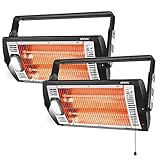
Overview:
The Shinic 2-Pack Electric Garage Heaters provide dual ceiling-mounted radiant heating solutions for larger spaces. Each unit delivers 1500W/750W via dual quartz tubes and includes integrated halogen work lights. The bundle features 90° rotation, five mode settings controlled by pull strings, and space-saving ceiling mounts designed for garages, shops, and patios.
What Makes It Stand Out:
The two-pack configuration offers immediate cost savings over individual purchases while providing zoned heating for larger garages. Each unit’s combination of radiant heat and work light maximizes functionality. The independent operation allows heating different work areas simultaneously.
Value for Money:
Excellent value for users needing multiple heating points. The bundle pricing typically offers 15-20% savings compared to buying two separate units. For two-car garages or workshops with distinct zones, this eliminates the cost of a single more powerful unit while providing targeted heating flexibility.
Strengths and Weaknesses:
Pros include cost-effective dual-unit package, space-saving design, integrated work lights, independent zone control, and 90° adjustability. Cons: Pull-string operation (no remote mentioned) may be less convenient than remote models; each unit requires separate installation; radiant heat limited to direct line-of-sight; two units may still be insufficient for very large spaces.
Bottom Line:
A smart choice for medium to large garages or multi-area workshops. The dual-unit bundle provides flexible, targeted heating with built-in lighting, making it more economical than separate purchases while delivering professional-grade performance.
Understanding Compact Garage Heaters
Why Size Matters in Garage Heating
Garage dimensions rarely accommodate bulky equipment, especially when you need room for vehicles, workbenches, and storage systems. Compact heaters address this challenge through innovative engineering that packs substantial heating power into surprisingly small packages. These units typically measure under 24 inches in any dimension, making them ideal for mounting in corners, on walls, or even suspended from ceilings where they won’t interfere with daily activities. The psychological benefit is equally important—when your heater doesn’t dominate the space, your garage feels larger and more functional.
Types of Compact Heating Solutions
Several heating technologies excel in small packages, each with distinct advantages. Infrared heaters use radiant heat to warm objects directly rather than heating the air, making them exceptionally efficient for spot heating in drafty garages. Convection heaters circulate air naturally or with small fans, providing gradual, even warmth throughout the space. Micathermic heaters combine convection and radiant heating in ultra-thin panels that mount flat against walls. Forced-air units, though slightly larger, can still qualify as compact when designed with vertical orientations that minimize floor space usage.
Key Features to Evaluate
Heating Capacity and BTU Ratings
Matching a heater’s output to your garage size prevents both underperformance and energy waste. British Thermal Units (BTUs) measure heating power, with compact units typically ranging from 5,000 to 30,000 BTUs. For tight spaces under 200 square feet, lower BTU ratings suffice, while larger two-car garages might require the higher end of this spectrum. Calculate your needs based on cubic footage and desired temperature rise, remembering that better insulation allows for smaller, more compact heater choices.
Physical Dimensions and Mounting Options
True compact heaters offer multiple installation configurations. Look for units under 15 inches deep that provide wall-mount brackets, ceiling suspension kits, or corner-mounting hardware. Some innovative designs function as both freestanding and wall-mounted, giving you flexibility to reposition as needed. Consider how the unit’s shape—vertical tower, horizontal panel, or cube—interacts with your garage’s specific layout challenges and traffic patterns.
Power Source Considerations
Compact heaters operate on either electricity or fuel, with each option presenting space-related trade-offs. Electric models eliminate ventilation concerns and install virtually anywhere with proper electrical service, though they require dedicated circuits. Fuel-powered units (natural gas, propane, or kerosene) deliver higher BTU output in smaller physical packages but need careful ventilation planning and fuel line routing. Your garage’s existing utilities often dictate the most practical choice for tight installations.
Thermostat and Temperature Control
Precision control prevents energy waste and maintains consistent comfort. Digital thermostats with remote sensors allow you to monitor temperature without accessing the heater directly—particularly valuable when mounted in hard-to-reach spots. Programmable timers let you pre-heat the garage before use, while built-in thermostats with wide temperature ranges accommodate both delicate projects and heavy-duty work. Look for units with adjustable heat settings that let you scale output based on current needs.
Safety Features That Matter
Compact heaters in confined spaces demand robust safety systems. Overheat protection automatically shuts down units when internal temperatures exceed safe limits. Tip-over switches are crucial for freestanding models, while cool-touch exteriors prevent burns in tight quarters where accidental contact is more likely. For fuel-burning heaters, oxygen depletion sensors are non-negotiable, and all units should carry certifications from recognized testing laboratories for garage-specific use.
Installation Strategies for Tight Spaces
Wall-Mounted vs Freestanding Units
Wall-mounted heaters free up zero floor space but require secure mounting to studs or masonry and proper clearances from combustibles. Freestanding units offer portability but consume valuable square footage. A hybrid approach works well for many garages—permanently mount a primary heater, then keep a small portable unit for spot heating specific work areas. Consider ceiling height when mounting; units placed too high lose efficiency, while those too low create obstruction hazards.
Electrical Requirements and Circuit Planning
Most powerful compact electric heaters require 240-volt circuits, which may necessitate electrical panel upgrades in older garages. Plan circuit placement to minimize cord length and avoid extension cords, which pose tripping hazards in tight spaces. Install outlets near intended mounting locations before heater arrival. For fuel units, factor in the space needed for fuel lines or propane tank storage, keeping tanks safely distant from ignition sources while maintaining accessibility for refilling.
Ventilation Needs for Fuel-Burning Heaters
Any combustion heater in a garage requires careful ventilation planning to prevent carbon monoxide buildup. Direct-vent models expel exhaust directly outside through a wall or ceiling penetration, making them safest for tight spaces. Even with proper venting, maintain some air exchange to replace oxygen and manage humidity. Never install unvented fuel heaters in enclosed garages, regardless of size claims—compact spaces allow toxic gases to accumulate dangerously fast.
Energy Efficiency and Operating Costs
Understanding Efficiency Ratings
Efficiency determines long-term operating costs, especially important when heating intermittently-used spaces. Electric heaters are 100% efficient at converting energy to heat, but electricity costs more per BTU than natural gas in most regions. Fuel heater efficiency varies widely; look for units with sealed combustion and high AFUE (Annual Fuel Utilization Efficiency) ratings above 80%. Infrared heaters offer “spot efficiency” by heating you directly rather than wasting energy on unused air space.
Calculating Your Heating Costs
Estimate operating costs by multiplying wattage or fuel consumption by your local utility rates and expected usage hours. A 5,000-watt electric heater running 4 hours daily costs approximately $0.60 per day at $0.12 per kWh. Propane heaters consume about 0.015 gallons per 1,000 BTUs per hour. For tight garages, factor in the cost of running the heater at full capacity initially to raise temperature, then maintaining warmth at lower settings—properly sized units cycle less frequently, saving money.
Smart Features That Save Money
Modern compact heaters increasingly include Wi-Fi connectivity and smart home integration, allowing remote control via smartphone apps. Geofencing features automatically adjust temperature when you leave or approach, while usage monitoring helps identify inefficiencies. Though these features add cost upfront, they prevent heating empty garages and provide precise control that reduces waste—particularly valuable in small spaces that heat quickly and can overshoot target temperatures.
Safety Protocols for Confined Areas
Clearance Requirements and Combustible Materials
Compact heaters demand strict adherence to clearance specifications, typically requiring 3 feet of space from combustible materials like wood, paper, and flammable liquids. In tight garages, this often means relocating storage or choosing heaters with reduced clearance certifications. Never mount heaters near shelving loaded with chemicals, paints, or gasoline containers. Maintain clear floor space beneath wall-mounted units to prevent debris accumulation that could ignite.
Carbon Monoxide Monitoring
Any fuel-burning heater installation in a tight garage must include a carbon monoxide detector placed at breathing height, not near the ceiling. Battery-powered units with digital displays provide peace of mind, while smart detectors send alerts to your phone. Test detectors monthly and replace them according to manufacturer schedules. Even with direct-vent heaters, CO detectors remain essential backup safety devices in confined spaces where air circulation is naturally limited.
Regular Maintenance Schedules
Compact heaters in dusty garage environments require more frequent maintenance than residential units. Clean or replace air filters monthly during heating season to maintain efficiency and prevent overheating. Inspect fuel lines and connections quarterly for leaks using soapy water solutions. Annual professional servicing for fuel heaters ensures safe combustion and proper venting function. Keep maintenance logs posted near the heater to track service dates and identify developing issues before they become hazardous.
Making Your Final Decision
Assessing Your Specific Space Constraints
Measure your garage’s cubic footage and identify potential mounting locations before shopping. Note ceiling heights, stud locations for mounting, and any obstacles like garage door tracks or storage loft supports. Photograph potential installation spots to reference when evaluating heater dimensions. Consider how your space usage might change seasonally—winter projects may require different heater placement than summer storage configurations. The tightest spaces benefit from heaters under 12 inches deep that tuck flush against walls.
Climate Considerations
Your local climate dramatically impacts heater selection. Cold northern regions demand higher BTU output even in small garages, while milder climates can use smaller units focused on comfort rather than survival heating. Consider humidity levels too; damp coastal garages need heaters that won’t rust quickly, while dry mountain air allows for simpler electric models. Wind exposure affects how quickly heat dissipates, so drafty garages benefit from radiant heaters that warm objects rather than air that escapes quickly.
Warranty and Support Factors
Compact heaters operating in harsh garage environments experience more stress than residential units, making warranty coverage crucial. Look for warranties extending at least 2 years for electrical components and 5 years for heat exchangers in fuel models. Check that manufacturers offer phone support for installation questions—particularly important when mounting in unconventional tight spaces. Extended warranties often pay for themselves in garage applications where dust, temperature swings, and occasional impacts shorten equipment lifespan.
Frequently Asked Questions
How do I calculate the right BTU rating for my compact garage?
Multiply your garage’s cubic footage (length × width × ceiling height) by the desired temperature rise, then divide by a standard factor of 1.6 for rough estimation. For example, a 20×12×8 foot garage (1,920 cubic feet) needing a 30°F rise requires approximately 36,000 BTUs. However, excellent insulation can reduce this requirement by 30%, while poor insulation may demand 50% more capacity.
Can I install a compact heater myself or do I need a professional?
Electric heaters with plug-in connections are DIY-friendly, though hardwired 240-volt units require licensed electricians for safety and code compliance. All fuel-burning heaters demand professional installation to ensure proper venting, gas line connections, and combustion safety. Even compact units involve complex codes around clearances and ventilation that DIY installation can void warranties or create hazards.
What’s the safest heater type for a garage filled with flammable materials?
Electric heaters with enclosed heating elements and no exposed flames offer the safest option for garages storing paints, solvents, or gasoline. Look for units certified for garage use with tip-over protection and overheat shutoff. Mount them high on walls away from storage areas, and never place flammable materials within the manufacturer’s specified clearance zone, typically 3 feet in all directions.
How much clearance does a compact garage heater really need?
Most compact heaters require 3 feet of clearance from combustible materials, though some certified low-clearance models need only 6-12 inches. Always check the specific manual—never assume smaller size means smaller clearances. Fuel heaters generally need more space than electric models, and all units require adequate air intake space for proper combustion or cooling.
Will a compact heater raise my electricity bill significantly?
Operating costs depend on wattage, local rates, and usage patterns. A typical 5,000-watt heater costs $0.50-$0.75 per hour at average US electricity rates. Using a programmable thermostat to heat only when needed, and maintaining temperature rather than reheating from cold, keeps costs manageable. Insulating your garage properly can cut heating costs by 50% or more.
Can I use an extension cord with a compact electric heater?
Never use extension cords with heaters drawing more than 1,500 watts—they create fire hazards from voltage drop and overheating. Compact high-output heaters require direct connection to properly rated outlets or hardwiring. If your ideal location lacks an outlet, hire an electrician to install one nearby. The cord length on most quality heaters is intentionally short to discourage dangerous extension cord use.
How long do compact garage heaters typically last?
With proper maintenance, quality compact heaters last 8-12 years in garage environments. Electric models often outlive fuel heaters since they have fewer moving parts and no combustion components. Regular filter cleaning, annual inspections, and protection from impacts significantly extend lifespan. Harsh conditions—dust, moisture, temperature extremes—shorten life expectancy compared to indoor use.
What’s the difference between garage-rated and indoor heaters?
Garage-rated heaters feature more robust construction, better moisture resistance, and enhanced safety features for dusty environments. They undergo additional testing for ignition protection around flammable vapors. Indoor heaters often lack the necessary safety certifications for garage use and may pose fire hazards. Always verify that any heater you consider specifically lists “garage” or “utility space” in its approved applications.
Can I mount a compact heater on the ceiling to save space?
Many compact models offer ceiling-mount kits, which work well for forced-air units that direct heat downward. Infrared heaters are less effective when ceiling-mounted since they heat objects in their line of sight. Ensure ceiling mounting maintains required clearances from garage doors, storage, and light fixtures. Consider maintenance access—mounting too high makes filter changes and servicing difficult.
How noisy are compact garage heaters during operation?
Electric heaters with fans typically produce 45-60 decibels—comparable to normal conversation. Fanless models like infrared or natural convection heaters operate silently. Fuel heaters may produce some combustion noise, usually under 50 decibels. For tight spaces where you’re working close to the unit, prioritize models advertising “quiet operation” or variable-speed fans that reduce noise at lower settings.
See Also
- 10 Expert-Recommended Compact Garage Heaters for Tight Spaces in 2026
- 10 Best Value Compact Space Heaters for Tight Spaces in 2026
- The 10 Ultimate Best Compact Baseboard Heaters for Tight Spaces in 2026
- 10 Best Low Profile Garage Heaters for Tight Ceiling Spaces in 2026
- 10 Best Compact Baseboard Heaters for Tight Spaces in 2026