Table of Contents
Transforming your garage from a frigid workspace into a comfortable year-round haven doesn’t require draining your savings account. Whether you’re a weekend warrior tackling DIY projects, a car enthusiast who refuses to let winter stop the restoration, or simply someone who wants to protect tools and vehicles from extreme temperatures, finding an effective heating solution under $200 is absolutely achievable. The key is understanding which features matter most for your specific space and how to prioritize performance over unnecessary bells and whistles.
This comprehensive guide cuts through the marketing noise to help you make an informed decision about budget garage heaters. We’ll explore the various types of heating technologies available in the sub-$200 price range, break down the essential specifications that impact real-world performance, and walk through critical safety and installation considerations. By focusing on what truly matters—heating capacity, efficiency, durability, and safety—you’ll be equipped to identify the perfect unit for your garage without falling for features that sound impressive but deliver little practical value.
Top 10 Garage Heaters
Detailed Product Reviews
1. Shinic 2 Packs Electric Garage Heaters, 1500W/750W Ceiling Mounted Heater Radiant Heaters with Halogen Light, 90 Degree Rotation, 5 Mode Settings, Space Heater for Garage, Shop, Large Room and Patio
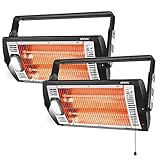
Overview: The Shinic 2-pack offers a practical approach to targeted garage heating with its ceiling-mounted radiant quartz design. Each unit delivers 750W or 1500W of instant warmth directly to people and objects below, making it ideal for workstations or specific areas rather than whole-room heating. The integrated halogen work light is a thoughtful addition for dimly lit garages, while the 90-degree rotation allows precise heat direction without wasting energy on empty spaces.
What Makes It Stand Out: The dual-unit packaging provides two heaters for the price of one competitor’s single unit—a compelling value proposition. The pull-string five-mode operation is refreshingly simple, eliminating complicated remotes or wiring. The radiant technology heats instantly without noisy fans, perfect for quiet workshop environments where concentration matters. The integrated work light solves two problems with one installation, saving ceiling space and electrical connections.
Value for Money: Exceptional considering you receive two complete ceiling-mount heaters. While each unit’s 1500W output won’t heat a massive garage alone, the ability to position them at different workstations delivers flexibility that a single 5000W+ unit can’t match. Installation is straightforward with standard 120V outlets, avoiding costly electrical upgrades. For spot heating multiple areas, this two-pack outperforms single units costing twice as much.
Strengths and Weaknesses: Strengths include the two-for-one value, instant radiant heat, integrated lighting, space-saving design, and simple operation. Weaknesses are the limited whole-room heating capability, manual pull-string controls that may be hard to reach when ceiling-mounted, and lack of thermostat precision for maintaining consistent temperatures.
Bottom Line: Perfect for DIYers and hobbyists needing targeted heat at multiple garage workstations. The two-pack value is unbeatable for spot heating applications where flexibility matters more than total coverage.
2. Comfort Zone Hard-Wired Ceiling Mount Garage Electric Space Heater, Fan-Forced, 5,000 watt, 240 volt, Overheat Protection, Thermal Cut-Out Switch, Ideal for Workshop & Garage, ETL Compliant, CZ220

Overview: The Comfort Zone CZ220 is a robust 5000W fan-forced heater designed for hard-wired, ceiling-mount installation in demanding environments. Built from heavy-gauge steel, it withstands temperature fluctuations and rough conditions typical of poorly insulated garages and warehouses. The fan-forced design ensures active heat distribution rather than passive radiation, warming entire spaces efficiently and consistently.
What Makes It Stand Out: The industrial-grade construction combined with user-friendly dual-knob thermostat controls creates a professional-grade solution. The adjustable louvers and mounting angle allow precise airflow direction, solving the common problem of wasted heat in cavernous spaces. ETL compliance and intelligent safety features including overheat auto-shutoff provide peace of mind during extended operation, making it suitable for commercial settings where safety regulations matter.
Value for Money: Solid for a hard-wired industrial unit. While installation requires a 240V circuit and professional electrician, the durable steel body and reliable performance justify the upfront investment compared to cheaper portable units that lack longevity. It’s a “buy once” solution for serious workshops, with robust construction that outlasts consumer-grade alternatives and eliminates replacement costs.
Strengths and Weaknesses: Strengths include rugged steel construction, excellent heat distribution via louvers, precise manual thermostat control, comprehensive safety features, and space-saving ceiling design. Weaknesses are the lack of remote control or digital features, necessity of professional installation, and absence of a timer function for automated scheduling.
Bottom Line: An excellent mid-power choice for medium-sized garages and workshops where durability and safety trump high-tech features. Worth the installation cost for permanent heating solutions in demanding environments.
3. Comfort Zone 7500W Hard-Wired Garage Heater – Industrial & Commercial Ceiling Mount, 240V Fan-Forced with Remote, Digital Thermostat, Timer, 2 Heat Settings, Overheat Protection, Grey

Overview: Comfort Zone’s 7500W industrial heater represents a significant step up in both power and sophistication for serious garage heating. This fan-forced unit combines robust construction with modern digital conveniences including remote control operation, a digital thermostat, and a 12-hour programmable timer—features rarely seen in this power class. It’s engineered for large residential garages and light commercial applications.
What Makes It Stand Out: The fully enclosed motor designed specifically for dusty workshop environments extends lifespan where standard motors would fail. The heavy-gauge steel body protects internal components, while the digital controls offer precision temperature management impossible with manual knobs. Variable louvers and mounting angles direct heat exactly where needed most, maximizing efficiency in irregularly shaped spaces.
Value for Money: Strong despite the premium price tag. The 7500W output handles large two-car garages with ease, while remote operation means no climbing ladders to adjust settings. Compared to the 5000W CZ220, the additional wattage and smart features justify the cost for those wanting convenience and power. The enclosed motor adds long-term value by reducing maintenance and replacement needs.
Strengths and Weaknesses: Strengths include high wattage for large spaces, remote/digital convenience, timer functionality, enclosed motor durability, and easy-clean removable grill. Weaknesses are the 240V hard-wire requirement mandating professional installation and higher energy consumption costs that impact utility bills.
Bottom Line: Ideal for large residential garages or light commercial use where convenience and power are equally important. The digital features make daily operation effortless and safe.
4. Comfort Zone 10,000W Hard-Wired Garage Heater – Industrial & Commercial Ceiling Mount, 240V Fan-Forced Heater with Remote, Digital Thermostat, Timer, 2 Heat Settings, Overheat Protection, Grey

Overview: The Comfort Zone 10,000W heater is the powerhouse of the lineup, delivering serious heating capability for expansive commercial and industrial spaces. This ceiling-mount unit employs powerful fan-forced technology to disperse heat across wide areas that lesser heaters simply cannot adequately warm. The heavy-gauge steel construction ensures exceptional durability in harsh environments and temperature extremes.
What Makes It Stand Out: The sheer heating power—capable of warming three-car garages, warehouses, and large workshops effortlessly. Despite the industrial output, it retains user-friendly features like remote control, digital thermostat, and timer functionality. The adjustable mounting bracket and louvers provide targeted heat distribution even across vast spaces, ensuring no corner stays cold.
Value for Money: Justified for those needing maximum coverage. While the highest-priced unit reviewed, the 10,000W output is double many competitors, potentially replacing two smaller heaters. For commercial applications, the productivity gains from a comfortable workspace offset the premium cost and energy consumption. It’s an investment in operational efficiency.
Strengths and Weaknesses: Strengths include unmatched heating power, wide dispersion, durable construction, premium digital features, and comprehensive safety systems. Weaknesses are the highest cost, significant 240V installation requirements, substantial energy usage, and potential overkill for standard residential garages where such power is unnecessary.
Bottom Line: The ultimate solution for large commercial workshops and industrial spaces. Unmatched power and features make it worth every penny for professional environments requiring serious heating capacity.
5. DR. INFRARED HEATER Portable Infrared Indoor and Outdoor Space Heater for Patio, Garage, Commercial & Residential With Remote Control, Without Thermostat, Black

Overview: Dr. Infrared’s portable heater breaks the mold of fixed garage heaters by offering true versatility for both indoor and outdoor applications. With IP55 weatherproof certification, this 1500W unit handles patio duty and garage heating equally well. The plug-and-go 120V design eliminates costly electrical work, while included mounting brackets offer optional fixed installation when desired.
What Makes It Stand Out: Genuine portability combined with outdoor readiness—something no other reviewed unit offers. The high-level mirror aluminum reflector achieves 90% reflectivity, maximizing efficiency of the carbon lamp infrared heat. Three power settings (900W/1200W/1500W) provide flexibility for different conditions and seasons throughout the year, adapting to changing needs.
Value for Money: Excellent for those seeking flexibility over raw power. Avoiding electrician fees saves hundreds, while the ability to use it patio-side in summer and garage-side in winter doubles its utility. Compared to hard-wired units, it’s a fraction of the total installed cost and can be deployed immediately without waiting for professional installation.
Strengths and Weaknesses: Strengths include indoor/outdoor versatility, easy plug-in installation, portability, efficient infrared technology, remote control, and included mounting hardware. Weaknesses are limited total output unsuitable for large garages, lack of thermostat for automatic temperature maintenance, and less powerful heating than industrial units.
Bottom Line: Best choice for homeowners wanting flexible, occasional-use heating without installation hassles. Perfect for patios, small garages, and multi-purpose spaces where portability is paramount.
6. CTSC 8500W Garage Heater Electric, 240v Hardwired Fan-Forced Electric Garage Heater with Digital Thermostat, Remote Control and Timer, ECO Function, Ideal for Workshop, ETL Listed Garage Heater

Overview: The CTSC 8500W is a heavy-duty, fan-forced electric garage heater designed for serious climate control in large spaces. Delivering 29,010 BTUs of heating power through a 240V hardwired connection, this unit can warm areas up to 850 square feet. Constructed from durable SPCC cold-rolled steel and ETL certified, it’s built for commercial-grade performance in workshops, garages, and industrial spaces.
What Makes It Stand Out: The innovative voltage display screen sets this heater apart, diagnosing installation issues by showing real-time voltage—addressing the most common failure point for commercial heaters. The combination of remote control and LED touch panel offers convenience, while the ECO function intelligently maintains temperature to reduce energy consumption. Wall-mounted and hanging options maximize floor space, and the three heat settings (8500W high, 5600W low, fan-only) provide versatile operation.
Value for Money: Priced competitively for its class, this heater justifies its cost through commercial-grade construction, unique troubleshooting features, and comprehensive safety systems. Compared to similar 8500W units lacking diagnostic displays or dual controls, it offers superior value. The ECO mode and timer (1-10 hours) deliver long-term energy savings that offset the initial investment.
Strengths and Weaknesses: Strengths include exceptional heating capacity, innovative voltage troubleshooting display, robust safety protections, flexible mounting options, and dual control methods. Weaknesses: mandatory professional hardwired installation adds cost, the 1-10 hour timer may be limiting for some users, and its power may be excessive for smaller garages.
Bottom Line: For large workshops and garages requiring reliable, powerful heating, the CTSC 8500W is an excellent investment. Its diagnostic features and robust build quality make it a standout choice for demanding environments.
7. Dura Heat EUH1465 Electric Forced Air Heater with Pivoting Base 5,120 BTU, Yellow

Overview: The Dura Heat EUH1465 is a compact, portable forced-air heater delivering 1,500W of PTC ceramic heating power. With 5,120 BTU output, it’s designed for spot heating in small garages, workshops, and commercial spaces. The rugged steel construction and bright yellow finish provide durability and high visibility, while the pivoting base allows directional heat control exactly where you need it.
What Makes It Stand Out: The pivoting base offers uncommon flexibility in this price range, allowing users to direct warmth precisely where needed. Its simple, no-frills design focuses on core functionality—reliable heat with minimal complexity. The PTC ceramic element provides self-regulating heat that won’t overheat, while the built-in thermostat maintains comfortable temperatures without fuss or constant adjustment.
Value for Money: This is a budget-friendly option that delivers essential heating without premium features. Its affordability makes it accessible for casual users, while durable construction ensures longevity. Compared to similarly priced heaters, the pivoting base adds functional value that competitors often lack, making it a smart choice for targeted heating needs in tight spaces.
Strengths and Weaknesses: Strengths include portability, rugged steel build, pivoting base for directional heating, overheat protection, and straightforward operation. Weaknesses: limited 5,120 BTU output only suits small spaces, lacks remote control or advanced programming, basic thermostat precision, and no mounting options beyond floor placement.
Bottom Line: The Dura Heat EUH1465 excels as an affordable, portable spot heater for small work areas. While underpowered for large garages, its durability and directional control make it ideal for targeted heating tasks.
8. Shinic Electric Garage Heaters with Remote Control, 1500W/750W Ceiling Mounted Radiant Quartz Heater with Work Light, 90° Rotation, 5 Mode Settings, Electric Heater for Garage, Shop, Patio Large Room

Overview: The Shinic ceiling-mounted heater combines radiant quartz heating with integrated task lighting in a space-saving design. Delivering 1,500W (or 750W on low) through dual quartz tubes, this unit warms people and objects directly rather than heating air. The included halogen work light illuminates workbenches, making it a dual-function solution for garages and workshops.
What Makes It Stand Out: The integration of a halogen work light with radiant heating is a unique value proposition, eliminating the need for separate fixtures. Ceiling mounting preserves valuable floor space, while 90° rotation directs both heat and light precisely where needed. Radiant technology provides instant warmth without preheating, ideal for intermittently used spaces.
Value for Money: Mid-priced for a specialty heater, it offers dual functionality that would otherwise require separate purchases. The ceiling mount design saves space in crowded workshops, while five mode settings provide flexibility. Compared to standalone heaters and work lights, the combined value is compelling for workshop environments where both are needed daily.
Strengths and Weaknesses: Strengths include instant radiant heating, integrated work light, space-saving ceiling mount, 90° adjustability, overheat protection, and ETL certification. Weaknesses: 1,500W output limits coverage to small-medium areas, radiant heat only warms line-of-sight objects, lacks precise thermostat control, and mounting requires secure overhead structure.
Bottom Line: Perfect for workshops needing both heat and lighting, the Shinic delivers targeted warmth where you work. Best for smaller garages or as a supplementary heat source in specific work zones.
9. InoKraft 7,500W Electric Garage Heater, Wire: 8 AWG, Plug: NEMA 14-50P, Remote, Ceiling Mount, Digital Thermostat, 240 Volt, 24-Hour Timer, Overheat Protection, ECO Mode, Ideal for Garage

Overview: The InoKraft 7,500W electric garage heater delivers robust fan-forced heating for spaces up to 750 square feet. Operating on 240V with a NEMA 14-50P plug, this unit combines power with precision through its digital thermostat (40°F-99°F) and 24-hour timer. Designed for wall or ceiling mounting, it includes a professional-grade 8 AWG power cord and operates at a moderate 65 dB.
What Makes It Stand Out: The 24-hour timer offers superior scheduling flexibility compared to typical 1-10 hour timers, enabling all-day programming. Five-angle installation adjustments ensure optimal heat distribution, while the intelligent ECO mode automatically modulates output based on ambient temperature. The included plug simplifies installation compared to hardwired alternatives, though professional installation remains recommended for safety.
Value for Money: Positioned between portable and premium commercial units, it offers professional features at a mid-range price. The precise digital thermostat and extended timer provide energy savings that justify the cost over basic models. Compared to 8,500W units, it sacrifices minimal power while gaining installation flexibility and smarter controls for better efficiency.
Strengths and Weaknesses: Strengths include powerful 7,500W output, precise temperature control, 24-hour timer, adjustable mounting angles, relatively quiet operation, and ECO energy savings. Weaknesses: still requires 240V outlet and professional installation, slightly less coverage than 8,500W competitors, and the plug requirement may necessitate electrical upgrades in some garages.
Bottom Line: An excellent balance of power, precision, and practicality for serious DIYers and professionals. The InoKraft 7,500W is ideal for those wanting advanced control without full commercial hardwiring, delivering reliable performance with intelligent energy management.
10. 8KW 110V/12V/24V Diesel Air Heater, All-in-One 5L Auto Thermostat Portable Car Diesel Heater with APP Control, 5500m Adaptive Altitude and No Tick for RV Camper vehicle Garage

Overview: This 8KW diesel air heater breaks from electric models with its all-in-one portable design featuring a built-in 5L fuel tank. Capable of operating on 12V, 24V, or 110V for the controller, it delivers powerful heating independent of grid electricity. The compact toolbox design with integrated handle makes it ideal for RVs, trucks, garages, and off-grid applications where electricity is limited.
What Makes It Stand Out: Bluetooth app control (“sunster”) provides unprecedented convenience, allowing temperature adjustment, timer settings, and altitude mode configuration from your smartphone. The altitude adaptation system automatically adjusts combustion up to 5,500 meters, maintaining efficiency in mountainous terrain. An upgraded silent fuel pump eliminates the annoying tick common to diesel heaters, while reinforced aluminum heat exchangers boost efficiency by 38%.
Value for Money: While commanding a premium price over electric heaters, it eliminates electricity costs and provides true off-grid capability. Fuel consumption of just 0.16-0.45L/hour delivers up to 20 hours of runtime per tank, offering exceptional economy. For mobile users and high-altitude workers, its specialized features justify the investment over conventional options.
Strengths and Weaknesses: Strengths include complete portability, app control, altitude adaptation, quiet operation, rapid heating (3-5 minutes), fuel efficiency, and multi-voltage compatibility. Weaknesses: diesel fumes require proper ventilation, fuel storage and refueling logistics, more maintenance than electric heaters, higher initial cost, and not suitable for enclosed living spaces without exhaust venting.
Bottom Line: A game-changer for off-grid heating needs. Perfect for RVers, truckers, and remote workers who need reliable heat anywhere. The smart features and altitude performance make it worth the premium for mobile applications where electricity is unavailable or impractical.
Understanding Your Garage Heating Needs
Before diving into specific heater categories, it’s crucial to assess your unique situation. A heater that works perfectly for a small, attached garage in Tennessee will likely disappoint in a drafty, detached three-car garage in Minnesota. Taking time to evaluate these foundational factors prevents costly mistakes and ensures you get maximum warmth for your money.
Calculating Square Footage Requirements
Start by measuring your garage’s length and width to determine total square footage. Most budget heaters list coverage areas in their specifications, but these numbers often assume ideal conditions. As a general rule, you’ll need approximately 10 watts of heating power per square foot for a moderately insulated space. For a 400-square-foot garage, that translates to a 4,000-watt heater. However, this calculation shifts dramatically based on ceiling height, insulation quality, and your local climate. Always size up slightly rather than down—an underpowered heater running constantly wastes more energy than a properly sized unit cycling on and off.
Insulation Assessment
Your garage’s insulation level directly impacts heater effectiveness and operating costs. Check walls, ceilings, and garage doors for proper insulation. An uninsulated garage can lose up to 70% of its heat through the roof alone. If adding insulation isn’t in the budget, you’ll need a more powerful heater or must accept that maintaining high temperatures will be expensive. Even basic weatherstripping around doors and windows can dramatically improve heat retention, making your budget heater perform like a more expensive model.
Climate Zone Considerations
Your geographic location determines how hard your heater must work. In mild climates where temperatures rarely dip below freezing, a smaller infrared or ceramic heater might suffice. Cold climate zones require units with higher BTU outputs and fan-forced circulation to combat extreme temperature differentials. Consider your lowest typical winter temperature and how warm you need the space to be. A 30-degree temperature rise requires significantly more power than a 15-degree increase.
Types of Budget-Friendly Garage Heaters
The sub-$200 market offers several distinct heating technologies, each with unique advantages and limitations. Understanding these differences helps you match the heater type to your specific needs rather than chasing the lowest price tag.
Electric Fan-Forced Heaters
These workhorse units use a heating element and powerful fan to distribute warm air throughout your space. They excel at raising ambient air temperature quickly and maintaining consistent warmth. Most models in this price range offer adjustable thermostats and multiple heat settings. The fan mechanism ensures even heat distribution, preventing cold spots in larger garages. However, they can be noisy and may stir up dust, which matters if you’re working on finishing projects or have respiratory sensitivities.
Infrared Radiant Heaters
Infrared technology heats objects and people directly rather than warming the air. This makes them incredibly efficient for spot heating or use in poorly insulated spaces where warming the entire volume of air would be futile. You’ll feel warmth almost instantly when standing in the heater’s path. They’re silent, making them ideal for workshops where noise is a concern. The trade-off is that they don’t raise overall room temperature significantly, so if you move out of the direct line, you’ll feel cold again.
Ceramic Space Heaters
Ceramic heaters use electricity to warm a ceramic plate, which then radiates heat into the room. Many combine radiant heat with a small fan for distribution. They’re compact, lightweight, and often include oscillation features for broader coverage. Modern ceramic heaters include excellent safety features like tip-over switches and cool-touch exteriors. While perfect for small to medium garages, they may struggle in very large or drafty spaces due to their moderate output.
Micathermic Panel Heaters
These sleek, flat-panel units combine convection and radiant heating principles. They heat up quickly, operate silently, and can be wall-mounted to save floor space. Their thin profile makes them unobtrusive, and many homeowners appreciate their modern aesthetic. Micathermic heaters distribute heat more evenly than pure radiant models but don’t match the raw power of fan-forced units. They’re excellent choices for insulated garages where consistent, gentle heating is preferred over rapid temperature spikes.
Propane and Natural Gas Options
While most sub-$200 heaters are electric, some ventless propane models fall into this price range. These offer tremendous heating power and don’t rely on your home’s electrical system. They’re particularly valuable during power outages. However, they require strict ventilation protocols and produce moisture as a byproduct, which can lead to condensation issues. Never use these in tightly sealed garages without proper air exchange, and always install a carbon monoxide detector.
Key Features to Evaluate
Beyond heating technology, several specifications separate reliable budget heaters from disappointing ones. Knowing which features offer genuine value helps you make a smart investment.
Heating Capacity and BTU Ratings
BTU (British Thermal Unit) ratings indicate heating power. For electric heaters, you can calculate BTUs by multiplying watts by 3.41. A 5,000-watt heater produces approximately 17,050 BTUs. In the under-$200 category, you’ll typically find units ranging from 5,000 to 25,000 BTUs. Match this rating to your space and insulation level. Remember that higher BTU ratings mean faster heating but also higher energy consumption. Look for units with adjustable output settings so you can scale power to current needs.
Safety Certifications and Features
Never compromise on safety to save a few dollars. Quality budget heaters carry certifications from organizations like UL (Underwriters Laboratories), ETL (Intertek), or CSA (Canadian Standards Association). These verify the unit has passed rigorous safety testing. Essential safety features include tip-over protection, overheat shutoff, and cool-touch exteriors. For gas heaters, oxygen depletion sensors are non-negotiable. Check that heating elements are properly guarded, especially if you have children or pets accessing the garage.
Thermostat and Temperature Control
Basic thermostats maintain temperature within a range, while digital thermostats offer precise degree-by-degree control. Programmable timers let you pre-heat the garage before use, saving energy and money. Some units include remote controls for convenient adjustments. Avoid heaters with only high/low settings unless you plan to pair them with a separate line-voltage thermostat. Consistent temperature control prevents energy waste and maintains comfortable working conditions.
Portability and Mounting Options
Consider how you’ll use the heater. Portable units with sturdy handles and wheels offer flexibility—heat the workbench area today, the car bay tomorrow. Wall-mounted or ceiling-mounted options free up valuable floor space and stay out of harm’s way. Many models offer both options, including mounting hardware. If portability matters, check the unit’s weight and cord length. Heaters under 20 pounds are easy to move, while heavier units may require permanent installation.
Energy Efficiency Metrics
While budget heaters rarely include premium efficiency features, some offer eco-modes that cycle between high and low settings to maintain temperature. Look for units with good insulation around heating elements and well-designed housings that direct heat where it’s needed. Consider the heater’s duty cycle—how often it must run to maintain temperature. A slightly more expensive but efficient model often costs less over a season than the cheapest option that runs constantly.
Installation and Setup Considerations
Proper installation dramatically impacts safety, performance, and longevity. Even the best budget heater underperforms if installed incorrectly.
Electrical Requirements
Most powerful electric heaters require 240-volt circuits rather than standard 120-volt outlets. A 5,000-watt heater draws approximately 21 amps, necessitating a dedicated 30-amp circuit. Before purchasing, verify your garage’s electrical capacity. Running a high-draw heater on an undersized circuit trips breakers and creates fire hazards. If you lack the proper outlet, factor electrician costs into your budget. Some smaller units operate on 120 volts, offering easier installation but reduced heating power.
Ventilation Needs
Electric heaters require minimal ventilation—just ensure air can circulate around the unit. Gas heaters demand serious attention to ventilation. Ventless propane heaters require at least one square inch of fresh air per 1,000 BTUs. A 25,000 BTU heater needs 25 square inches of permanent ventilation (like a partially open window or dedicated vent). Poor ventilation leads to oxygen depletion, carbon monoxide buildup, and excessive humidity. Never operate gas heaters in completely sealed garages.
Mounting vs. Freestanding Decisions
Wall mounting saves space and positions heat at a useful level, but requires sturdy brackets and proper hardware for your wall type (stud finders are essential). Ceiling mounting works well for infrared heaters aiming downward. Freestanding units need stable, level surfaces away from foot traffic and combustible materials. Maintain at least three feet of clearance around all heater types. Consider vibration—fan-forced units can rattle on metal shelves, transferring noise throughout the structure.
Operating Costs and Efficiency
The purchase price tells only part of the story. Understanding ongoing operating costs prevents budget heaters from becoming expensive mistakes.
Understanding Energy Consumption
Calculate hourly operating costs by multiplying the heater’s wattage by your electricity rate. A 5,000-watt (5 kW) heater running at $0.12 per kWh costs $0.60 per hour. If it runs 50% of the time during winter months, that’s $216 monthly. Propane heaters consume fuel at varying rates—check the BTU rating against propane’s 91,500 BTUs per gallon. A 25,000 BTU heater running continuously uses about 0.27 gallons per hour. At $3 per gallon, that’s $0.81 hourly.
Cost-Per-Hour Calculations
Factor in your actual usage patterns. You might run the heater two hours daily, five days a week. That 5,000-watt electric heater costs about $24 monthly in this scenario—quite reasonable. Programmable thermostats that warm the garage only when needed slash costs dramatically. Insulation improvements often pay for themselves within one heating season through reduced runtime. Track your actual usage the first month and adjust settings to balance comfort and economy.
Maintenance Requirements
Budget heaters need regular maintenance to operate safely and efficiently. Clean dust from intake grilles monthly using a vacuum or compressed air. Check power cords for damage, especially if you move the unit frequently. For fan-forced models, lubricate the motor if the manual specifies. Propane heaters require annual inspection of burners, pilot lights, and ventilation systems. Set aside $10-20 annually for replacement filters or basic parts. Proper maintenance extends lifespan from a few seasons to many years.
Safety Best Practices
Garage environments present unique hazards that demand extra caution. Vehicles, flammable liquids, and power tools create risks that bedroom or living room heaters never face.
Clearance Requirements
Maintain at least three feet of clearance in all directions from the heater. This includes vehicles, workbenches, storage shelves, and especially any containers of gasoline, paint thinners, or other flammable liquids. Never hang items above or around the heater. In tight garages, measure carefully before installation—what seems like adequate space can shrink when a vehicle is parked inside. Create a marked “no-storage zone” on the floor around the unit as a visual reminder.
Carbon Monoxide Awareness
Electric heaters produce no carbon monoxide, making them inherently safer. Any combustion-based heater (propane, natural gas, kerosene) produces CO as a byproduct. Install a battery-powered CO detector in your garage, positioned at breathing height. Test it monthly and replace batteries seasonally. Recognize CO poisoning symptoms: headache, dizziness, nausea, and confusion. If you experience these, leave immediately and seek fresh air. Never use outdoor-only heaters indoors, regardless of ventilation claims.
Proper Usage Guidelines
Never leave heaters running unattended overnight or when you’re away from home. Unplug electric heaters when not in use for extended periods. Don’t use extension cords unless absolutely necessary—if you must, use a heavy-gauge cord rated for the heater’s amperage. Keep a fire extinguisher rated for electrical and chemical fires easily accessible. Teach family members about heater safety, especially children who might view the garage as play space. Create a pre-use checklist: clear area, check cords, test safety shutoffs, verify ventilation.
Frequently Asked Questions
1. Can a $200 heater really warm a two-car garage effectively?
Yes, absolutely. A properly sized heater in the $150-200 range can effectively warm a standard two-car garage (400-500 square feet) if the space is moderately insulated. Look for units delivering 15,000-20,000 BTUs with fan-forced circulation. The key is matching the heater’s capacity to your specific conditions rather than expecting a small space heater to perform miracles in a drafty, uninsulated space.
2. How much will it cost to run a budget garage heater monthly?
Operating costs typically range from $30-150 monthly depending on heater size, local energy rates, insulation quality, and usage patterns. A 5,000-watt electric heater running three hours daily at average electricity rates costs roughly $35-45 monthly. Poorly insulated garages can double or triple this expense. Propane heaters cost slightly more per hour but often heat faster, reducing overall runtime.
3. Is it safe to leave a garage heater running overnight?
Electric heaters with tip-over protection and overheat shutoff are generally safe for extended operation, but it’s not recommended. The safest practice is to use a programmable timer to warm the garage before you need it, then turn it off when finished. Never leave propane heaters running unattended. For overnight freeze protection, consider a dedicated low-temperature thermostat set to 40-45°F rather than room temperature.
4. Do I need a 240-volt outlet for an effective budget heater?
Not necessarily, but 240-volt heaters offer significantly more heating power for the money. In the sub-$200 category, you’ll find some 120-volt models producing up to 5,000 BTUs, suitable for small garages or mild climates. However, stepping up to a 240-volt, 7,500-10,000 watt unit dramatically improves performance in larger spaces. If you lack a 240-volt outlet, factor $200-300 for electrician installation into your total budget.
5. What’s the difference between convection and radiant heating for garages?
Convection heaters warm the air, which then circulates to heat the entire space. This works well in insulated garages where you want consistent ambient temperature. Radiant heaters warm objects and people directly through infrared waves, making them ideal for spot heating or poorly insulated spaces. You feel warmth immediately but only within the heater’s line of sight. Many modern budget units combine both technologies for balanced performance.
6. How important is garage door insulation when using a budget heater?
Critically important. An uninsulated metal garage door acts like a giant radiator, sucking heat out of your space. Even a $50 insulation kit for your garage door can reduce heating costs by 30-50% and make a budget heater perform like a premium model. If door insulation isn’t possible, consider a radiant heater that warms you directly rather than trying to heat the entire space.
7. Can I use a household space heater in my garage?
Standard household space heaters lack the power and durability for garage environments. They’re not designed to handle dust, temperature extremes, or the larger volumes of garage spaces. More importantly, they often lack the safety certifications and rugged construction needed for workshop conditions. Invest in a heater specifically rated for garage or industrial use, even in the budget category.
8. What safety certifications should I look for in a budget garage heater?
Prioritize heaters with UL (Underwriters Laboratories), ETL (Intertek), or CSA (Canadian Standards Association) certification. These marks indicate the unit has passed independent safety testing for fire hazards, electrical safety, and operational reliability. Avoid heaters without these certifications, regardless of price. For gas heaters, also look for ANSI (American National Standards Institute) certification.
9. How long do budget garage heaters typically last?
With proper maintenance, a quality budget heater should last 5-10 years. Electric models generally outlast gas heaters due to fewer moving parts and no combustion-related wear. Fan motors are typically the first component to fail. Units with brushless motors and permanently lubricated bearings last longer. Clean dust regularly, avoid physical damage, and store properly during off-seasons to maximize lifespan.
10. Are propane heaters cheaper to operate than electric in the $200 price range?
Operating cost comparisons depend on local fuel and electricity prices. Currently, propane averages $2.50-3.50 per gallon, while electricity runs $0.10-0.15 per kWh in most areas. For equivalent BTU output, propane often costs slightly less per hour. However, propane heaters require ventilation, produce moisture, and need tank refills. Electric heaters offer convenience and precision control. Calculate both options using your local rates before deciding.
See Also
- 10 Best Budget Garage Heaters Under $150 for Homeowners in 2026
- 10 Best Budget Natural Gas Garage Heaters Under $200 for Homeowners
- Stop Drafts in Workshops with the 10 Best Garage and Workshop Ceramic Heaters This Year
- Stop Freezing in Your Garage with the 10 Best Portable Garage Heaters This Year
- 10 Best Ceiling Mounted Garage Heaters for Tall Ceilings This Year