Table of Contents
Choosing the right ceiling fan doesn’t have to drain your wallet, especially when you’re stepping into homeownership or tackling your first major upgrade. That $100 price point is a sweet spot where smart design meets essential functionality, proving you absolutely can find reliable airflow without resorting to noisy, wobbly compromises. For first-time buyers navigating a sea of options, the real victory lies in understanding what truly matters within this budget – it’s less about flashy extras and more about core performance that keeps your space comfortable day after day. Forget feeling overwhelmed; this guide cuts through the noise to focus solely on the features that deliver real value when every dollar counts.
The anxiety of making a “forever home” decision on something as visible as a ceiling fan is real, particularly when you’re just starting out. You want something that looks decent, won’t rattle the walls, and actually cools (or circulates warm air in winter!), but you’re rightly hesitant to splurge on untested features. The good news? The budget fan market has evolved dramatically. Manufacturers now prioritize efficiency and durability even in entry-level models, meaning you can secure a solid performer that handles daily use without constant adjustment or repair. This isn’t about settling for less; it’s about being a savvy shopper who knows exactly where to focus your limited budget for maximum comfort impact. Let’s demystify what makes a budget fan truly worth your money in 2026.
Top 10 Budget Ceiling Fans Under $100
Detailed Product Reviews
1. Depuley Modern Ceiling Fan with Light: 42-Inch Black Small Fans for Bedroom Indoor Outdoor - Dimmable Low Profile Ceiling Fans with Remote Control Flush Mount 5 Reversible Black Blades 6 Speeds Timer

Overview: The Depuley 42-inch ceiling fan targets small to medium rooms (129-215 sq.ft) with its low-profile flush mount design. It combines a dimmable LED light, reversible DC motor, and remote control, suitable for both indoor bedrooms and covered outdoor spaces like patios. Constructed primarily from plastic, it emphasizes quiet operation and year-round climate control.
What Makes It Stand Out: Its versatility is key—functioning indoors and outdoors under cover, offering 6 fan speeds, 3 color temperatures (3000K-6000K), and stepless dimming. The reversible copper motor optimizes seasonal airflow, while the 24-hour customer support and comprehensive remote (including timer and night light modes) enhance user convenience significantly.
Value for Money: Priced competitively for its dual indoor/outdoor use and feature set, it undercuts pricier metal-blade models. While plastic construction may concern some, the energy-efficient DC motor and included technical support justify the cost for budget-conscious buyers needing reliable room coverage.
Strengths and Weaknesses: Strengths: Quiet DC motor, excellent remote functionality, versatile indoor/outdoor use, dimmable multi-temperature lighting. Weaknesses: Plastic build may lack premium feel, outdoor use limited to covered areas only, light output not specified in lumens.
Bottom Line: An affordable, feature-rich solution for small spaces seeking quiet operation and seasonal adaptability. Ideal for renters or homeowners prioritizing ease of use and versatility over heavy-duty materials. Recommended for covered patios and bedrooms under 215 sq.ft.
2. MOTCTQVD Ceiling Fans with Lights and Remote, Ceiling Fan Light 3000K-6000K 3 Colors Dimmable, Ceiling Fan, 1000 Lumens LED Ceiling Fans for Bedroom Garage Kitchen

Overview: This innovative 16.5-inch screw-in ceiling fan/light hybrid replaces standard E26/E27 bulbs, eliminating complex wiring. Designed for compact spaces like closets, garages, or small kitchens, it integrates a 1000-lumen LED light with a 3-speed fan, controlled entirely via remote up to 40 feet away. Its ultra-lightweight (1 lb 2 oz) design simplifies installation.
What Makes It Stand Out: The tool-free, socket-screw installation is revolutionary—no electrician needed. It offers 3 color temperatures, 5 dimming levels, and sub-30dB operation, making it perfect for noise-sensitive areas. The ability to pair one remote with multiple units adds unique multi-room flexibility uncommon in this category.
Value for Money: Exceptional for hard-to-wire spaces. At its price point, the dual functionality (light + fan) and effortless setup provide superior convenience versus traditional fans requiring hardwiring. Energy savings from the low-power DC motor further enhance long-term value.
Strengths and Weaknesses: Strengths: Tool-free installation, superb quietness, remote multi-unit pairing, versatile bulb-socket compatibility. Weaknesses: Limited to small areas (low CFM), single remote per fan limitation, minimal blade size restricts airflow coverage.
Bottom Line: A game-changer for retrofitting fans into existing light fixtures. Highly recommended for closets, laundry rooms, or garages where wiring is impractical. Avoid for larger living areas due to size constraints, but unbeatable for niche installations.
3. Goniyado 41" Black Low Profile Ceiling Fans with Lights and Remote, Modern Flush Mount Ceiling Fan Light with Quiet Reversible DC Motor for Bedroom Kitchen

Overview: The Goniyado 41-inch flush mount fan targets bedrooms and kitchens with its noise-conscious design (under 35dB). Featuring a copper DC motor, 6-speed reversible airflow, and full-spectrum LED lighting, it prioritizes eye comfort with flicker-free, stepless dimming. Installation is streamlined via included video guides, targeting DIYers.
What Makes It Stand Out: The “memory function” retains light settings (brightness/color) between uses—a rarity at this price. Its eye-friendly LED mimics natural light with low blue light, while the thickened copper motor ensures durability. The reversible seasonal airflow and 6-speed precision cater to year-round comfort.
Value for Money: Offers premium features (memory function, copper motor) typically found in costlier models. The energy-efficient DC motor reduces bills, and robust build quality justifies its mid-range price for buyers seeking longevity in covered indoor/outdoor spaces.
Strengths and Weaknesses: Strengths: Memory function for lighting, exceptional quietness, eye-safe LED, reversible seasonal airflow, easy DIY install. Weaknesses: Light memory doesn’t apply to fan settings, outdoor use restricted to covered areas, remote lacks timer details.
Bottom Line: A top pick for health-conscious users needing customizable, silent operation. The lighting memory and natural-spectrum LED make it ideal for bedrooms. Recommended for primary indoor use where precise ambiance control matters most.
4. 41 inch Ceiling Fans with Lights, Black Flush Mount Ceiling Fan with Remote, 3CCT, LED Dimmable, Reversible, 6 Fan Speeds, Quite Low Profile Ceiling Fan with Lights Modern Bedroom Kitchen Indoor
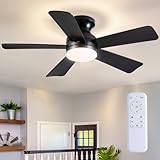
Overview: This 41-inch flush mount fan delivers 1,800 lumens of flicker-free light and 6-speed reversible airflow for spaces up to 150 sq.ft. Its DC motor operates under 30dB and saves 20-30% energy versus AC models. Designed for flat ceilings, it suits bedrooms or kitchens with its dimmable 3CCT lighting and straightforward installation.
What Makes It Stand Out: The default lighting memory function (retaining brightness/color on restart) stands out in its class. Combined with 10%-100% dimming, 3 color temps, and a 2-hour timer, it excels in ambiance customization. The ultra-quiet DC motor and energy savings further differentiate it from budget alternatives.
Value for Money: Competitive pricing for its high lumen output and energy efficiency. The lighting memory adds unexpected value, while the 20-30% energy reduction offsets long-term costs—making it a sensible upgrade from basic AC-motor fans despite minor feature omissions.
Strengths and Weaknesses: Strengths: Bright 1,800-lumen lighting, energy-saving DC motor, lighting memory function, very quiet (<30dB), reversible seasonal airflow. Weaknesses: No app/smart control, fan settings not memorized, outdoor use limited to covered areas.
Bottom Line: A balanced, reliable choice for noise-sensitive rooms needing bright, customizable lighting. The memory feature and energy efficiency justify its price. Highly recommended for bedrooms or kitchens under 150 sq.ft where quiet operation is essential.
5. Ohniyou Ceiling Fans with Lights, 52’’ Low Profile Ceiling Fan with Light and Remote/APP Control, Modern Flush Mount Ceiling Fan for Indoor Bedroom Living Room, Dimmable, Qiuet DC Motor, Black

Overview: The Ohniyou 52-inch fan merges smart tech with powerful performance, featuring app and remote control, 4,580 CFM airflow, and a whisper-quiet 20dB DC motor. Its dimmable 18W LED (3 color temps) and reversible function suit large living rooms or bedrooms up to 225 sq.ft, with a stylish dual-tone blade design.
What Makes It Stand Out: Dual app/remote control is rare in this segment, enabling voice commands and scheduling. The 20dB noise level is exceptionally quiet, while the reversible blades (black/wood-grey) adapt to diverse decors. The robust 4,580 CFM output outperforms smaller competitors for spacious areas.
Value for Money: Priced higher but justified by smart capabilities, superior airflow, and premium build. Energy savings from the DC motor and long-term convenience of app control offset the initial cost, especially for tech-savvy users managing larger rooms.
Strengths and Weaknesses: Strengths: App + remote control, ultra-quiet (20dB), high 4,580 CFM output, dual-finish blades, easy 30-min install. Weaknesses: Premium price, app dependency may frustrate non-tech users, outdoor use not explicitly supported.
Bottom Line: The smartest, most powerful option here. Worth the investment for large rooms where app control and near-silent operation are priorities. Ideal for modern households seeking seamless integration with smart home ecosystems. Highly recommended despite the cost.
6. addlon Ceiling Fans with Lights and Remote, 24’’ Low Profile Flush Mount Ceiling Fan, 3000–6000K Dimmable LED Fandelier, Bladeless Crystal Fan Light for Bedroom, Kitchen, Living Room, Black
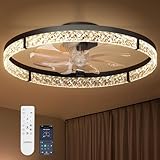
Overview: The addlon 24’’ low-profile flush mount fan combines bladeless safety with integrated lighting, targeting small-to-medium rooms like bedrooms and kitchens. Its compact design suits low ceilings while promising enhanced airflow coverage over smaller models. What Makes It Stand Out: The bladeless “crystal fan light” design eliminates safety hazards for children and maximizes airflow spread (80% wider than 20" models). The dimmable LED fandelier offers 10%-100% brightness and three color temperatures (3000K-6000K), controlled seamlessly via remote or app with memory recall for last settings. Value for Money: Priced mid-range, it justifies cost through dual functionality (efficient cooling + high-quality lighting) and child-safe operation. While smaller than 52" alternatives, its focus on safety and modern aesthetics offers better value for constrained spaces than basic single-function fans. Strengths and Weaknesses: Strengths: Ultra-quiet DC motor, reversible seasonal operation, tool-free installation, and elegant bladeless profile. Weaknesses: Limited 24" span restricts use in large rooms; LED panel may lack intensity for primary task lighting compared to dedicated fixtures. Bottom Line: Ideal for safety-conscious households with low ceilings or small rooms seeking a stylish, dual-purpose unit. Avoid for large open areas, but excellent value where compact, safe airflow and ambiance lighting are priorities.
7. hinomy Ceiling Fans with Lights,28” Small Ceiling Fan Light, Easy-to-Install Ceiling Fans with Light and Remote,3000-6500k, Dimmable, Small Ceiling Fan for Bedroom/Kitchen/Garage.Black.

Overview: The hinomy 28" flush mount fan prioritizes simplicity and broad room compatibility, targeting renters and DIYers needing quick setup without wiring. It delivers airflow and 2000-lumen lighting for spaces like kitchens, garages, or bedrooms. What Makes It Stand Out: “No wiring, no adapters” installation is its core innovation—everything mounts directly to existing junction boxes. The robust DC motor provides strong airflow for its size, while natural wind mode and 6500K max color temperature cater to versatile lighting needs. Value for Money: Positioned as budget-friendly, it excels in ease-of-use and reliability. The inclusion of app control at this price point (rare for sub-30" fans) and hassle-free setup offers exceptional value over competitors requiring professional installation. Strengths and Weaknesses: Strengths: Truly tool-free installation, powerful airflow for compact size, natural wind simulation, and comprehensive remote/app features. Weaknesses: 28" size still limits coverage in larger rooms; build quality may feel less premium than higher-end models. Bottom Line: A top pick for renters, DIY beginners, or secondary spaces needing fast, functional cooling and lighting. Compromises on sheer power for unmatched accessibility, making it a smart budget investment for targeted use.
8. Passky Ceiling Fans with Lights, 52 inch Flush Mount Ceiling fan with Remote Control, Low Profile Ceiling Fan for Bedroom, Farmhouse, Reversible, 3CCT, Dimmable, Noiseless DC Motor, Black
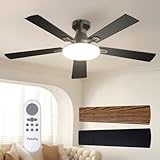
Overview: This 52" Passky fan merges farmhouse aesthetics with modern tech, featuring reversible blades and a whisper-quiet DC motor. Designed for larger rooms (bedrooms, living areas), it emphasizes energy efficiency (A-rated) and versatile indoor/outdoor use. What Makes It Stand Out: Dual-sided blades (white/yellow wood grain) allow decor customization, while the ultra-quiet 35dB operation suits light sleepers. Its reversible motor cuts heating costs in winter, and renter-friendly installation avoids ceiling damage—all backed by strong customer care. Value for Money: Competitive pricing for a 52" smart fan with A-energy rating. The reversible blades, outdoor suitability (covered areas), and quiet operation provide long-term savings and flexibility exceeding similarly priced units focused solely on basic cooling. Strengths and Weaknesses: Strengths: Exceptional quietness, dual-blade customization, energy savings, easy no-drill install, and robust warranty support. Weaknesses: Flush mount limits height adjustment; outdoor use restrictions (no direct rain exposure). Bottom Line: Highly recommended for primary living spaces needing quiet, stylish, year-round climate control. The blend of farmhouse charm, practical features, and renter adaptability makes it a standout value for medium-to-large rooms.
9. Passky Ceiling Fans with Lights, 52 inch Sleek Ceiling Fan with Light and Remote Control, 3CCT, Dimmable, Reversible, Noiseless, Black Ceiling Fan for Bedroom, Living Room

Overview: Nearly identical to Product 8 but with black/walnut dual-sided blades, this Passky 52" model targets contemporary décors. It shares the same core focus on silent operation (35dB), energy efficiency, and versatile indoor/outdoor mounting. What Makes It Stand Out: The black/walnut blade options cater specifically to modern or industrial interiors, while retaining all key tech: app/remote control, 6-speed adjustment, 3000K-6000K dimmable lighting, and reversible seasonal airflow. The “natural wind” mode enhances comfort realism. Value for Money: Matches Product 8’s value proposition but better suits dark-toned rooms. The premium blade finish and identical feature set justify its price against competitors lacking dual-blade versatility or true quiet operation at this scale. Strengths and Weaknesses: Strengths: Near-silent performance, elegant dual-blade finish, comprehensive smart controls, and A-energy efficiency. Weaknesses: Downrod installation (vs. flush mount) may challenge very low ceilings; identical limitations for outdoor use. Bottom Line: Choose this over Product 8 if your décor leans modern—ideal for living rooms or master bedrooms needing sophisticated style without sacrificing performance. An excellent all-rounder for discerning buyers prioritizing aesthetics and quiet comfort.
10. Fanbulous 52 inch Ceiling Fans with Lights, Smart Flush Mount Ceiling Fan and Remote APP, Modern Low Profile, 3CCT 20W LED with 6-Speeds Quiet Reversible Motor for Bedroom, Living Room, Kitchen, Black

Overview: The Fanbulous 52" fan emphasizes smart integration and robust build quality, offering triple control (remote/app/wall switch) for cooling and its 20W dimmable LED light. Targeted at tech-savvy homeowners for living rooms or kitchens. What Makes It Stand Out: True triple-control flexibility (including physical wall switch) and infinitely adjustable brightness (216LM-1800LM) set it apart. The thick wood blades and DC motor deliver powerful yet silent airflow, while dual-sided blades add functional style. Value for Money: Premium pricing aligns with superior stability and smart features. The inclusion of a wall switch adapter (uncommon at this tier) and exceptional motor quality provide better long-term reliability than cheaper app-enabled alternatives. Strengths and Weaknesses: Strengths: Triple-control convenience, sturdy construction, wide brightness/color range, and effective reversible operation. Weaknesses: App interface may lack polish; outdoor use limitations similar to competitors. Bottom Line: Best for users wanting seamless smart-home integration without sacrificing build quality. Justifies its cost through control versatility and durability, making it a top-tier choice for primary living spaces demanding both performance and tech.
Understanding Your Space and Needs
Before diving into specs, honestly assessing your room and expectations is crucial for making a smart $100 investment. Getting this step wrong is the most common reason budget fans disappoint.
Measuring Room Dimensions Accurately
Grab a tape measure – your room’s square footage and ceiling height are non-negotiable starting points. A fan too small for a large room is ineffective, while one too large for a compact space feels overwhelming and noisy. Measure length and width, multiply them for square footage, and note the ceiling height from floor to ceiling. Don’t forget to check for sloped ceilings or low clearance areas; these dramatically impact which fan styles (like hugger or low-profile models) will even fit safely and function properly within your budget constraints.
Identifying Primary Usage Goals
Why do you need this fan right now? Is it primarily for combating summer heat by creating a wind-chill effect, improving winter heating efficiency by circulating warm air trapped near the ceiling, or simply reducing reliance on noisy, energy-hungry window units? Your main goal influences critical features. If summer cooling is key, prioritize strong airflow (measured in CFM – cubic feet per minute). If year-round use matters, ensure the fan has a reversible motor switch – a surprisingly common omission in ultra-budget models that significantly impacts value.
Considering Existing Lighting and Décor
Take a hard look at your current lighting situation. Does the room lack sufficient overhead light, making an integrated light kit almost essential? Or is ambient lighting already ample, allowing you to skip that cost and focus budget purely on airflow? Also, quickly note your room’s dominant style (modern, rustic, traditional). While high-end finishes are rare under $100, choosing a fan with a blade color or basic finish (like brushed nickel vs. oil-rubbed bronze) that roughly complements your space prevents a jarring visual clash that cheapens the whole room.
The Motor: Heart of the Fan’s Performance
Don’t be fooled by shiny blades; the motor is the unsung hero determining longevity, noise levels, and consistent airflow. This is where skimping often leads to regrettable wobble and early failure.
Why AC Motors Dominate the Budget Tier
Under $100, you’ll almost exclusively find AC (Alternating Current) induction motors. While DC (Direct Current) motors offer superior energy efficiency and quieter operation at higher price points, modern AC motors in reputable budget lines have become remarkably reliable and sufficiently quiet for most living spaces. Focus less on the motor type at this price and more on build quality indicators – a heavier motor housing often signifies better internal components and less vibration. Avoid fans with motors that feel flimsy or lightweight when handled (if possible before buying).
Evaluating Noise Levels Realistically
“Whisper-quiet” claims are rampant, but truly silent operation is rare under $100. Instead, look for honest descriptions like “quiet for its class” or check reviews specifically mentioning noise. Pay attention to when noise occurs: a slight hum on the highest setting might be acceptable, but constant clicking, grinding, or excessive wobble-induced vibration at any speed is a red flag indicating poor motor balancing or assembly – a common flaw in the cheapest imports. Prioritize models with positive comments about smooth, quiet operation on medium and low settings, where fans are used most often.
Understanding Wattage and Energy Efficiency
While not as efficient as DC motors, a well-designed AC motor still impacts your electricity bill. Check the wattage consumption, especially on the highest speed setting. Lower wattage (e.g., 50-60W on high) generally means lower operating costs over the fan’s lifetime compared to a 70-80W model. Don’t obsess over tiny differences, but if two otherwise similar fans are comparable, the one using less power offers tangible long-term savings. Remember, even budget fans are significantly more energy-efficient than air conditioners for cooling.
Blade Design and Material Choices
Blades are highly visible, but their material and pitch (angle) matter far more for performance and durability than looks alone, especially when budget is tight.
Plastic vs. Wood-Grain Composite: Practical Trade-offs
Solid wood blades are virtually nonexistent under $100. Instead, you’ll encounter two main types: molded plastic (often ABS) and wood-grain composite (typically MDF or particleboard with a laminate finish). Plastic blades are incredibly lightweight, resistant to warping in humidity, and very affordable – ideal for damp locations like bathrooms (if rated for it) or kids’ rooms where durability matters. Wood-grain composites offer a warmer, more traditional look but can be slightly heavier and are more susceptible to warping in very humid or dry environments. Neither is “better” universally; choose based on your room’s conditions and aesthetic preference within your budget.
The Critical Role of Blade Pitch
This is often overlooked but vital for effective airflow. Blade pitch refers to the angle at which the blades are tilted relative to the horizontal plane. A pitch between 12 to 15 degrees is generally considered optimal for moving the maximum amount of air efficiently. Budget fans sometimes have flatter pitches (8-10 degrees) to cut costs, resulting in noticeably weaker airflow – you’ll need to run the fan on higher, noisier settings to feel the breeze. If specs mention blade pitch, prioritize models in that 12-15 degree sweet spot for the best cooling performance per watt under $100.
Control Systems and User Convenience
How you interact with your fan daily impacts satisfaction. Finding the right balance of simplicity and functionality is key within budget constraints.
Pull Chains: The Reliable Workhorse
Don’t dismiss pull chains! They are incredibly common, dependable, and cost-effective at this price point. A simple 3-speed pull chain (often with an optional light pull) is virtually foolproof, requires no batteries, and avoids the complexity (and potential failure points) of remotes or wall controls. They are perfect for straightforward installations where the fan is easily reachable. The main drawback is the need to physically pull the chain, which can be inconvenient in high or hard-to-reach locations.
Basic Remotes: Convenience Within Reach
Some $100 fans now include very basic remote controls. Manage expectations: these are usually simple RF (radio frequency) remotes with minimal range (often line-of-sight isn’t needed, but walls can weaken signal) and limited features (on/off, 3 speeds, light on/off). They rarely offer dimming or speed memory. While adding convenience, ensure the remote has a secure cradle on the fan itself – losing a tiny remote is a common frustration. Battery life is also a consideration (usually CR2032).
Wall Controls: A Rarer Budget Find
Integrated wall-mounted speed controls are less common under $100 due to the added hardware cost. If a package includes one, it’s often a very basic rheostat-type dial offering smooth speed adjustment rather than preset steps. This can be a significant usability upgrade over pull chains, providing easy access without needing a remote. However, installation is slightly more complex, requiring wiring the control into the wall switch box. Only consider this if you’re comfortable with that level of electrical work or budgeting for professional installation.
Installation Considerations for First-Timers
Getting the fan up safely and correctly is non-negotiable. Underestimating installation challenges is a major pitfall for budget-conscious first-time buyers.
Assessing Your Electrical Box Readiness
This is paramount and often the hidden cost killer. Your ceiling electrical box must be rated for ceiling fan support (usually marked “For Ceiling Fan Support” or similar). Standard light fixture boxes are not designed to handle the dynamic weight and vibration of a fan and can pull loose from the ceiling, causing damage or injury. If your existing box isn’t fan-rated, you must install a retrofit fan brace box. This involves cutting a hole in the ceiling drywall to secure the brace between joists – a task many first-timers find daunting and may require professional help, adding significant cost beyond the $100 fan price.
Understanding Weight and Mounting Types
Budget fans are generally lighter (15-25 lbs) than premium models, which helps. However, you still need the correct mounting system:
- Standard Mount: For flat ceilings 8-9 feet high. Most common.
- Hugger/Low Profile Mount: Essential for ceilings 8 feet or lower. The fan mounts directly to the ceiling canopy with minimal downrod, providing crucial headroom clearance. Verify the fan specifically includes or is compatible with a hugger mount kit within your $100 price – not all do.
- Sloped Ceiling Adapter: Required for angled ceilings. Often sold separately, so factor this potential extra cost in if needed.
Lighting Integration: To Include or Not?
Deciding whether to get a fan with a light kit involves balancing immediate cost, future needs, and installation complexity.
Weighing the Cost of Integrated vs. Separate Lighting
A fan with a basic integrated light kit often costs only $10-$20 more than a non-light version under $100. If your room lacks adequate overhead lighting, this small premium can save you the cost of buying and installing a separate ceiling light fixture later. However, if you already have sufficient ambient lighting (recessed cans, a central fixture), skipping the light kit keeps your initial investment lower and simplifies installation (one less wire to connect). Consider the total project cost: fan + light kit vs. fan-only + separate light fixture.
Evaluating Basic Light Kit Options
Budget fan light kits are functional, not fancy. Expect simple designs: a single dome (glass or plastic) housing one or two standard-medium base (E26) bulb sockets. Fancy features like dimming (beyond basic on/off), integrated LEDs, or multiple bulb types are rare at this price. Check the maximum wattage per socket (often 60W incandescent equivalent). If you plan to use energy-efficient LEDs (highly recommended), ensure compatibility – most basic kits handle them fine, but verify. The main consideration is whether the light output meets your room’s needs.
Maximizing Value and Avoiding Pitfalls
Smart shopping within the $100 bracket means knowing where to be flexible and where to stand firm on quality.
Reading Reviews Critically for Red Flags
Don’t just skim star ratings. Dive deep into 3 and 4-star reviews – these often reveal real-world compromises. Look for recurring complaints: “wobbles on high speed,” “remote stopped working after 3 months,” “light flickers.” These indicate systemic quality control issues. Conversely, praise for “surprisingly quiet,” “easy install,” or “great airflow for the price” are strong positive signals. Pay special attention to reviewer comments mentioning they are first-time installers – their experience is most relevant to you.
Understanding Warranty Realities
Warranties on budget fans are typically shorter (1-5 years) than premium models (often lifetime motor warranties). A standard 1-year warranty is common under $100. Don’t dismiss a fan solely for a shorter warranty if reviews indicate good durability, but view an unusually short warranty (e.g., 90 days) or lack of clear warranty info as a caution sign. Know what the warranty covers – usually the motor, sometimes the remote. Blades, lights, and remotes often have shorter coverage or are excluded. Register your fan online if possible to ensure full warranty protection.
Prioritizing Core Performance Over Gimmicks
Resist the allure of unnecessary features that inflate the price within your tight budget. Skip:
- Excessive Speeds: 3 speeds are standard and sufficient. 5+ speeds often add cost without meaningful benefit under $100.
- “Smart” Features: True Wi-Fi/app control is virtually impossible to do well under $100; these are usually unreliable RF remotes rebranded as “smart.”
- Overly Complex Designs: Intricate blade shapes or multi-tiered bodies often sacrifice airflow efficiency for looks and can be harder to clean. Focus your dollars on a solid motor, appropriate blade pitch, and a mounting system that fits your ceiling.
Long-Term Care for Budget Fan Longevity
Getting years of service from a $100 fan requires simple, consistent maintenance – an often-overlooked aspect of true value.
The Non-Negotiable: Regular Dusting
Dust accumulation is the #1 enemy of smooth, quiet operation, especially on budget models where balance is more critical. Dust on blades creates imbalance, leading to wobble and strain on the motor. Wipe blades down with a microfiber cloth (dry or slightly damp) at least once a month. A vacuum cleaner with a soft brush attachment works well for quick cleanups. Neglecting this turns a potentially quiet fan noisy and shortens its lifespan significantly.
Checking for Loose Parts and Balance
Every few months, especially after cleaning, turn the fan off and check:
- Blade Screws: Ensure all screws attaching blades to the motor brackets are snug (don’t overtighten plastic).
- Canopy Screws: Verify the main canopy housing is securely fastened to the mounting bracket.
- Wobble Test: Turn the fan on low speed. If you see noticeable wobble, it’s usually an imbalance. Most budget fans include simple balancing kits (small weights and instructions). Following these steps meticulously can often eliminate wobble without professional help, preventing premature wear.
Frequently Asked Questions
Frequently Asked Questions
Can a $100 ceiling fan really be quiet enough for a bedroom?
Yes, many modern budget fans achieve acceptable quietness for bedrooms, especially on medium and low speeds. Focus on models with positive reviews specifically mentioning “quiet bedroom use” and ensure proper installation (a securely mounted fan box is critical for minimizing vibration noise).
Do I absolutely need a professional electrician to install a budget fan?
It depends on your electrical box. If your existing ceiling box is not rated for fan support, you must hire an electrician to install a proper fan brace box – this is a safety issue. If the box is already fan-rated, a confident DIYer with basic electrical skills can often install the fan itself using the included instructions.
Are plastic blades as good as wood for a budget fan?
For durability and performance under $100, plastic (ABS) blades are often the smarter choice. They resist warping from humidity changes (common in bathrooms or seasonal climates), are lighter (reducing strain on the motor), and are generally more impact-resistant than the thin wood-grain composites found in this price range.
Will a budget fan save me money on air conditioning?
Absolutely. Using a ceiling fan allows you to raise your thermostat setting by 4°F or more in summer while maintaining comfort, directly reducing AC runtime and energy costs. Even a basic $100 fan uses far less electricity than an AC unit, making it a cost-effective cooling supplement.
What’s the biggest mistake first-time buyers make with budget fans?
Underestimating the importance of the ceiling electrical box. Installing a fan into a box not rated for fan support is dangerous and a leading cause of fan failure or ceiling damage. Always verify the box rating before purchasing the fan.
Do fans with lights use significantly more electricity?
The light kit adds minimal wattage compared to the motor, especially if you use LED bulbs. A typical fan motor might use 50-60W on high, while two 9W LED bulbs in the light kit add only 18W. The combined usage is still far less than many standalone light fixtures.
Why does my new budget fan wobble slightly?
Minor wobble is common initially. Ensure all blade screws and canopy screws are tightened evenly. If wobble persists, use the included balancing kit – it’s a simple process involving a test weight to identify the unbalanced blade. Proper balancing is crucial for longevity.
Can I use a budget fan on a sloped ceiling?
Yes, but only if the fan specifically includes or is compatible with a sloped ceiling adapter kit. Do not attempt to mount a standard fan directly to a slope. Verify adapter compatibility and cost before purchase, as adapters are sometimes sold separately.
How often should I replace a $100 ceiling fan?
With proper installation and basic maintenance (dusting, checking tightness), a quality budget fan should last 8-15 years. Signs it’s time for replacement include persistent loud grinding noises, severe unfixable wobble, flickering lights indicating electrical issues, or significantly reduced airflow.
Are there energy rebates for budget ceiling fans?
Rebates typically target high-efficiency DC motor fans, which are usually above $100. It’s unlikely you’ll find utility rebates for standard AC motor fans in the $100 range, but always check your local utility company’s website for current programs, as offerings can change.
See Also
- 10 Best Budget Tower Fans Under $50 for First-Time Buyers in 2026
- 10 Best Budget Tower Fans Under $50 for First-Time Renters in 2026
- The 10 Best Ceiling Fans Every First-Time Homebuyer Needs This Year
- 10 Best Budget Ceiling Fans Under $100 for Renters in 2026
- 10 Best Budget Ceiling Fans Under $100 for Small Spaces in 2026